Using your real estate better: online images

As we discussed in the stop doing giant wads of text post, it’s a good idea to break up your text with images.  But too often online images stop at the first level of work for you: they show the problem or make the donor feel better or the like, but don’t do anything else.

We’re going to put pictures to work for us to do second and third level duty.  Here’s how.

Follow the eyes.  We discussed this a bit in what we can learn from political campaigns.  It’s one of my top 200 blog posts so far, so I’d recommend a read, but the TL;DR version is that we follow where people’s eyes are looking or where they are pointing.  Since having a homepage image of people pointing to your donate button is a little on the noise, having your image subject looking at the donate button can do this work for you.  Here’s a heat map sample from that earlier post:

Engage the multichannel donor.  It is well into 2016, which means not only am I no longer writing 2015 on my checks; I’m no longer writing checks.  Another implication of it being 2016 is that people are going to go to your Website to see what you are doing before donating.

So it’s to your advantage to tie the solution you telling on your site and in your offline communications together with the use of images.  If your mail piece tells the story of the impact of your mission on a child, it’s great to have a further picture of that child on your homepage with a link to the story and the ability to donate.  While you should have a personalized URL in your piece, a person may not be sitting down at their computer (laptop, phone, tablet, watch, etc.) with that mail piece in hand.

Insert key messaging.  And only key messaging.  Take a look at charity.water’s homepage monthly giving ask.  Very few words — just the essentials.  
water


Embed your ask in the picture.  You’ll note in the heat map above that even before we look at eyes, we seek out faces.

If the image is where people are going to be looking on your site anyway, where better to begin your ask?  If that ask is an email sign-up, you can probably do all of that in the same picture (as you only need first name, last name, email address, and maybe state or zip code.  What?  You are asking for more information on your email sign-up?  Have you tried asking for less and seeing what the difference is?  You can always ask for more in the welcome series.)

If that ask is an online donation, you might as well as for some of the starting information in the picture.  Most often, you can get someone to pre-select their donation amount in the initial image.

One of the cardinal rules for donation forms for a number of years has been to minimize the number of clicks necessary to complete the form.  Recent tests that I’ve seen may indicate this is no longer the case.  I hypothesize a few reasons for this:

  • We humans have a poor understanding of sunk costs.  A multistage donation form, then, gets people to take the first few steps quickly and then asks for more, getting the person to think “well, I’ve come this far.”
  • Multistage donation forms can often render better in mobile devices with smaller screens (and worse keyboards).
  • E-commerce has taught us how to use multistage forms.  Think of the arrows at the top of your Amazon order page telling you what step you are on and how much further you have to go.  The fact that you can probably picture an Amazon order page shows how common this has become.  (I’m not judging – I’m surprised it’s not burned onto my retinae).

Anyway, getting the person to give you the amount first asks as a commitment device and pre-checks the “sunk cost” box.  And you are saving a step: rather than clicking on donate, then putting in the amount, they are able to combine these.
Using your real estate better: online images

Using your real estate better: post-donation interaction

Online and telemarketing donations have a unique feature that few other direct marketing interactions have: you are still communicating with them once they have made their donation.

Obviously, a large part of this post-donation interaction should be aimed at confirming that the donation was made and sincerely thanking the person for contributing to the cause.

But there is a unique opportunity in these interactions to get additional value from and give additional value to your donors; it’s the time between donation and processing.  A person has selected an amount, given their credit card (or EFT) information, and decided to make the donation (whether online or by phone).  But the person or the series of tubes has not yet processed the credit card.

You may not even have known there was a time in between donation and processing; I know it took me years before realizing this.  But you can put a shadowbox on your donation page immediately after someone hits “Submit” (or hopefully a more creative button like “Save Lives Now!”).  For telemarketers, it’s just a part of the script.

Since the donor is unlikely to turn back at this point, it’s an ideal time to explore an additional option with them (and I do mean “an” in the sense of “one and only one” – we do not want to turn off the donor).  There are two goals you can have for this: upgrade in amount or upgrade in kind.

If you are looking to upgrade in amount, I would suggest:

  • Selecting a small amount – something that is 10% or less of your normal donation in the medium.
  • Tying it directly to a tangible and immediate win for the donor – e.g., “if you add $3 to your donation right now, you’ll be feeding a child three healthy, lifesaving meals in war-torn Freedonia tomorrow.”
  • Making it very easy to say no and move on with the original donation.  This is not a circumstance to let the better be the enemy of the good.

Because of the limited upside of this tactic, I would suggest the second option: aiming for an upgrade in kind.  This will almost always be trying to upgrade to a monthly gift.  Some tips on this upgrade:

Don’t get greedy.  One of the more frequent upgrade strategies attempted online is a check box that says “repeat this gift on a monthly basis” as part of the donation form.  There are three problems with this:

  1. It explains none of the reasons why you would want to do such a thing
  2. It’s stilted, non-donor-friendly language
  3. It’s before the donation is attempted.  In this case, if the donor is turned off by this half-asked ask, there is no donation.

You want to make the donation ask small enough that it seems like a similar amount of money to what they have already pledged to give.  While you will want to test what this amount is for your organization, I’d advocate a rule of thumb that you’d want to start at about a quarter, plus or minus, of what a person has pledged to give.  Thus, if someone wanted to make a $100 gift, ask them if they would like to make a $25 monthly donation instead.

It doesn’t take a rocket surgeon or a brain scientist to see that this will take at least four months to pay off.  But the average monthly donor is far more loyal than the average one-time donor and will likely extend out past this four-month mark.  And, since we humans value present money more than future money (witness the exchange rate we are taught between birds-in-hand and birds-in-bush), this seems reasonable-ish to the prospective donor.

Explain the benefits of the upgrade to the organization. Your donor has already made the tough decision: to donate to you in order to help people.  If there is a way that they can be more effective in their giving, they are more receptive to it at this point than almost any other (and, at the very least, are not that likely to be turned off by it).  So let them know that giving a smaller amount per month helps even more, because it’s predictable revenue that helps you get through lean times together.  You’ll also likely want to have some strong social math here (what does their $10/month do in terms of tangible benefit) as well as positioning against a hedonic good (“that’s the price of a cup of coffee each day”) to help you win the upgrade.

Explain the benefits of the upgrade to the donor.  Of course, to some extent, being able to help more people is a benefit to the donor – that was their goal going in and they are able to do more of it.  However, there are also tangible benefits as well:

  • Ease.  No more forgetting a donation the donor might want to make.
  • Budgeting.  The donor would be able to budget for donations on a monthly basis, which is how our mental accounting systems usually work.
  • The donor will be able to cancel at any time.  This is critical in the pitch.  You want people to know that you want only 100% satisfied* donors and thus want them to have freedom in their donation.  This is also because one of the primary mental objections to setting a monthly donation is “what if I change my mind?” (and its close cousin, “what if the organization does something I don’t like?”).

You can also put in whatever benefits your organization has for monthly donors (e.g., special member card, donor newsletter, etc.), but I would test it both with and without.  You might find your donors are more drawn in by the mission and the impact they are having and don’t want that special relationship cheapened.

Speaking of special relationships, I’d like to have one with you through our weekly newsletter.  You can sign up here and get the week’s updates in digest form, along with late-breaking thoughts and information.  Thanks for reading!

* Perhaps even donors who are 110% satisfied, for those direct marketers who are bad at math.

Using your real estate better: post-donation interaction

Using your real estate better: preheaders

You have your subject line science down — you do an A/B test in the morning and you roll out with the test in the afternoon.  You ask questions to entice someone to open.  You create urgency.  And you are still seeing your open rates going down.

Maybe it’s that right after your subject line, people see “To view this email in your browser, click here” instead something of interest.

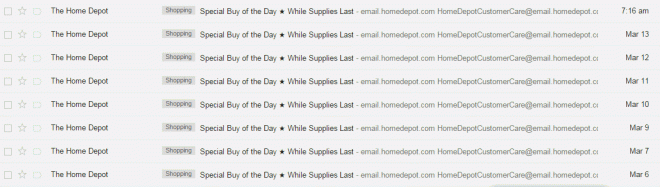
Gone are the days where the subject line was all that mattered.  The first lines of your email now matter, because in many email clients, they are shown alongside the subject line.  This verbiage is called the preheader and it’s valuable real estate that many otherwise really strong marketers ignore.  For example, here are my last few emails from Home Depot as I write this:

home depot

If you thought that these were the first emails I ran to open, you would be incorrect.

Not only to preheaders show up in this way, but they also travel with the subject line to show up in the lower-right corners of Gmail, Yahoo, and Outlook accounts.  Additionally, the preheader can entice someone to read the email (gasp!), not just open it.

So what do you want to do with this to draw your readers in?  Some ideas:

Keep it relatively short.  Not subject line short, but make sure that it gets your point across in the first 75 characters or so, so mobile email clients will show what you want shown.

Tag team with your subject line.  My best email newsletter open and click performance was on the same email.  (Hey, if you thought we were getting through a post on email pre-headers without me plugging that you can sign up for my free weekly e-newsletter, which gives the story version of the week’s blog posts plus super secret extra benefits, you were sorely mistaken.)

The subject line was “Lead gifts and priming and men, oh my.”  The pre-header was “And the details on how social proof works in direct marketing and the power of hedonic good comparisons, but that made for a really long subject line…”

If you have only 75 characters, you get the gist of what the email is going to be about.  And if you have more, it’s a paired attempt at humor.  This had an 80%+ open rate and 40%+ click-through rate.

Another good tactic here is to ask a question in the subject line that you begin to answer in the pre-header.

Personalize.  A pre-header can start with “Dear Mary,”.  (This, of course, only works if the recipient’s name is Mary.  If it’s Vlad, you may be in trouble.)  Anyway, this pre-header establishes that you know the person’s name.  This, sadly, differentiates it from many other emails that don’t know your name, so it’s more likely to get opened.

Tell them what’s in the tin.  If you have a video in your email that thanks the person for being a supporter, your preheader may not have to be any fancier than something like “Watch a thank-you video from our president.”  If you don’t have content that is worthy of being in the pre-header, rewrite the email.

Make the call-to-action.  Not “Donate now!”  I haven’t tested that as the beginning of a pre-header only because I anticipate it would go down in flames.  But “Today, you can save a life with one minute and two clicks.” does a nice tease of the content as well as creating urgency and timeliness.

So make sure you are testing this valuable real estate.  And when you do get that email from someone who just has their logo’s alt text as the pre-header, forward them this email if you like the organization (and if you don’t, prepare to steal their donors).

Using your real estate better: preheaders

Let’s get small: microimprovements

402px-david_von_michelangeloThere is a story, perhaps apocryphal, that someone watched Michelangelo retouching every inch of one of this statues.  The bystander asked him why he bothered with such trifles; the artist replied “Trifles make perfection. And perfection is no trifle.”
In the direct marketing world, it’s difficult to say that there is such a thing as perfection.  You will likely never see, in any quantity, a 100% response rate or open rate.  But our goal is to strive, to seek, to find, and not to yield.

There rarely is an idea that you have that will double the completion of your online donation page.  But you can find 16 ideas that each get you five percent better, each one compounding to double your response.

So without further ago, a few small ideas that may make small (or big) differences.  In no particular order:

Change the color of your donate button to something not approved in your brand guidelines.  It will stick out.  Good.  Things that stick out get clicked on.  When this starts to lose its effectiveness, change it again.

Reduce the size of your download.  A Sprint phone downloads an average of 11 MB per second on 4G .  We can easily design pages with enough extra code and random things to download to cost an extra second.  One second lost means 7% fewer conversions.

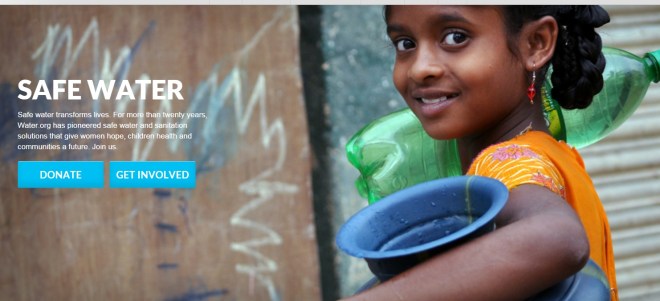
That’s probably why water.org has their homepage look like this:

water

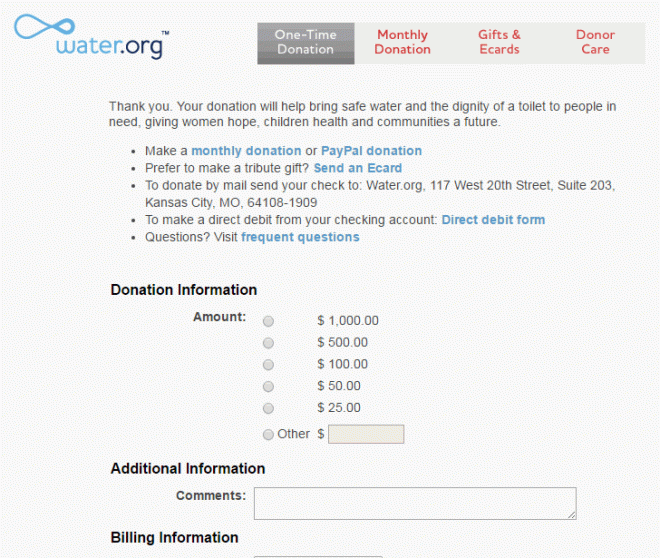
But their donation page looks like this:


waterdonationpage

Increase customization by a variable.  If you do name, do name and location.  If you do name and location, add in donation history.  Et cetera.  These are more than 5% tactics

Add a small donate bar at the top of your site.  Human Rights Watch reported (at DMA’s DC nonprofit conference) that the below orange bar and a larger orange footer on their site increased donations from the home page by 256%.  Many days, I’d settle for 2.56%.

Go into Google AdWords.  And do what it says to do.  If it recommends splitting up your keywords, it probably knows that doing so will allow you to customize your copy.  Punctuate your headline properly.  It knows that increases click-throughs.  And so on.  It will keep bringing up these opportunities; you just have to act on them.

Try adding a picture.  Not necessarily guaranteed, but a quality picture will usually improve a home page, mailpiece, donation page, content marketing, etc.  I’ve found a significant difference in the traffic I get from blog posts with pictures over those without.  Hence David hanging out at the top of this one.

Call some donors.  Ideally some of your best, but these thank you’s will both help with the donor’s loyalty and give you ideas for things you can try (or stop).

Take some fields off of your donation form.  Phone number?  Ask for that afterward.  If you have the ability to divine city and state from ZIP on your form, go for it.  You are looking to streamline this process.

Similarly, reduce the clicks to get to the donation form.  Hopefully, it’s one or zero (that is, you can start entering info on the Web page).

Remove the navigation from your donation page.  Now is not the time for someone to want to look at your executive’s pictures.  Four tests show improvements from the tiny to the oh-my-goodness here.  

Run a test.  Are those ask amounts correct?  How do you know?  If you are mailing, emailing, or calling with the same thing for 100% of your communications, you are missing out on your 5% opportunities.

Hopefully, one of these gets you 5%.  If it does, please leave it in the comments.  If it doesn’t, please let us know in the comments what did.

Let’s get small: microimprovements

Let’s get small: microseconds

You haven’t got long.

We’re on to the next email, text, phone call, app.

Literally milliseconds.

What you have to do:

Make the first online images count. People know what they think of a site faster than they blink.  That impression carries over.  It impacts content, action, and donation.

Make the first words count.  Average reading speed is about 140 WPM.  Average subject line is about 7 words? (makes math easy)  Ergo, subject line = 3 seconds.  That is, if you are reading and not skimming.  You are skimming.  So’s your audience.  Be sure to use pre-headers as well.  I’ll talk about those next week.  Subscribe here to get an email when it’s up.

Evoke emotion.  Emotion hits the brain 3000X faster than rational thought.  Reason hasn’t got a chance to set the hook.

Load quickly on mobile.  Only 11% of people expect content to be much slower on their phones.   One additional second = 7% decrease in conversions.  One. Bleedin’.  Second.

Send those thank you’s quickly.  Thank you speed is among the best predictors of retention.  Long-term and short-term.

Don’t wait for your mail testing.  Test to your mail audience online.  Facebook and Google ads = messaging tests.  Subject lines = teaser copy.  It’s not entirely representative.  But it will predict disasters well.

Make the ask.  The act should be in the first three paragraphs of the letter.  They need to know why you are writing.

Flood the zone.  They pitched your letter?  Even after you did outbound voice mail to let them know it’s coming?  You’ll get them in the email.  

Didn’t open the email?  We resend those to people who don’t open.

Still didn’t?  We have ads that follow them around the Web.  Then we’ll call; can’t escape just by going offline.

Multichannel is the way to get in the impressions.  Impressions are the way to get a message through.  Message is the way to get the donation.

Spend time where it counts.  Some donors actually want to read a 12-page letter.  But only if it’s written well.  Not Shakespeare well.  Not James Joyce well.  Da Vinci Code well.  Tom Clancy well.  The kind of letter that forces you to read to find out what’s next .

Sign up for my newsletter.  I won’t waste your time.  Promise.

Let’s get small: microseconds

Let’s get small: microbudgets

Unless you are at a very large nonprofit, you have probably had a miniature budget at one time or another.

True story: I ran MADD’s first pay-per-click search engine ads over a decade ago with $20 from my own credit card (this was pre-Google Grants).  I said I would only claim for reimbursement if we raised back that money.  One $30 donation later and MADD had its first proto-paid-donation-acquisition budget.

The challenge is that many nonprofit budgets are zero to start; they only come about because they are willed into existence.

The one and only bit of good news about a budget of zero is that your budget isn’t negative.  When you think about it, most direct marketing budgets are negative: you are given an amount of money and you have to return an even larger amount of money when you are done.

So you have an idea you’d like to pursue (let’s say display advertising to fuel online donations).  You have no budget.  The first thing you need to do is go to your boss and tell her or him:

  1. About your idea
  2. How much it would normally cost
  3. You are willing to do it for nothing
  4. If you are able to reinvest the new revenues you get in your idea

This last part is the critical thing you are looking for.  Your boss doesn’t have to hear about you talking about your idea ever again if you were wrong.  And if it goes wrong, it won’t cost her/him anything.  But if it goes right, you want to help make it go more right.

This is usually an agreement a boss should be willing to make.  If not, examine 1) you, 2) your boss, and 3) your boss’s impression of you.  At least one of these things is not very good.

So, now that you have your reinvestment plan, you need efforts that will generate net revenue at no cost.  

The first way is Google Grants.  You knew I was going to say this, didn’t you.  There’s almost no way not to be able to additional revenues from this:

  • If you don’t have an account get one.
  • If you have an account, maximize your spend.  
  • If your spend is maximized, optimize your spend.
  • If your spend is maximized and optimized, apply to go to the next level of revenue.
  • If your spend is maximized, optimized, and at the highest level of Google Grants, you are at a large enough non-profit that you should be able to get a small budget for an innovation if you are justifying it well.

The thing is that your grant dollars in AdWords are fairly easy to maximize and optimize, because every time you log into AdWords, they will have recommendations for you to have a sentence in the first half of your ad to increase clicks or split your ad groups up or add keywords or create a dynamic ad or what-have-you.  Follow the recommendations and continually refine.

Failing that, list out your ads and see what has the lowest interactions.  Re-write the ads and test the new ads against the old.

Failing that, list out your ad groups, see what URLs to which you are sending traffic have the lowest conversions and work on the conversion side of things on your Web site.

Eventually, I’ll do a whole week on AdWords, because it is a highly useful tool, but if you continually refine like this, revenues will follow.

The other way to start to create a budget online is with services like eMiles that run cost-per-acquisition donor campaigns.  That is, they will offer to get you donors for, lets say, $40 per donor.  If your average gift is generally $50 per person, run the campaign and take the extra profit.

If these options aren’t open to you, running a co-targeting campaign to your cream of the crop donors online will also generally have positive results.  That will put some of your own money at stake, but, as I mentioned at the opening, I’m not adverse to that.

So these are some ways to kickstart your budget.  Once you have strategies that work for you, grind on it.  Your goal is to be at the poker table continually garnering chips.  You may lose some hands, but with the law of large numbers and the ability to reinvest, you will almost certainly come out ahead.

And, with your $0 budget, you can also subscribe to my free newsletter here.  Hopefully, I’ll have some tips there that will help you get into the high single-digit budgets in no time.

Let’s get small: microbudgets

Let’s get small: micromoments

41sazggrh3l
This week, I’m going to talk about microthings with macroimpacts.

As so many good things of this world, this inspiration came from Angie Moore of Eleventy Marketing.  Her NonProfit Pro piece, which I recommend heartily, talks about Google’s discussion of how we live our lives in micromoments.  Their Think With Google piece talks about how with mobile devices, we are constantly acting on our needs at and in the moment.

I found this rung true for me.  When was the last time you wondered who that actress is and what you knew her from*?  When that happened, were you content to just not know?

No.  Not knowing is so ’90s.

So are not comparison shopping, not buying, not getting what you buy for weeks, not hearing about your donation, not being able to reach the person you want to reach.

And these micromoments come and go so quickly.  I remember vividly Googling how to give CPR to a dog.  I had never needed that information before and hope never to again.  In that moment, however, that question was my world.

As Google says, “Our preferences and purchases are shaped in these micro-moments. Ultimately, the brands that do the best job of addressing our needs in each moment will win.”  We are the sum of these moments individuals and we are the sum of these moments to those we wish to reach for donations and support.


Do I dare
Disturb the universe?
In a minute there is time
For decisions and revisions which a minute will reverse.

For I have known them all already, known them all:
Have known the evenings, mornings, afternoons,
I have measured out my life with coffee spoons;
— T.S. Eliot, The Love Song of J. Alfred Prufrock.


So I’m going to try to cover this without covering what Angie did, which is excellent, by focusing on intent.

One of the things that Google talks about is how intent eats demographics for dinner.  You might think, for example, that the people searching for video games are 18-34-year-old males.  Only 31% of them are.  So by targeting people who are looking for video game content, rather than a demographic segment, you can get the people that advertising on Spike won’t get you.

The same is true for the nonprofit world, except that the need that people have is rarely to donate.  At best, they may have a need to make a difference, but more often, they want to learn more about something or verify something they’ve heard or take action on an issue they’ve heard about right-flippin’-now.

So, as we’ve preached, you need to be consistently creating content and doing so for the things that people care about.

But more than that, it needs to convert.  Once someone has fulfilled their desire to learn, verify, do, etc., and only then, you can make the turn to make an ask.  This ask needs to be quick and it needs to be tied directly to what they just did.  If it was emailing their congressperson about global warming, the confirmation page should thank them for taking action and ask for a donation to help the nonprofit advocate more effectively to stem the tide of global warming.

In the micromoment world, you don’t get this chance again, so you need to be there, fulfill the desire, and tie the ask to the desire.

Tomorrow, we’ll talk about microbudgets — how do you act when the amount allocated for your budget is $0.


* If you are like me, the answer is probably a Jerry-Orbach-era Law and Order episode.

Let’s get small: micromoments

Learning from political fundraising: chip in change for change

You’ve seen the headlines: “Americans more divided than ever”, “Gridlock reaching threat level crimson, which is worse than red somehow”, and “Pelosi-McConnell dancing knife fight leaves two dead.”*

Seemingly, parties can’t agree on anything.

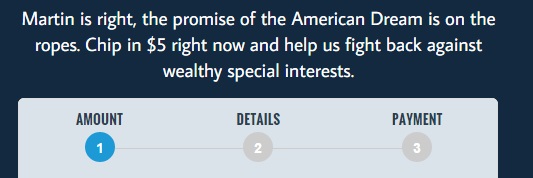
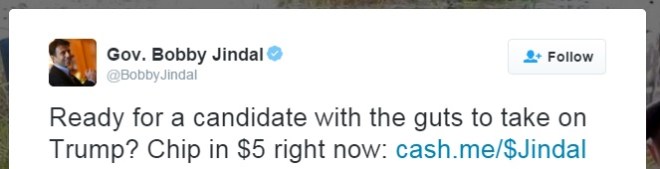
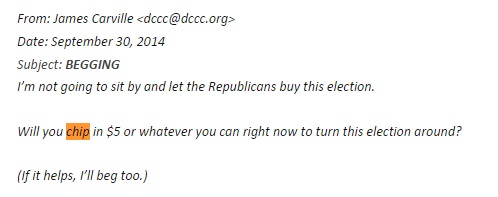
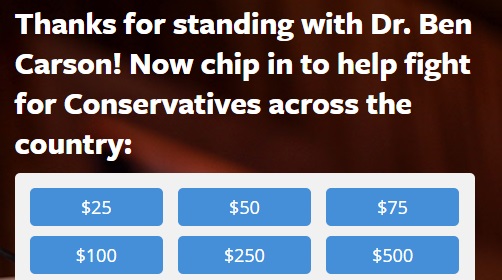
But here’s a ray of hope.  They can agree on donors chipping in:

Martin O’Malley:

chipinomalley

Rand Paul:

chipinrandpaul

Bobby Jindal:

chipinjindal

DCCC:

chipindccc

RNC:

chipinnrcc

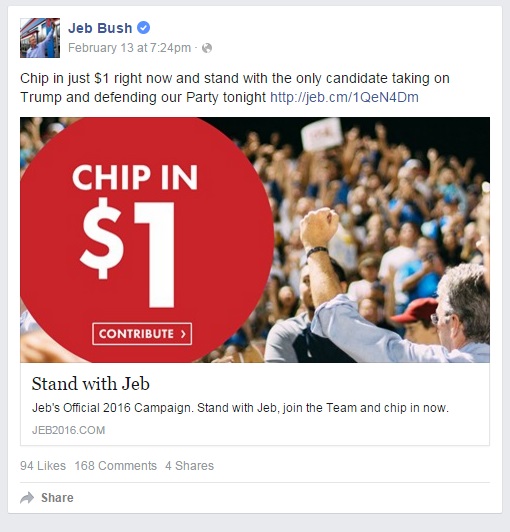
Jeb Bush:

chipinbush

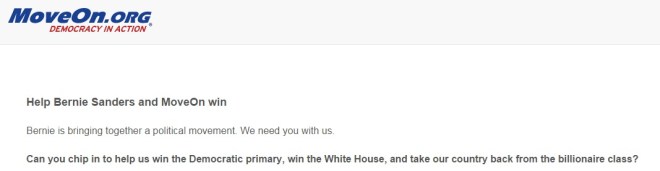
Bernie Sanders and MoveOn:

chipinsanders

John Kasich:

chipinkasich

Marco Rubio:

chipinrubio

Hillary Clinton:

chipinclinton

I’ll be honest: usually my research for this blog is harder than this.  The hardest parts of finding these were:

  1. Remembering who had been running for president.  For example, it turns out Lincoln Chafee is not a model of car.
  2. Finding photographic from former campaign sites.  There’s evidence that Scott Walker, Chris Christie, Mike Huckabee, and others used chip-in language, but couldn’t find them online.  So passes away the glory of a presidential campaign.

But nonprofits don’t seem to be using “chip in” much.  Yet.  I think BirdConservancy.org was the largest organization I could find in my Googling.

So why do political organizations almost unanimously use “chip in”?  Here are my theories:

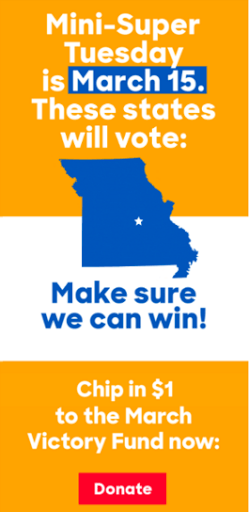
  • “Chip in” sounds very small. Giving permission for small donations increases the likelihood of giving. This is probably part of the appeal.  This extends to the standard ask strings.  Clinton, Cruz, Kasich, Rubio, Sanders, and the current Republican frontrunner (since I pledged I wouldn’t use his name as a cheap SEO play) all start their asks at $3-25.  In fact, if you take out Kasich, the highest initial ask is $15 (ironically, for Bernie Sanders).
  • Making a cost sound small also decreases the amount of pain that someone feels from making a purchase/donation. 
  • The value of a name in political spheres far exceeds just their donation value.  A $3 donor is also a voter at worst and perhaps a volunteer or district captain.  And of course, they may be able to give more in the future.  A $2,700 donor is these things, plus someone who may be able to attract like-minded funders at a max level.

    I say this is in political spheres.  But isn’t this true for your nonprofit as well?  You want that $3 donor as a volunteer, walker, bequest donor, monthly donor, etc.  And yet we generally have higher online ask thresholds. 
  • “Chip in” implies that others are doing the same.  In fact, Oxford Dictionaries defines “chip in” as “contribute something as one’s share of a joint activity, cost, etc.”  Social proof is a powerful persuasive force and knowing that others are doing it and are counting on you too can greatly influence decisions. 
  • People like to be a part of something bigger than themselves.  This is especially true for causes, political or non-profit.  The ability to make something part of your identity that ties you into a larger in-group can be very powerful.

So I’d encourage you to try chipping in as part of your emailing strategy (and, if it works, test elsewhere) as a way of pulling these cognitive levers.

A post-script: after I drafted this piece, this came in from the Clinton campaign:

unnamed


* I will offer a free signed book (in that I will print out any one of my ebooks , sign it, and mail it to you) for the first person who can do a Photoshop of this based on West Side Story.


Learning from political fundraising: chip in change for change

Learning from political fundraising: hypercustomization

fireworks4_amkOn the path to his win in Iowa, Ted Cruz took an unusual position for a presidential candidate. He spoke out against fireworks regulations.

Usually, Iowa contests focus on broad national issues that a person would be expected to lead on as president (plus ethanol).  Fireworks range as a national issue somewhere around garbage collection and why-don’t-they-do-something-about-that-tacky-display-of-Christmas-lights-on-Steve-and-Janice’s-house.

But from a data perspective, the Cruz campaign knew its supporters.  There’s a great article on this here.  Here’s a quote:

“They had divided voters by faction, self-identified ideology, religious belief, personality type—creating 150 different clusters of Iowa caucus-goers—down to sixty Iowa Republicans its statistical models showed as likely to share Cruz’s desire to end a state ban on fireworks sales.

Unlike most of his opponents, Cruz has put a voter-contact specialist in charge of his operation, and it shows in nearly every aspect of the campaign he has run thus far and intends to sustain through a long primary season. Cruz, it should be noted, had no public position on Iowa’s fireworks law until his analysts identified sixty votes that could potentially be swayed because of it.”

As we unpack this, there are several lessons we nonprofits can take from this operation:

The leadership role of direct marketing.  Cruz’s campaign is run by a direct marketing specialist.  Contrast this with Marco Rubio’s campaign, which is run by a general consultant, or Jeb Bush’s, which was run by a communications specialist.  As a result, analytics and polling in the campaign are skewed not toward what generalized messages do best with a focus group or are the least offensive to the most number of people.    

In fact, in the campaign, the analytics team has a broader set of responsibilities than normal.  Analytics drive targeting decisions online and offline.

The imperative to know your constituents.  Much political polling is focused on knowing donors in the aggregate.  The Cruz campaign wanted to know them specifically.  So they gathered not just people who were supporters and asked them about local concerns.  This came up with 77 different ideas, including red-light cameras and, as you probably guessed, fireworks bans.  We’ve talked about knowing your constituents by their deeds and by asking them; what’s important about this example is the specificity of the questions.  It’s not “what do you like or dislike”; it’s “what do you care about.”

Testing to know potential constituents.  One the campaign had these ideas, they tested them online with Facebook ads.  The ads weren’t specific to the Cruz campaign, but rather asked people to sign up for more information about that issue.  Once they had these data, they not only had specific knowledge of what people cared about, but the grist for the mill of data operations that could model Iowa voters and their key issues.  

Focusing on actual goals.  Cruz’s end goal is to drive voters, just like ours is to drive donations.  By simplifying things down to what gets people to pull their levers/hit the button/punch the chad, they had a crystallizing focus.  One can debate whether this is a good thing, as the campaign sent out a controversial Voting Violation mailing that attempted to shame infrequent voters with Cruz leanings to the polls.  (It should be noted that these mailings are the part of campaign lore — they’ve been tested and found to be very efficient, but few campaigns have ever wanted to backlash that comes inevitably from them.)  But that focus on things that matter, rather than vanity metrics like Facebook likes , help with strategy.

Hypertargeting: All of this led to some of the most targeted direct marketing that has been seen in the political world.  When telemarketing was employed for particular voters, not only would the message reflect what they cared about (e.g., fireworks bans) but also why they cared about it (e.g., missed fun at 4th of July versus what seems to some as an arbitrary attack on liberty).  This came from both people’s own survey results and what models indicated would matter to them.

So now, let’s look at this in a nonprofit direct marketing context.  How well do you know your donors and potential donors?  Or how well do you really know them?  And how well do you play that back to them?

I’ve frequently advocated here playing back tactics to donors that we know work for them and focusing our efforts on mission areas and activities we know they will support at a segment level.

But this is a different game altogether.  The ability to project not only what someone will support, but why they well, and designing mail pieces, call scripts, and emails that touch their hearts will be a critical part of what we do.  And once you have this information, it’s cheap to do: if you are sending a mail piece or making a phone call already, it’s simplicity itself to change out key paragraphs that will make the difference in the donation decision.

This also applies in efforts to get donors to transition from one-time giving to monthly giving or mid-major gift programs.

So, how can you, today, get smarter about your donors and show them you are smarter about them?

Learning from political fundraising: hypercustomization

Learning from political fundraising: combined databases

This is a lesson from something the 2008 Obama campaign got wrong online.

I know, it’s blasphemy.  The 2008 Obama campaign was so far ahead on digital fundraising that you could call what we are doing even now eight Internet years later (which is 576 regular years) as evolutions from that model, rather than subsequent revolutions.

I know I got questions from board members at the time as to why we couldn’t deliver the same type of Internet fundraising progress as that campaign.  (These questions dissipated after they learned of the price tag.)

And for perhaps the first time ever, political marketing was ahead of commercial marketing: witness Obama campaign veterans going to work for private industry post-election.  

But there was a massive problem with the back end of the Obama e-juggernaut: multiple different databases.

I’ve railed against this before, arguing that you need one database that is the Truth. Even if there are databases that feed in, some system has to be the one you go to get every record with enough detail on it to be able to work with it for donor relations and basic communications.

The Obama 2012 tech team did an illuminating set of interviews with Time to be released after the 2012 election.  The article is fascinating; here’s a salient excerpt:

Back then [2008], volunteers making phone calls through the Obama website were working off lists that differed from the lists used by callers in the campaign office. Get-out-the-vote lists were never reconciled with fundraising lists. It was like the FBI and the CIA before 9/11: the two camps never shared data. “We analyzed very early that the problem in Democratic politics was you had databases all over the place,” said one of the officials. “None of them talked to each other.”

So over the first 18 months, the campaign started over, creating a single massive system that could merge the information collected from pollsters, fundraisers, field workers and consumer databases as well as social-media and mobile contacts with the main Democratic voter files in the swing states.

This probably sounds familiar, no?  You can feel the resources being wasted.  If a get-out-the-vote canvasser doesn’t have the donor list, you could be asking a maxed-out Obama donor if they plan to vote as if they were a person off the street.  Likewise, a passionate supporter met while doing GOTV may not make it into the mail or online databases.

As we work toward a world of multichannel marketing, it is destructive to have data silos.  Your telemarketers need to be able to get information about mail and online donations (no sense calling the person to renew their membership when you received their check or debited their card yesterday).

Now look at the line in this piece that should send shivers down your spine: “So over the first 18 months, the campaign started over.

That’s a difference between the political world and the nonprofit world: there are lulls in the political world (not many, not for long, and fully compensated for by the frenzy of election years, but they do exist).  For nonprofits, you need to build your new plane while you are flying it.

But that’s no excuse for not having the data structure you want and need firmly in your mind and continuing to drive for it.  I personally have been on a crusade with an organization for almost a decade where we have been killing off databases gradually as we are able to assimilate them.  It’s not stopping everything to recreate the database, but it’s continual forward progress.

So, what can you do to avoid Obama 2008’s horrid fate (he said, tongue firmly in cheek)?  It’s twofold: know where you want to get and move toward it, all while you continue to do your job in the meantime.

One thing I didn’t mention above is you need these data to construct models of donor behavior: figuring out not only who supports you now, but why and who else may be willing to join.  We’ll talk about this more tomorrow looking at the Cruz 2016 Iowa campaign.

Learning from political fundraising: combined databases