Implications of more donors versus better donors

Let’s say you’ve organizationally had the debate that we’ve been following the past three days and you have come down on the side of better donors: you’ve taken into account all of the long-time and non-financial benefits of lower-dollar donors and still can’t make the average $10 or less donor work for you organizationally.

Here are the steps you can take in your program to skew your results toward getting fewer, better donors.  Note that if you decide the other way — neither of these approaches are right or wrong — just do the opposite of everything listed below.

Up your ask strings.  As we’ve seen in two different studies of ask strings (here and here), increasing the bottom number on your ask string increases average gift.  If you are in a Pareto efficient model like we talked about on Monday, there will likely be a resultant decrease in response rate.  

Like this study indicates, I would do this with single donors and not try to get my multi-donors to elevate when they aren’t ready to.  There, I think you would be wise to keep the highest previous contribution as the base donation, but increase your multiply.

Change your defaults.  This can be the default online (where you have the radio button start on $50 instead of $25) or the amount you circle on a direct mail piece with the social proof “Most people give X”.  Moving the default up should get you fewer higher-value donors.

Move up your list selects.  When you rent or exchange with outside lists, even if a list works well for you with no qualifier on it, you can request only $5+ or $10+ donors to that organization.  It will cost a little bit more to get that list, but you will be able to cut some of the potential tippers out of your program.

Incidentally, there is a trick you can do here with a list that performs well and offers a higher-value list select (say, $50+): rent the list twice.  Once, rent it with a $10+ select and the other with a $50+ select.  Then, you can separate out your ask strings to those two lists and mail the $50+ list twice (like multis) with an appropriate ask string.

Work with your modeling agencies and coops.  They will be more than happy to build you a model that maximizes gift instead of maximizes response rates.

Invest in telemarketing upgrades.  Upgrading seems to work better when people talk with other people.  I would counsel doing this with a monthly giving ask with the appropriate audience — it’s literally the gift that keeps on giving.

Shift your lapsed reacquisition selects.  Because you “own” those names, you have the most freedom to play around with who you are trying to reacquire.  You may be able to change the complexion of your file by communicating less deeply (say, moving from 12 months to six months) among under $10 and more deeply (say, moving from 36 months to 48 months) among your $50+ donors.

Use ZIP modeling.  This can work with both acquisition and donor communications.  In both cases, you can get more aggressive about your ask strings with wealthy ZIP codes.  In acquisition, you may even choose to omit the bottom half (or whatever) percent of ZIP codes from some lists.  As with tighter donation selects, you will pay a bit more for those names, but you will get higher average gifts.

Invest in your second gift apparatus.  This is probably a good idea regardless, but if you are going to bleeding donors intentionally, you are going to need a way to make sure you are converting those you do bring on.  This may be an investment you only make for $20+ donors or the like, but a welcome series for this audience will help you keep the donors you want to keep.

Thanks for reading.  Be sure to sign up for my newsletter to keep up with the latest debate.

Also, I’d appreciate it if you’d let me know at nick@directtodonor.com if you like the debate format.  If so, we can try this with some other hot topics in nonprofit direct marketing.  If not, then we need never speak of this again.
Implications of more donors versus better donors

Round 3 of the more donors versus better donors debate: intangibles

For our viewers joining the program already in progress, for the past two days, Betty (arguing in favor of better donors over more donors) and Mo (arguing in favor of more donors over better donors) have been debating.  Today, the final round of the debate: intangibles.

Mo: The implications of focusing on fewer donors scares me.  My thinking is that you will draw the line at five dollar donors and cut quantity and donor volume accordingly.  Then, when you have fewer people on file and higher per piece costs, you’ll have to move that line up to ten dollars.  And so on down a death spiral.

Betty: As we’ve established, the amount that I’ll save by not having to have expensive means of communication to donors that aren’t going to pay back helps our bottom line.  If anything, focusing on higher-value donors is a way of getting out of a death spiral by cutting out the people who helped us get there.

And we know that number of donors on file is a false metric.  It ignores that some people are worth inherently more to the organization than others.

My concern is that there’s only so much time and attention you can give to a direct marketing program.  Too much of it goes to the Sisyphean task of trying to get $5 donors to become profitable.  Why not focus on what matters?

Mo: Because bulk matters too.  When we go to lobby for legislation, officials ask how many members we have.  They notice if we are a force.

And upgrading got us where we are.  Look at your current high-value donors.  They were $5 donors 20 years ago.  It was cultivation and upgrade strategies that made us what we are.

Betty: That’s fine and dandy back when acquisition could turn a profit.  But every year, acquisition becomes a little harder and a little more expensive.  This isn’t kindergarten where everyone has to have a turn.  We are accountable to all of the donors that we have that we use their donations wisely.  If we aren’t getting net money from a person, we owe it to all of our donors to let them go.

Mo: Why not just customize your donor stream for them where you can make a profit?

Betty: You should if you can, but you can’t always.  And keeping them in the mail stream does something else: it starts making your pieces that win in tests the ones that are tailored toward a lower common denominator.  That’s the death spiral you should worry about: the temptation to cut costs by doing things like not personalizing pieces that don’t matter as much to the most marginal segments of your file.

Verdict: I’d like to know what you think at nick@directtodonor.com.  Personally, I buy some of Betty’s arguments here.  There always is a threshold at which you need to cut some donors off.  Rationally, then, it seems like there should be a threshold at which you should try not to acquire them.  What that threshold is will vary from organization to organization.

So tomorrow, we’ll talk about the implications of if and where you choose to draw the line.

Round 3 of the more donors versus better donors debate: intangibles

More donors versus better donors: long-term and external benefits

To review, yesterday, Betty (arguing in favor of better donors over more donors) won a slight victory over Mo (arguing in favor of more donors over better donors) in talking about costs of fundraising.  Today, they will debate again: this time on the topic of external benefits of donors.

Mo: The case here is manifest.  To put a value on a constituent that comes only from what they give through direct marketing is myopic.  Having more donors means having more people that support you and having more people that support you means:

  • More awareness of your mission in the community
  • More volunteers
  • More advocates

Betty: It’s nice to believe that there are something things you can’t put a price on, but you can.  You can get awareness with PSAs and earned media. You can advertise for volunteers (and incidentally, thinking someone who gives $5 at time is dedicated enough to your mission to be your top volunteer is wishful at best.)  And you can get online advocates for $1.50 a pop from Care2 or Change.org.  If you want real change, the high-dollar donors in a congressperson’s district will hold more sway; they are who you get through consciously soliciting for value.

Mo: That works for some districts, but if you are doing the things that you need to do to get high-value only donors like zip selects, you are going to be ignoring a lot of districts that are just plain poor.  And you are going to be ignoring them with your message, mission, awareness, and advocacy.

But if you want to boil it down to dollars and cents, let’s go there.  Some smaller donors make for extremely effective peer-to-peer fundraisers.  You rarely know who is a deacon at the church and can pass the hat at the plant.  And casting your net broadly gives you a greater opportunity to get those types of donors.

Betty: You may have a point on peer-to-peer fundraising, but low-dollar peer-to-peer fundraisers are likely to bring in more low-dollar donors.  Now you have twice the problem.

Someone who gives more money at the outset is also likely to give more outside of a traditional single-channel direct marketing program.  They are the ones who will become the multichannel givers, major donors, and monthly givers.

Mo: Yes, if you go exclusively for the people who eat with multiple forks and pinkies out, you will get more of those high-value upgrades.

But you will rarely get bequests.  There is a great case study from the ASPCA.   Because they had focused on higher-value donors, they were not getting as many bequests.  In fact, they were excluding the 70+-year-old, $10 and under givers that were their best planned giving prospects.  So they made a conscious choice to go back and reacquire these donors, sending them (only) the best house mailings and working to upgrade them to bequest giving.

The verdict: Have to give this one to Mo on points.  A traditional lifetime value calculation ignores the value of donors as volunteers and advocates, which do have their own quasi-monetary value.  And bequest giving often comes from “tippers” on your direct marketing file of a certain age who give to help you in their lifetime, but are saving a nest egg for donation at the end of their lives.

This is certainly not to say that higher-average-gift donors don’t have greater major donor prospects; it’s just saying that a portfolio approach of quantity will have hidden benefits that should be uncovered.

More donors versus better donors: long-term and external benefits

More donors versus better donors: cost of fundraising

Previously on Direct to Donor…  the question was raised as to whether it is better to have fewer, better (that is, higher value) donors or more, lower value donors.  And now, today’s episode…

point counterpointWe’ll try this debate style.  Betty will be arguing for our better, fewer donor model (aka the Ravenclaw strategy) and Mo will be arguing for our more donors regardless of how much they give (aka the Hufflepuff strategy).

Betty:  Simply put, many donors just don’t pay for themselves.  Let’s say you have a robust multichannel solicitation program that costs you about $5 per person to run.  If your $10 donors don’t average more than a half a gift year (which may be pushing it, assuming that a healthy portion of them are first-time donors), these donors are literally losing you money every time you communicate with them.

Mo: Then don’t mail them so much.  Solicitation costs are something that are under your control.  Lower-dollar donors don’t have to have the same cadence as a higher-dollar donor.  Nor do you have to send the same packages or use more expensive means like telemarketing to keep your lower-dollar donors.  Try to convert them to less expensive means like giving online.

In fact, because volume is a big predictor of communication costs for means like direct mail, you save money on all segments by having more people on file.

Betty: First, let’s dispense with the notion that a $8 offline donor is suddenly going to become a $50 online donor.  Honestly, at that level, you wouldn’t even pay to e-append them.

Second, bulk of donors will save you per piece, but only by a couple cents per piece.  That doesn’t compensate for the vast differences in net per piece value from a strong donor.  In fact, that’s why you can communicate much deeper into your file with higher-dollar donors; even a small chance of getting a gift from a $100+ donor is better than a good chance of getting a gift from a $5 donor.  

And in very strong average gift segments, you can be making over a dollar, two dollars, five dollars, or more per communication to your strong segments, a virtual impossibility with lower dollar segments.  So your fundraising efficiency is much greater.

Mo: Fundraising efficiency should not be a metric.  You can tell it’s unimportant and misleading because Charity Navigator measures it. (rim shot)  What you want is to be able to maximize the net revenue you can deliver to the mission of the organization.  And thus you want to have these donors.  There are some segments of donors that like to give $5 at a time, but they will do it to every other or every third communication you send them.  While it’s not a home run, getting on base often means something.

And these donors are much cheaper to get.  Sometimes they are half of the cost of acquiring a larger-average gift donor.

Betty: But because they make smaller gifts and usually have smaller response rates, they are far less able to make back the investment.  A quality donor is a gift that keeps on giving and lower quality donors simply aren’t.

Mo: But you don’t know the hidden gems when you acquire them.  Having more donors is likely panning for gold.  And so you want quantity.

Betty: That would be true if donors generally upgraded.  However, if someone gives you the same amount three times, chances are you are going to be getting that amount for the rest of their useful donor life.  Upgrading is good to try to do, but you can’t count on it for the bulk of your audience.  And loyalty goes up as average gift goes up, so you really can tell from average gift whether someone is more likely to become a good donor for you.

The verdict: This one is a split decision.  The case for more donors makes some good points and you should be doing whatever you can do to minimize your costs with low-dollar audiences.

But, by a nose, we have to give this to the case for better donors.  There is a point in every file where donors just stop being profitable.  For some, it’s at $5; for some, it’s at $15.  At that point, you don’t have a good way to make money for your mission from them.  And when you can’t fund your mission from them, you should aim not to acquire them.

“But wait!” Mo says.  “What about the non-monetary benefits of having more donors?”  Well, that will be tomorrow’s debate.

More donors versus better donors: cost of fundraising

The choice: more donors or better donors?

There is a forthcoming study in the Journal of Marketing Research looking at the choice of defaults in donation asks (e.g., which radio button you have auto-clicked on your Website for donation level).

One of the findings was that for many scenarios, changing this default impacted average gift and response rate, but didn’t change revenue.  That is, the average gift and response rate moved in exactly offsetting ways.  So which is the winner?  

Let’s leave aside the fact that there is an obvious correct answer to this*.  It brings up an interesting conundrum: all other things being equal, would you rather have fewer, better (which we will operationalize to higher average gift) donors or more, lesser donors (lower average gift)?

So, let’s say your campaign is bringing in $100,000: would you rather have 2,000 $50 donors or 5,000 $20 donors or some other scenario?

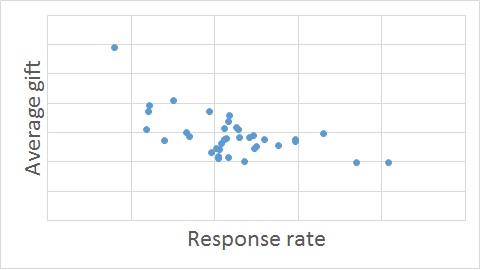
This is a realistic question.  If you graph out your acquisition success by outside list that you are using, chances are you will get something like this:

paretoefficiency

This is actually a good sign.  It means that you are using the best lists, as you are approaching something close to the Pareto efficient frontier (a fancy way of saying you can’t grow any more; you can only make tradeoffs).  After all, if there were a list that was in the upper right here — high response rate and high average gift — you’d be doubling down on that.  But since there isn’t, do you invest more in the upper left or lower right?

This has far-reaching implications.  For example, what metric do you use to determine the success or failure of an acquisition piece?

Yes, in a perfect world, you would use lifetime value.  But we don’t live in a perfect world (if you doubt this, watch a presidential debate at random; this could make Dr. Pangloss open a vein).  Lifetime value takes time to manifest and you need to know what you are making a decision on tomorrow.

So, for your preliminary work, do you go toward net cost to acquire a donor, which will reward getting a large number of smaller donors?  Or do you go to something like net per piece, which will reward fewer larger donors?

(Or, as I’m starting to do, do you look at the donors that a campaign is bringing in and their initial give, then projecting out their average gifting as a poor man’s model for lifetime value?  This is a better solution, but again, don’t let logic get in the way of a good thought experiment.)

This week, I’d like to explore this thought experiment in some detail (in part because it’s something I’m struggling with as well), laying out the case for both approaches and seeing what the implications of this are.
* The correct answer is to set up ask strings and defaults based on previous giving history and/or modeling; customization cuts this particular Gordian knot.

The choice: more donors or better donors?

Using your real estate better: online images

As we discussed in the stop doing giant wads of text post, it’s a good idea to break up your text with images.  But too often online images stop at the first level of work for you: they show the problem or make the donor feel better or the like, but don’t do anything else.

We’re going to put pictures to work for us to do second and third level duty.  Here’s how.

Follow the eyes.  We discussed this a bit in what we can learn from political campaigns.  It’s one of my top 200 blog posts so far, so I’d recommend a read, but the TL;DR version is that we follow where people’s eyes are looking or where they are pointing.  Since having a homepage image of people pointing to your donate button is a little on the noise, having your image subject looking at the donate button can do this work for you.  Here’s a heat map sample from that earlier post:

Engage the multichannel donor.  It is well into 2016, which means not only am I no longer writing 2015 on my checks; I’m no longer writing checks.  Another implication of it being 2016 is that people are going to go to your Website to see what you are doing before donating.

So it’s to your advantage to tie the solution you telling on your site and in your offline communications together with the use of images.  If your mail piece tells the story of the impact of your mission on a child, it’s great to have a further picture of that child on your homepage with a link to the story and the ability to donate.  While you should have a personalized URL in your piece, a person may not be sitting down at their computer (laptop, phone, tablet, watch, etc.) with that mail piece in hand.

Insert key messaging.  And only key messaging.  Take a look at charity.water’s homepage monthly giving ask.  Very few words — just the essentials.  

water


Embed your ask in the picture.  You’ll note in the heat map above that even before we look at eyes, we seek out faces.

If the image is where people are going to be looking on your site anyway, where better to begin your ask?  If that ask is an email sign-up, you can probably do all of that in the same picture (as you only need first name, last name, email address, and maybe state or zip code.  What?  You are asking for more information on your email sign-up?  Have you tried asking for less and seeing what the difference is?  You can always ask for more in the welcome series.)

If that ask is an online donation, you might as well as for some of the starting information in the picture.  Most often, you can get someone to pre-select their donation amount in the initial image.

One of the cardinal rules for donation forms for a number of years has been to minimize the number of clicks necessary to complete the form.  Recent tests that I’ve seen may indicate this is no longer the case.  I hypothesize a few reasons for this:

  • We humans have a poor understanding of sunk costs.  A multistage donation form, then, gets people to take the first few steps quickly and then asks for more, getting the person to think “well, I’ve come this far.”
  • Multistage donation forms can often render better in mobile devices with smaller screens (and worse keyboards).
  • E-commerce has taught us how to use multistage forms.  Think of the arrows at the top of your Amazon order page telling you what step you are on and how much further you have to go.  The fact that you can probably picture an Amazon order page shows how common this has become.  (I’m not judging – I’m surprised it’s not burned onto my retinae).

Anyway, getting the person to give you the amount first asks as a commitment device and pre-checks the “sunk cost” box.  And you are saving a step: rather than clicking on donate, then putting in the amount, they are able to combine these.

Using your real estate better: online images

Using your real estate better: post-donation interaction

Online and telemarketing donations have a unique feature that few other direct marketing interactions have: you are still communicating with them once they have made their donation.

Obviously, a large part of this post-donation interaction should be aimed at confirming that the donation was made and sincerely thanking the person for contributing to the cause.

But there is a unique opportunity in these interactions to get additional value from and give additional value to your donors; it’s the time between donation and processing.  A person has selected an amount, given their credit card (or EFT) information, and decided to make the donation (whether online or by phone).  But the person or the series of tubes has not yet processed the credit card.

You may not even have known there was a time in between donation and processing; I know it took me years before realizing this.  But you can put a shadowbox on your donation page immediately after someone hits “Submit” (or hopefully a more creative button like “Save Lives Now!”).  For telemarketers, it’s just a part of the script.

Since the donor is unlikely to turn back at this point, it’s an ideal time to explore an additional option with them (and I do mean “an” in the sense of “one and only one” – we do not want to turn off the donor).  There are two goals you can have for this: upgrade in amount or upgrade in kind.

If you are looking to upgrade in amount, I would suggest:

  • Selecting a small amount – something that is 10% or less of your normal donation in the medium.
  • Tying it directly to a tangible and immediate win for the donor – e.g., “if you add $3 to your donation right now, you’ll be feeding a child three healthy, lifesaving meals in war-torn Freedonia tomorrow.”
  • Making it very easy to say no and move on with the original donation.  This is not a circumstance to let the better be the enemy of the good.

Because of the limited upside of this tactic, I would suggest the second option: aiming for an upgrade in kind.  This will almost always be trying to upgrade to a monthly gift.  Some tips on this upgrade:

Don’t get greedy.  One of the more frequent upgrade strategies attempted online is a check box that says “repeat this gift on a monthly basis” as part of the donation form.  There are three problems with this:

  1. It explains none of the reasons why you would want to do such a thing
  2. It’s stilted, non-donor-friendly language
  3. It’s before the donation is attempted.  In this case, if the donor is turned off by this half-asked ask, there is no donation.

You want to make the donation ask small enough that it seems like a similar amount of money to what they have already pledged to give.  While you will want to test what this amount is for your organization, I’d advocate a rule of thumb that you’d want to start at about a quarter, plus or minus, of what a person has pledged to give.  Thus, if someone wanted to make a $100 gift, ask them if they would like to make a $25 monthly donation instead.

It doesn’t take a rocket surgeon or a brain scientist to see that this will take at least four months to pay off.  But the average monthly donor is far more loyal than the average one-time donor and will likely extend out past this four-month mark.  And, since we humans value present money more than future money (witness the exchange rate we are taught between birds-in-hand and birds-in-bush), this seems reasonable-ish to the prospective donor.

Explain the benefits of the upgrade to the organization. Your donor has already made the tough decision: to donate to you in order to help people.  If there is a way that they can be more effective in their giving, they are more receptive to it at this point than almost any other (and, at the very least, are not that likely to be turned off by it).  So let them know that giving a smaller amount per month helps even more, because it’s predictable revenue that helps you get through lean times together.  You’ll also likely want to have some strong social math here (what does their $10/month do in terms of tangible benefit) as well as positioning against a hedonic good (“that’s the price of a cup of coffee each day”) to help you win the upgrade.

Explain the benefits of the upgrade to the donor.  Of course, to some extent, being able to help more people is a benefit to the donor – that was their goal going in and they are able to do more of it.  However, there are also tangible benefits as well:

  • Ease.  No more forgetting a donation the donor might want to make.
  • Budgeting.  The donor would be able to budget for donations on a monthly basis, which is how our mental accounting systems usually work.
  • The donor will be able to cancel at any time.  This is critical in the pitch.  You want people to know that you want only 100% satisfied* donors and thus want them to have freedom in their donation.  This is also because one of the primary mental objections to setting a monthly donation is “what if I change my mind?” (and its close cousin, “what if the organization does something I don’t like?”).

You can also put in whatever benefits your organization has for monthly donors (e.g., special member card, donor newsletter, etc.), but I would test it both with and without.  You might find your donors are more drawn in by the mission and the impact they are having and don’t want that special relationship cheapened.

Speaking of special relationships, I’d like to have one with you through our weekly newsletter.  You can sign up here and get the week’s updates in digest form, along with late-breaking thoughts and information.  Thanks for reading!

* Perhaps even donors who are 110% satisfied, for those direct marketers who are bad at math.

Using your real estate better: post-donation interaction

Using your real estate better: preheaders

You have your subject line science down — you do an A/B test in the morning and you roll out with the test in the afternoon.  You ask questions to entice someone to open.  You create urgency.  And you are still seeing your open rates going down.

Maybe it’s that right after your subject line, people see “To view this email in your browser, click here” instead something of interest.

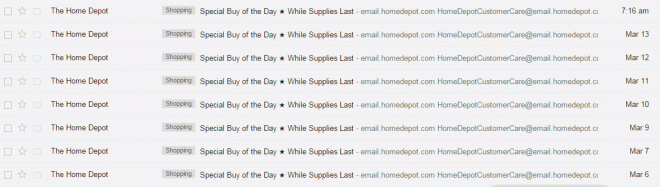
Gone are the days where the subject line was all that mattered.  The first lines of your email now matter, because in many email clients, they are shown alongside the subject line.  This verbiage is called the preheader and it’s valuable real estate that many otherwise really strong marketers ignore.  For example, here are my last few emails from Home Depot as I write this:

home depot

If you thought that these were the first emails I ran to open, you would be incorrect.

Not only to preheaders show up in this way, but they also travel with the subject line to show up in the lower-right corners of Gmail, Yahoo, and Outlook accounts.  Additionally, the preheader can entice someone to read the email (gasp!), not just open it.

So what do you want to do with this to draw your readers in?  Some ideas:

Keep it relatively short.  Not subject line short, but make sure that it gets your point across in the first 75 characters or so, so mobile email clients will show what you want shown.

Tag team with your subject line.  My best email newsletter open and click performance was on the same email.  (Hey, if you thought we were getting through a post on email pre-headers without me plugging that you can sign up for my free weekly e-newsletter, which gives the story version of the week’s blog posts plus super secret extra benefits, you were sorely mistaken.)

The subject line was “Lead gifts and priming and men, oh my.”  The pre-header was “And the details on how social proof works in direct marketing and the power of hedonic good comparisons, but that made for a really long subject line…”

If you have only 75 characters, you get the gist of what the email is going to be about.  And if you have more, it’s a paired attempt at humor.  This had an 80%+ open rate and 40%+ click-through rate.

Another good tactic here is to ask a question in the subject line that you begin to answer in the pre-header.

Personalize.  A pre-header can start with “Dear Mary,”.  (This, of course, only works if the recipient’s name is Mary.  If it’s Vlad, you may be in trouble.)  Anyway, this pre-header establishes that you know the person’s name.  This, sadly, differentiates it from many other emails that don’t know your name, so it’s more likely to get opened.

Tell them what’s in the tin.  If you have a video in your email that thanks the person for being a supporter, your preheader may not have to be any fancier than something like “Watch a thank-you video from our president.”  If you don’t have content that is worthy of being in the pre-header, rewrite the email.

Make the call-to-action.  Not “Donate now!”  I haven’t tested that as the beginning of a pre-header only because I anticipate it would go down in flames.  But “Today, you can save a life with one minute and two clicks.” does a nice tease of the content as well as creating urgency and timeliness.

So make sure you are testing this valuable real estate.  And when you do get that email from someone who just has their logo’s alt text as the pre-header, forward them this email if you like the organization (and if you don’t, prepare to steal their donors).

Using your real estate better: preheaders

Using your real estate better: reply devices

When people in your organization review a mail piece, people expend sound, fury, and energy on the teaser copy, the word choice in the letter, and the photographs used.  

But I bet you could send around a reply envelope with the wrong return address on it and have no one notice it.  I’ve actually done this test, albeit unintentionally; I am not immune.  I caught the error in the final proof process, meaning I missed it twice before.

This is where you, as the direct marketing expert, justify your salary.  Anyone can go through a letter with a red pen and choose their own favorite words.  You get to do the unsexy things that will get results.

And the reply device is probably the unsexiest thing in mail, which is saying something.  If your mail piece were the crack spy team, the reply device would the guy in the van.

573-20091

“You know what? I’m sick of being in the van. You guys are going to be in the van next time. I’ve been in the van for 15 years, Harry.”

— Gib,  True Lies

It’s also where a mail piece is one and lost.  And it’s a place where you can implement your priorities where no one will yell boo.

So, some ideas:

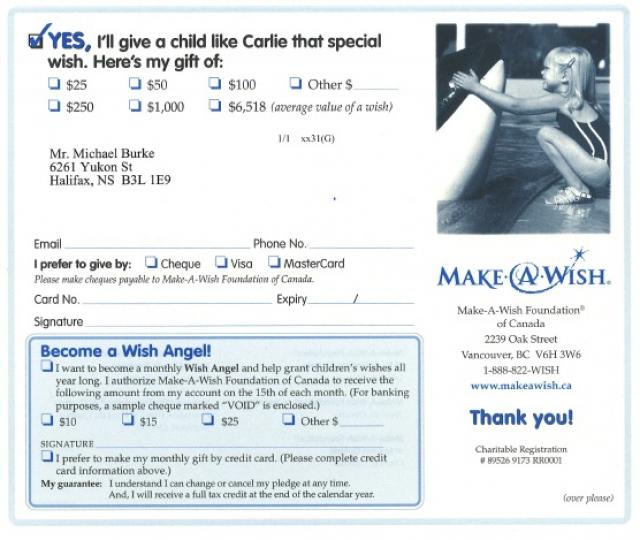
  • Anchoring.  We’ve talked a bit about this here and the science of ask strings here.  However, there’s a wonderful SOFII article about the making of a mail piece here  that explains the below the reply device.

    art_51_reply

    Did you notice the $6518 option?  Not only is that a nice high anchor that people are giving toward, but they find that some people actually give that.  From the SOFII piece:

    There is, however, one twist: there is an option to donate a sum of $6,518. We put that figure in because it is the actual average cost of granting a wish. Every now and then, when I’ve done that before, you find a donor who is willing to donate at that level. We did this once for a hospital when the price point for a piece of equipment was $6,942.73. Thirteen people “bought” this device. These donors upgraded from an average of $65 to nearly $7,000. It never hurts to ask.

    Good for you, Make-A-Wish!

  • Ask for more information about a donor.  Your mind must always be in two places about a donor or prospect: where they are now and where there are the possibilities of them going. One opportunity is for this donor to become a multichannel donor; to do that, you need an email address or phone number.  And, while you can append these data, this has costs both in money and in not learning what method(s) by which your donor wants to be contacted.

  • Ask about other opportunities.  Would this donor be interested in more information about becoming a monthly donor, leaving your organization in their will, or donating a used car?  You will never know unless you ask.

  • Customize based on what you already know.  Usually, reply devices are mass printed, which seems to be a missed opportunity.  If you already have the person’s email address or phone number, you shouldn’t ask again.  Likewise, if someone has ignored your checkbox for planned giving five times in a row, perhaps a monthly giving offer is more her/his speed.

There’s also the reply envelope; if the reply device is the guy in the van, the envelope is the guy in the van’s intern.  Usually these are blank.  However, messaging on the envelope can:

  • Reinforce the person’s decision to donate with trust indicators like the BBB seal.
  • Build urgency with messages like “Rush this envelope to save lives.”
  • Spread program awareness (e.g., “If you or a loved one has been affected by X, please call our hot line at 800-XXX-XXXX”)
  • Help with the program allocation of your mail piece in joint cost allocation.  (For those not familiar with this procedure, you should be looking at each of your pieces and determining what percentage of this content is for each of your programs and what is fundraising for the purposes of your tax returns.  Additional program messaging on the envelope gives a slight boost to the programmatic content.)

Just because the reply mechanisms don’t have as much messaging doesn’t mean that you still can’t make them work for you.  Hopefully, these tips have helped you customize your reply so that you can get more replies.

Using your real estate better: reply devices

Using your real estate better: customization

One of the very few useful concepts I remember from undergraduate economics is the difference between fixed and marginal costs. This is in part because I was taught in the pre-behavioral economics days, so the world the equations described was entirely unfamiliar to me.  But it’s also because this difference reverberates for me even today.

To review, the difference is what you have to pay regardless of the scope of the project (fixed costs) and what you have to pay per quantity generated (marginal costs).  If you want to send out a mail piece, the copywriting costs are fixed — they are the same regardless of whether the piece goes to one or one million.  But the paper, postage, etc., are not.

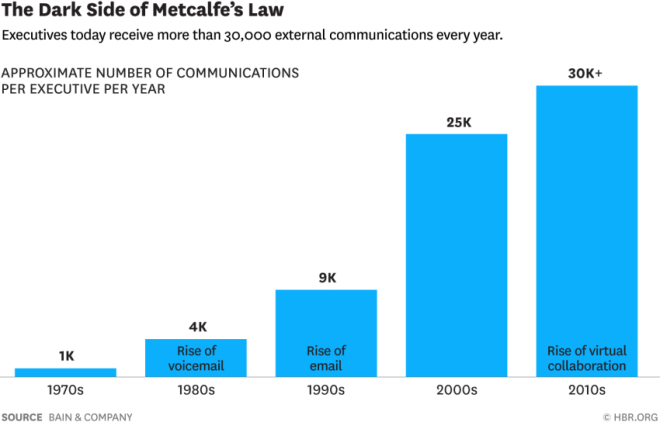
For implications, think of Metcalfe’s law that the value of a communications network is proportional to the square of the number of users connected to it (which is why Facebook will be hard to dislodge — it’s tough to leave a place where all of your friends are).  A recent HBR article showed the dark side of this law when the marginal cost of some communications are so low:

w160219_mankins_darkside-850x544

It’s tempting to look at this graph and say “30,000 messages?  Sounds like Thursday.”  And that’s the challenge — we are inundated as consumers and inundating as marketers.

This means we want to maximize the real estate that we have in our communications.  While we have a constituent’s or donor’s attention, we want to milk it for all it’s worth.

pch-sweepstakes-partsOften, this is done crudely.  When a direct mail envelope is stuffed with so many offers, buckslips, and tchotchkes to make a 1980s-era Publishers Clearing House mailing blush, the effectiveness of any one offer is diminished and the ask can often go missing.  

(Incidentally, the modern Publishers Cleaning House is a great transitional story; look at this case study for a quick idea of just the social media side.)

Similarly, many email newsletters look like nonprofit Christmas trees, where every department wants to hang a few ornaments on them.

But this week, we’re going to explore some untapped resources and hidden gems — places you can put content that are both impacting and low (marginal) cost.

And, since every blog post should have at least one good tip in it and not be full of just introductory material, one of the biggest and easiest of these is:

Customization

When you decide to send a mail piece or make a phone call to a person, the vast majority of the costs of that communication are already incurred. Then, it’s just a question of what you put into that communication.

True, there is an additional cost of customization.  But once you customize anything in a phone script or on one side of a letter, the marginal cost of adding in additional customization is almost nothing — maybe some additional data costs.

The return is almost always positive.  And, since the alternative to getting additional revenues is likely communicating more, which incurs additional costs and has diminishing returns, it’s a preferred route.

So here are some ways to customize your communications that will let your donors know you know them and increase their receptiveness to your appeals:

All of these can cost you little, but bring you significant results.  This is what we’ll shoot for for the rest of the week, so if you don’t think you’ll be back, please sign up for our weekly newsletter here for a digest of these tips and tricks, plus some secret subscriber benefits.

Using your real estate better: customization