Donorcentricity: it’s only a fad if you aren’t doing it

I had the pleasure of doing a debate at last week’s DMA Nonprofit Federation Leadership Conference with Lynne Wester, the Donor Relations Guru, about donorcentricity.  She was pro (and was a pro, surprising no one); I was con.

Several people asked me afterwards what I actually believe.  For the most part, I’m very much pro-donor-centrism.  I took the con side because I believe what John Stuart Mill said:

quote-however-unwillingly-a-person-who-has-a-strong-opinion-may-admit-the-possibility-that-john-stuart-mill-125-26-67

And also because sometimes an admirable goal of improving the nonprofit sector’s sometimes abysmal treatment of donors loses sight of the goals of fundraising.

So this week, I’d like to poke, prod, and challenge the wisdom for and against a donor focus, starting with what it is and why it’s important.

The answer is not to make our donors feel better.

The answer is to cure cancer.  Or end drunk driving.  Or prevent mistreatment of animals. Feed the hungry.  Protect the abused.  Light the fire of education.  All this and more.

To do these things, we need money.  To get money, we need donors.  To get and keep donors, we need our donors to give happily.  Thus, making our donors happy is a good goal.  It’s just not the end goal.

But at the same time, we ignore it at our peril.  In the room, I talked about the amazingly low retention rates we have, especially for first-time givers, as a reason to churn-and-burn.  My actual conclusion could not be farther from the truth – retention is something on which can we continually work and improve.

We face numerous challenges right now to the very model of nonprofits historically.  Donors are looking to fund an impact and a cause, not necessarily an organization.  Why should they pay what they perceive to be (but aren’t) high overhead rates when they can do a microloan with Kiva, or directly fund a school through DonorsChoose or find a particular person in need through GoFundMe ?

In addition, aggregator sites are more than happy to give nonprofits the money as long as they own the constituent.  Facebook, usually a reliable example of most examples of walled gardens and rented land, is one of these where information does not get to the nonprofit for meaningful communication.

All of these satisfy donors’ needs to make a difference and feel an impact, while not engaging with an organization.

There are three ways I can see to adapt to this new world:

1. Fail.  Remember, in the words of Adam Savage:

8f91734f6c29ed44eb6cdf9041940470

This may not sound particularly palatable, but it’s better than being the best buggy-whip salesperson or whale-oil-light manufacturer or print journalist left on earth.

2. Compete on the value of our models for effectiveness. Small scale efforts like GoFundMe can fund one person, but they can’t fund a systemic scale against hunger.  Individual donors tend to pick projects based on the basis of attractiveness and skinniness and whiteness (unfortunately), so nonprofits fill a role in helping everyone.  Small efforts can’t effectively change laws or study methods for change.  And they while they fix things well, they can’t prevent them from breaking.

Unfortunately, these are usually tough sells.  For years, we have talked about the systemic problems through the story of the one.  It’s the one that touches the heart and we know that emotion is far better than education in low-dollar appeals (and since you attract people as low-dollar donors, that hurts acquisition as well).  If someone can see a person’s plight and fix it, rather than the underlying problem, easy trumps thorough.

3. Compete based on how well we can treat donors. That’s donorcentricity.  That’s where we can have a meaningful advantage.  One-off sites like Facebook can’t build a relationship around an issue like we can.  And while Kiva is fabulous in terms of creating an addiction around helping, other sites lack in this regard.

So rather than die off, donorcentricity is going to be (in my mind) how we justify our very existence: we are the best at creating meaningful connections between donors and the world they wish to create.

So this is not a fad.  It is not everything, but neither is it nothing.  But in my mind, it also doesn’t mean what some people think it means.

Along those lines, I’ll be talking about communication quantity tomorrow.
Donorcentricity: it’s only a fad if you aren’t doing it

Ask string amounts: to round or not to round


Rounding can be controversial.  On the one hand, round numbers could potentially help with fluency, which is crucial in persuasion.  Rounding out ask strings can help you get out of weird numbers that consistent upgrading can create (e.g., if you donate $30, then upgrade by 50% each time, that’s $45, $67.50, $101.25, then $151.875.  And if you haven’t got a ha’penny, then God bless you).

On the other hand, there is a potential draw in using an odd amount specifically to stop someone short (e.g., your $17 will feed X people).  In fact, in face-to-face settings, panhandlers found that when they asked for change, 44% of people contributed.  When they asked for a quarter, 64% contributed.  When they asked for 17 cents or 37 cents, 75% of people made a contribution.  This is called the pique technique: the idea being that the odd request breaks people out of their normal mental structures, forcing them to think about what you are saying.

However, this may or may not be as applicable in non-face-to-face environments.  Burger et al took a look at the mechanism by which this worked.  They found that contributions only increased among people who came over to ask a question; there was no difference in giving between people who were given a specific answer (e.g., “I need to buy a stamp”) versus those who were given a generic answer (e.g., “I need to buy some stuff”).  Since there isn’t a mechanism for someone to stop and ask you a question in the mail or online (yet!), this technique may not work on asynchronous platforms.  And, in fact, a study of the pique technique when applied to causes, rather than donating directly to the person face-to-face, found no significant difference with this technique.

There is, however, evidence that rounded numbers can increase giving.  One study of donations found that rounded values increase giving by seven percent.  Specifically, they found that people were more likely to choose things that were on the ask string (what they called an appeal scale) than rounded numbers not on the ask string, but that a good number of people wrote rounded numbers in as the other when not on the ask string.  Additionally, they found when a round number was on the ask string, there was a particularly strong pull of that number on donations.

In addition to articulating that round numbers have a pull that is independent of the pull of a person’s internal reference point and the ask string itself, they also helped define a conundrum.  To wit: what is a round number?  As the authors put it:

“While the notion of a round quantity is seemingly intuitive, it is nonetheless difficult to make precise. Round numbers are operationalized in the present paper as the face values of commonly used French currency notes or small integral multiples thereof. Based on the data used here, this functional definition accounts for all but a negligible proportion of off-scale donation amounts, in the sense that adding or removing additional rounded values does not substantially alter any aspect of the analysis.”

As we noted in the all about the Benjamins piece, these banknote values are especially strong — $100 in particular. 


In summary, fluency seems to trump creativity in the case for round numbers, especially at higher levels.  If you are looking to increase average gift, it should be to something that is highly fluent like $20, $50, or $100; if you have to be creative, do it with lower ask amounts so that they don’t have as much draw.

However, there is some evidence that having one oddball, very high donation amount can be helpful, as we noted with the Make-a-Wish Canada example here.

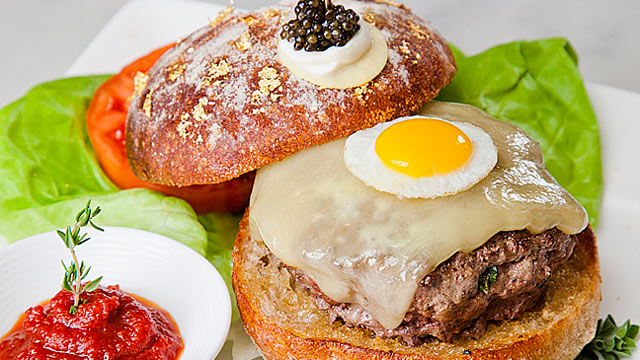
The idea of providing an outlier as a potential anchor and/or moneymaker is an interesting one.  While I could find no data on this from the nonprofit world, there are studies from the for-profit world that indicate that the existence of one very high product can increase what someone is willing to spend on a medium-priced product.  This explains the existence of those news stories you hear from time to time about how someone has created an even more expensive hamburger, made with wagyu beef, caviar, gold leaf, and unicorn tears.  

ht_burger_kb_120530_wmain

Medium rare, unicorn tears on the side, please.

Having this burger on a menu, in addition to the free publicity, could also increase average spending.


This post is a section of my upcoming, not-quite-a-book, not-quite-a-white-paper about ask strings.  It will be free to all subscribers to my free weekly newsletter, so please sign up here.

Ask string amounts: to round or not to round

Cognitive fluency, your brain, and direct marketing

“Cognitive fluency” means brains like things easy.  Easy things make brains happy.  Happy brains make people do things we want them to do (proof is here). 

Options of three things are easy.  Brains Goldlocks it and pick the one in the middle – not too much, not too little.  There’s a study that shows this

Repeating things makes them easier.  Seeing something once makes you more likely to like it a second time.  Thrice is even better.  Even if it is nonsense, you like it because you’ve seen it.  

The easier something is, the more it convinces.  That’s also been shown.

art1__1264872682_4038

Image credit: The Boston Globe.

For example, reading Arial makes us think doing something will be easy.  Reading a script font makes us think it will be hard.  The study is here.  

Simply named stocks do better than tough ones.  Simply named people become president.  More info here.

Also, repeating things makes them easier.

So make it easy for your donors.

Have people looking at your donate button.

Repeat things.  Because repeating things makes them easier.

Build up to your ask.  Small steps like email petitions increase donations.  

Tell people what other people are doing.  That’s social proof.  Brains like social proof because it makes things easy.

Just like repetition does.

Make your text a very different color from the background.  Because this stinks.  If it’s too close, it blends in.  Blending is bad.  Reading easily is good.  

Bigger fonts are also better.

Write at the lowest grade level you can without sounding Dick and Jane.  Jeff Brooks, in his very good book, recommends 4th to 6th grade level.

Some may call this stupid.  But it’s not dumbing down.  It speeds your donor up.  It makes it easy for their brain.  And that makes you more persuasive.

So, small words.  Short sentences.  Fragments of sentences, even.

Your high school English teacher might disagree.  If s/he wants a say, s/he needs to donate.

Please make your donors’ brains happy.  Make it easy for them.  Then they will make it easy for you.

Cognitive fluency, your brain, and direct marketing

How the brain decides whether to donate

The classic of this decision-making writing is Daniel Kahneman’s Thinking, Fast and Slow.  In it, he talks about two thinking systems, cleverly named one and two.  System one is our fast thinking, emotional, instinctual system; system two is our contemplative, logical, slower system.  Many of the cognitive biases and heuristics that we talk about in this blog stem from system one having clever (and not-so-clever) shortcuts so that we don’t have to spend the energy to think.

There’s a subtle shift on this that more neurological minded decision theorists propose (not that Kahneman’s system is bad — there’s a reason it’s a classic).  They say there are three decision-making pathways: 

  1. Pavlovian: This is the system that makes you want a meringue cake dessert.

    300px-pavlova_dessert

    Nope, sorry.  Knew I shouldn’t be writing while watching Food Network.  A Pavlovian pathway is instinct: it’s an unconscious or nearly unconscious, reflexible behavior.  It gets its name from the ring-a-bell, get-a-treat, now-the-dog-salivates-when-the-bell-rings conditioned response guy.  This may be System 0 in the Kahneman taxonomy.

  2. Habitual: When you repeat actions over and over, they become subconscious behaviors.  There’s a neurological saying “fire together, wire together,” meaning that if you do something repeatedly, the stimuli involved in that something will tend to become associated and more efficient working together.  Think of walking the same path through grass day after day.  Pretty soon, that path becomes almost as good as a sidewalk, controlled by your basal ganglia.

  3. Goal-oriented: When you make conscious, reasoned decision based on trying to get to a positive outcome.  You likely have heard about how people like President Obama, Steve Jobs, and Mark Zuckerberg wear the same thing every day so they don’t have to make that decision every morning.  There is a germ of truth in this: we can only handle so much in a day and every goal-oriented decision takes its toll.

If you would like to read about these three mechanisms and how they function in prosocial (not selfish) behavior, there’s a nauseatingly detailed study here

So what are the implications for direct marketing?  I’d love to hear yours; here are a few of mine:

  • For a certain type of supporter, is reduced cognitive load part of the pitch for a monthly donation EFT?  That is, can you take something that you have to think about in the goal-oriented pathways and put it into automatic?
  • Conversely, do you want to?  Do you want to encourage goal-oriented thinking or aim for a more conditioned response?
  • Donors will likely expect that you behave like Pavlov’s dog.  That is, you need to do what you say you are going to do, especially as it relates to acknowledgments.  If someone is going to expect that hit of dopamine upon receiving their thank you, you need to follow through on that.
  • This likely explains the reason that gifts under $100 are given with the heart and over $100 are given with the head.  At that point, a gift goes from a habitual response to a goal-oriented action full of actual thoughts.
  • What type of conditioning are you doing with your direct marketing program?  There is a chance that premiums are conditioning some of your donors, whether habitually or Pavlovianly, to donate only when they get something for that donation.
  • Are there some means of communication that are truly Pavlovian?  I’m thinking here of mobile messaging.  When someone automatically checks their phone when they get a ding sounds, it’s not too many steps removed from a salivating dog listening to the bell.
  • See if you can discern habitual behaviors in your donors.  Do you have a set of donors who gives every year in November or December, but never in the other ten months out of the year (answer: yes, you do)?  Do you still mail them or call them with all of the other donors in June?

Any other thoughts?  I’d love to hear how you are building positive habits with your donors at nick@directtodonor.com or in the comments section.

How the brain decides whether to donate

Oxytocin and direct marketing: beyond the cuddle chemical


Oxytocin is a hormone produced in the hypothalamus, which is responsible for a number of major autonomic (or unconscious, like breathing) functions of the body.

Oxytocin is sometimes called the cuddle chemical or the hug hormone.  It’s a natural classification.  Oxytocin is released naturally as a part of childbirth and is associated with maternal behavior and social attachment.  

However, it goes much beyond this.  More recent research has shown it’s important in the formation of trust.  People dosed with oxytocin are more willing to trust their money with strangers.  Some researchers think this is because they are also more able to read facial expressions and emotional states.

On the dark side of oxytocin, while it promotes trust with in-group members, it also increases distrust of foreigners and outgroup members (study here)

More to the point of nonprofit direct marketing, when people empathize with a story, oxytocin levels are on average 47% higher. (study here)  (More so among women than men, which is perhaps why women are more likely to empathize and give charitably).

This translates to additional giving.  Subjects who received oxytocin gave to 57% more causes and 56% more money after exposure to PSAs (study).

But that’s nothing compared with what is possible.  In the same study, they looked at what happened when people experienced increases in both oxytocin and a fast-acting arousal hormone called adrenocorticotropic hormone (which people abbreviate ACTH for obvious reasons).  When the PSA increased both of these, giving increases 261%.

This means that the story has to both arouse empathy (releasing oxytocin) and draw the person in (stimulating ACTH).

So how do you do that with your narrative?

First thing is to take what your high school English teacher taught you about the five-act structure of plays, where you have rising action, leading to a climax, then a falling action that leads to a resolution.  Remember that?  (You may even remember the term Freytag’s pyramid, in which case, good job, Hermione.)

Now crumple it into a ball, throw it away, and try to forget it ever existed.  As we’ve said before, all pyramids are lies.  Even in the two-minute video that Zak used to test his subjects, attention tended to drift until tension raised again.  This is far less Freytag’s pyramid and far more the latest Avengers movie, where there has to be a tension set piece every so often to hold interest.

The goals are emotional resonance and attention holding.  When you have a narrative that does that, you release oxytocin and ACTH.  And when you do that, you get donations.

We’ve talked a lot about ways to do this, imagery and specific details being particular favorites.  However, when it boils down to it, take a look at your story.  If there are any paragraphs, sentences or words (especially adverbs!) that don’t help one identify with the people in the story or hold the attention of the reader/listener/watcher, cut it.

It’s brutal, but you need to hold attention and create empathy with it in order to succeed.

Tomorrow, we’ll get out of chemistry and into how people make decisions.  

Oxytocin and direct marketing: beyond the cuddle chemical

Doping in your direct marketing

lance_armstrong_tour_de_france_2009_-_stage_17

Not this kind of doping.

Our brains are miracles of electricity and chemistry.  Each electrical and chemical reaction is a way of communicating from one part to the other.  And there’s hardly a more fun chemical in the brain that dopamine.

Dopamine is what’s called a neurotransmitter.  It is released by nerve cells (neurons) to send messages to other nerve cells.  And it moves through special dopamine pathways.  One of these is called the mesolimbic pathway, aka the reward pathway.  There will not be a test on this.

Think of the classic rat-pushes-a-level-and-gets-a-reward-experiment.  That’s what dopamine does.  Do good.  Get a dopamine reward.  Most addictive drugs work through dopamine and most anti-addictive medicinal treatments repress dopamine.  In fact, there are case studies, including this very readable one from The Atlantic, of people who are addicted to giving because of their neural pathways.

Dopamine dulls pain, arouses, causes pleasure, and dilates the eyes.  I mention this last one so I can give you a good tip for reading people by way of Sherlock.

tumblr_n3qys4fdr51qbskx5o1_500

Sherlock: because I took your pulse: elevated; your pupils: dilated. I imagine John Watson thinks love’s a mystery to me, but the chemistry is incredibly simple and very destructive.

As a result, it’s a pretty nice thing to have on your side in nonprofit direct marketing.  The “warm glow” of giving is largely a dopamine reward (mediated by oxytocin, which we’ll talk about tomorrow).  When researchers look at fMRI data, they found that when someone gives to charity, the nucleus accumbens (which is usually associated with unexpected rewards) lights up and produces dopamine.

So how do you build dopamine and how do you use it?

The first is obvious and we’ve talked about it ad nauseum: thank your donors well.  Part of why dopamine is addictive is that the brain tends to anticipate it.  And you don’t want to deny someone that hit of dopamine for their good deeds.  Conversely, an unexpected reward can have the same impact that unexpected flowers or a gift can have for a spouse or loved one.  No, not the wondering what you did wrong one — the good one.

Beyond that, it’s something you can stimulate in your copy and storytelling.

Seeing other people happy releases dopamine and makes the person who observes them happy.  While I’m on the record not to sugarcoat our issues, when you can show the after and the impact you are having, you can do so in a way that makes your donor happy as a result.

Affirmations.  On online buttons, you’ll notice a lot of conversion buttons are now starting with “Yes,” or its excitable cousin “Yes!”.  This is because a positive affirmation can release dopamine and excite the person seeing it.  We become the rat pushing the lever.

Exclusivity can also give a dopamine hit.  We’ve talked about its power in persuasion; dopamine is part of why.  Here there’s a double shot; once when you know things that no one else knows and once when you share it with them.

And finally, use lists.  Our brains love to complete things, thanks to the reward it gives itself every time.  Bullet points tend to work better than comma’ed lists with each one making a nice mental check every time it’s read.

So that’s dopamine in a nutshell (or a skull).  Please check back tomorrow to learn about oxytocin, or sign up for our newsletter and never miss a post!

Doping in your direct marketing

This is your brain on direct mail

Readers of a certain age (namely, around my own) will recognize the 80’s era PSA that taught a generation of Americans about proper egg cookery.

But the truth is that your brain is awash in drugs constantly.  They just happen to be of your body’s own making.

So this week, I want to take a look at how people’s brains receive our direct marketing communications and how it should influence our efforts.

Three caveats:

  1. I am not a brain scientist.
  2. Neuromarketing is still in its infancy.  It’s difficult to tell whether what is lighting up on an fMRI is a cause or an effect.  To a large extent, we are still black boxes, where we can observe what’s going in and coming out, but only guess at what happens in the middle.  There’s also a great deal of hucksterism in the community because of the newness.
  3. If #2 were wrong, I wouldn’t necessarily know it because of #1.

Now, if you are still with me, I’d like to talk about how the brain processes tangible marketing (e.g., mail) versus non-tangible marketing (e.g., online).

Temple University (at the request of the Postal Service Inspector General, so not the purest possible study) looked at how the brain processes mail versus online

They showed subjects a mix of 40 postcards and emails and monitored them through eye tracking (for visual attention), fingertip sensors for heart rate, breathing, sweating (for emotional engagement), and MRIs (for brain activity).  

Online efforts were distinctly better in one thing: focusing attention.  On the other hand, print won in terms of emotional interaction/arousal, engagement time, desirability for the things in the ads and recall.  The two means tied for memory recall and information processing.

Specifically, the researchers found greater activity in the hippocampus and areas around the hippocampus for physical ads than in digital ads.  The hippocampus is associated with memory formation and retrieval, meaning that participants could remember a greater context for their paper-based stimuli.

If you are a fan of Sherlock, as I am, or the book Hannibal (eh…) you know about the memory technique known as a mind palace — associating things you want to remember with physical locations.  Part of the reason this works is that tangible things are, well, more tangible and easier to retrieve out of memory.

As a result, a week later, subjects showed greater emotional memory for print.

This was replicated in a UK study and a Canadian studySpecifically, with print, more processing took place in the right retrosplenial cortex, which I had never heard of before this paper.  Apparently, this is involved in processing emotional cues and helping them get into memory.

So, in our first foray into brain science, we can say that while people may focus more on online images (in part because it is a more structured environment; life is rarely so structured outside of a computer screen), they forge greater bonds with mail.

The one caveat to this is that mail versus print ads misses the interactivity that is possible online.  It didn’t test video, or click-throughs, or quizzes: just static online ads.  So, just as we shouldn’t trumpet the death of direct mail, neither should we dismiss online as mere ephemera.  There’s more to learn here.

And we’ll do some of that tomorrow with the role of dopamine in nonprofit direct marketing.

This is your brain on direct mail

Escaping fixed ask strings

Most of the science of ask strings that we’ve talked about is related to variable ask strings that depend on who the potential donor is.  However, when acquiring new donors, this is often not possible, since you know little to nothing about who the person is (yet).  Thus, while we’ll talk mostly about variable ask strings or topics that apply to both fixed and variable ask strings, it’s important to discuss fixed ask strings.

Namely, don’t use them whenever possible.  Yes, they are necessary for some acquisition purposes, but the effort to customize them to even what little you know about a donor is worthwhile.  Some tips:

Online donation forms are usually customizable.  CDR Fundraising Group estimates that this simple step can increase your response rate by 50% and your average gift by 40%.  In fact, they’ve posted code for how to do this in Salsa Labs. What if you don’t use Salsa Labs?  Usually searching for “dynamic ask strings XXname of giving platformXX” will get you some tips on how to.

But if these tips are Greek to you, you can always take a shortcut: setting up multiple donation forms with different ask amounts and sending the links to customized segments of your audience.  This isn’t ideal, but it gets you most of the way there.  Even if you take a very shortcut and have a $100+ versus under $100 versions of your donation form to send, you will be customizing the experience for your online donor a little bit.

Use intelligence from your outside list selects.  If you are like many organizations, your outside list selects will feature a minimum threshold below which you won’t accept donors (often $5 or $10).  Chances are you have tested into these amounts:one list is productive without a threshold, so you haven’t incurred the cost; another had subpar performance, so you asked for a more select group of donors.

Chances are, your $10+ donors from one list will behave differently from your $5+ donors from other and from your “anything goes” donors from list number three.  Thus, you can use this threshold as a customization point for your fixed ask, making sure to ask people who give more for more.

Make sure your ask string testing doesn’t select just one winner.  When you test an ask string in acquisition, there’s a temptation to treat it like a traditional control and test, where a winner is chosen and rolled out with.  Here, however, you may find that even though the majority of lists performed best with your control ask string, there were a few lists that had demonstrably better results with your test version.  Since different lists have different donor characteristics, you may get better results by keeping with an ask string that better fits those donors.

Use modeling to determine your ask.  List cooperatives will be only too happy to create models for you.  Chances are, they can do a response model that maximizes response and another that maximizes average gift.  The folly is when both of these groups get the same ask strings when they were set up with different goals in mind.

However, you don’t have to use a co-op or pay a PhD to run a basic model.  Simply take the average gifts from your current donors at acquisition by ZIP code, standardize them (rounding to the nearest five or ten for fluency), and use that as the basis for your fixed ask strings.  After all, there’s no reason you have to treat 90210 as the same as 48208 in Detroit.

Make sure you are using information from multichannel giving when running a conversion program.  Sadly, walkers, event donors, volunteers, online donors, and e-newsletter subscribers are often dropped into an offline acquisition with nary a thought as to ask string.  Please don’t do this.  You could be asking your $500 online donor or your gala chair to sign a $20 check.  It’s debatable whether it would be worse if they didn’t give a gift or if they did.

Instead, make sure all giving, not just channel-specific giving, is taken into account when formulating your asks.  Additionally, even if someone has not given, you can apply filters like ZIP code or historical data (e.g., last time, your volunteers’ average donation was twice that of your e-newsletter subscribers; why not ask for twice as much?) to your ask string.
Hopefully, these tips help make even your fixed ask string more customized.


This is a special bonus Sunday blog post.  As I was writing my mini-book on ask strings, I realized this was a topic I hadn’t covered yet on the blog, so I’m putting up a draft version of the content here.  Please let me know what you think at nick@directtodonor.com so I can improve it.  And, if you would like a free copy of the book when it is ready, sign up for my weekly newsletter here.

Escaping fixed ask strings

An ode to the mostly filled thermometer

When was the last time you saw an analog, mercury-based thermometer?  Chances are, it was in a fundraising campaign, indicating how close you were to goal.  Even as thermometers go digital, their ancestors are honored through skeuomorphism* to symbolize progress.

But we come here not to bury the fundraising thermometer, but to praise it.

Specifically, we want to praise how the fundraising thermometer, or a specific state of it, can make people more likely to donate.

fundraising-thermometer-template

Cryder, Loewenstein, and Seltman took a look at how the amount toward goal already raised impacts a person’s likelihood of giving here.

They call it the goal gradient hypothesis: they think that people will be more likely to donate the closer a campaign is to goal.

So they tested this with Kiva, the microlending site that you may remember from such hits as “does being more attractive increase your chances of getting funded on Kiva”?  (Yes, it does.)

They found that when an individual fundraising goal was 0-33% complete, the average hourly progress toward goal was 6.7%.  When it was 33-66% complete, progress was 10.8% per hour; for the final third, it was 12.8% per hour.

So, having the thermometer partial full helped increase fundraising efforts.  This would tend to make sense, since the thermometer is a measure of social proof, a potent persuader.  (It’s the same reason that servers will seed a tip jar with larger denomination bills — it helps set the pressure and the anchor)

Hey, I can hear you yawning.  Yes, I know you aren’t going to be going on Kiva tomorrow.  But we’re just warming up.  The researchers then worked with a nonprofit to mail lapsed donors.  They had three separate goals that they were trying to reach and mentioned that one was 10% complete, a second was 66% complete, and the third was 80% complete.  They also had control conditions where no progress was mentioned.

Sure enough, the 10% and 66% conditions were not significantly different from the no progress control.  However, the 85%-to-goal piece significantly increased response rate (from .5% in the control to 1.17% in the 85%-to-goal version).

They even tested the “why” of this with donor surveys.  They asked people if they would be more likely to buy candy bars from a 7th grade fundraiser if the fundraiser was two bars short of goal or 32 bars short.  Two-bars-left won handily.  Additionally, the donors who chose the two bars indicated they felt like they were having a bigger impact and were more satisfied with their donation.

So, since not everyone can be the donation that pushes you over the finish line, how can you use this?

One tactic is to have a silent period of a campaign.  For online year-end giving, I’ve worked with organizations that will set their goal and their thermometer based on what it will take to hit goal starting from November 1, but only announce the goal and the effort on Giving Tuesday.  That way, their thermometer is at least 20% full when the first donor hits the form.

Another is to ask internal audiences (especially board members) to make the first gifts.  Showing them this research may help them feel like their gift is making a difference by getting others to give more freely.

Finally, you can define down your goal.  The 85%-to-goal condition mentioned above was based on being 85% toward buying a GPS unit for an international relief organization.  This is not a high-ticket item.  By setting the goal low, they were able to talk about 85% complete easily.  This type of microcampaign, repeated writ large, can help illustrate impact for your donors.

So keep those thermometers more than half full and you should be on your way to filling it up the rest of the way.
* A design based on an older version of an item to help people understand the newfangled version.  It’s the reason that email programs look like folded envelopes and your video app probably features an old-school movie clapper.

Thanks to Tim Vandevall here for the thermometer image.


If you’d like more nonprofit direct marketing content like this, please subscribe to my free weekly newsletter. You’ll get all of my blog posts, plus special subscribers-only content.

An ode to the mostly filled thermometer

When does a match light a flame?

We’ve talked about how a lead donation can be as or more effective than a matching gift campaign and how using a lead donation can also calm the overhead related concerns of donors.  

From that, it may sound like I’m anti-match.


mission2bimpossible2bfuse2blighting2bmatch2btv

(insert Lalo Schifrin score here:
BUM BUM BABA
BUM BUM BABA
WAHNAHNAAAH WAHNAHNAAAH etc.)

But I’m not.  It’s a widely used tool that I’ve found to be effective in several cases and, unlike most tactics, the donors I talk to also seem to enjoy matching campaigns.

Some research can help shed some light on when to use a match and when not to.  Karlan, List, and Shafir published a study in the Journal of Public Economics (and who doesn’t pick that up for a little beach reading over the summer) looking at match rates.  

Normal studies tend to focus on whether the match works overall: yes it does or no it doesn’t.  This study, however, gives some guidance on when to deploy a match.  It also cross-deployed the match with a test of urgency, which is one of the building blocks of influence.

So there were four test conditions:

  • Matching gift with urgency (with a reply device and PS that said things like “NOW IS THE TIME TO JOIN THE FIGHT!”; you can tell it’s urgent because it’s in ALL CAPS!).
  • Matching gift without urgency
  • Control with urgency
  • Control without urgency

And they did a bunch of other stuff also that is not relevant for our purposes here, including testing different match sizes and timings and such.

The authors found that urgency actually hurt the appeal in many cases (probably, they hypothesize, because there was no particular reason given for the urgency; when it was combined with a match deadline, this negative effect disappeared).

As for the matching gift, there was evidence that it worked, but it only worked for donors who had made their previous gift in the past year.  These donors were 3.2% more likely to donate with a match in place and their average gift went up.  On the flip side, donors who had last given more than 12 months prior had their response rate drop when the match condition was in place.

I mentioned earlier that the donors with whom I spoke seemed to like the tactic and that seems to be supported by this study: active donors do like a match.  However, it seems to bump into trouble when the person has not donated reanecdotalcently.

There’s likely one exception to this (and this is based only on anecdotal evidence, so take this with an appropriate-sized amount of salt).

I have found that people who have given to a match before are more likely to give to a match again.  Thus, if you are suppressing out 13+ month donors from your match campaign, I’d counsel you to leave the ones who have shown the tactic has worked for them.

Want more studies and analysis like this?  Please sign up for my free enewsletter.

When does a match light a flame?