The human face of overhead

I am overhead.  And I have been overhead for over eight years now.

I’ve been in charge of a direct marketing program.  I’ve participated in our board meetings, managed staff, and written fundraising strategies.

If you care whether you accidentally get two of a communication or not, that’s me.  I helped set up the database systems for our organization, set deduplication criteria, and worked to make sure our fundraising and outreach efforts run smoothly.

All of these are overhead.

When someone says they want to fund a mission or a cause, but not the overhead that goes along with it, they think they mean that they want to make sure nonprofit executives don’t fly to Gstaad on their private G6s.  

emirates-executive-lounge-area

Probably not the local homeless shelter’s board meeting. (Image credit)

What they actually mean, whether they realize it or not, is that they prefer that I and thousands of other people who work for nonprofits don’t exist.  No lawyers to sign our leases, defend our copyrights, and review our contracts.  No finance operations to make sure that every donor dollar is spent in accordance with policy and that all of the books balance.  No one on the other end of the phone to take a donation and talk with you about your monthly gift.  And no mail piece to ask you to give; you’ll just come to the Web site and do that on your own, right?  Not really, because Web software to accept and process donations is also overhead.

Not only do we need these, we want these (or, at least, we should).  Stanford Social Innovation Review said that nonprofits aren’t investing enough in these things and, as a result, are getting subpar results.

We transcend lean and mean; we are now emaciated and ticked off.

There are some lights in the wilderness.  The Ford Foundation, realizing that 10% was too little for overhead on its projects, has raised their limit to 20% And the initiative for the Overhead Myth is gaining some steam (although the irony of Charity Navigator being involved will be discussed later in the week).

But this is something we must address together.  As Ben Franklin said, “we must hang together or we will most assuredly hang separately.”

That’s why, even though they may work, I strongly encourage to remove your Charity Navigator four-star rating as a false badge of honor and for you to stop talking about the percent of your dollars that go toward your mission.  All of your dollars go toward your mission.  Some of them just take longer to get there.

The human face of overhead

What’s in a name? Word choice in direct marketing

It is an article of faith that names have power. In Genesis 1 and 2, Adam names the animals as part of his dominion over them. Many wizards in the Potterverse dare not speak the name of Voldemort, choosing He Who Must Not Be Named instead. Shakespeare asked what was in a name and it turned out it was quite a bit, given the death toll at the end of that play. Rumplestiltskin, Isis versus Ra, Doctor Who, Bilbo in Smaug’s den, YHWH, and so on: so much of our myth and mythology is about there being power in what something is called.

The truth is that, because of nominal biases, what something is called matters. I’m cheating a bit with this topic, because this isn’t one big cognitive bias, but a few different ones. They can have an impact on your direct marketing language.

People tend to prefer things, people, objects, etc. that are easy for them to understand. (study here). This is known as the fluency bias. There’s a reason that only eight names cover more than half of our presidents (James, John, William, George, Thomas, Andrew, and Franklin (which used to be a lot more popular than it is now)). Names that are more common help people rise faster in occupations. Believe it or not, stocks that have ticker symbols that can be pronounced as words outperform stocks that can’t be

Our brains are more persuadable by things that are easy to read and to hear. Winston Churchill, winner of the Nobel Prize for Literature (and he did some other stuff), talked about how he intentionally chose words with few syllables in his speeches. As a result, they have a fluency that sticks in the mind.

Even as an American, I can easily recall more of Churchill’s rhetoric (“this was their finest hour”, “an Iron Curtain”, “we will fight them on the beaches”, “blood, toil, sweat, and tears”) than FDR’s (“a day that will live in infamy”, “all we have to fear is fear itself”, and I hit a wall).

So never select a gargantuan word when a minuscule one will suffice.

Of course, the most fluent name for something is one’s own name. Believe it or not, people who have the same initial as a hurricane give more in disaster relief to that hurricane. The theory is that people want to distance themselves from the act that “they” are committing.

This works in other ways as well. I once tested state-specific victim stories in direct mail pieces. In half of them, I indicated that the story came from that person’s state; in half, I didn’t. Response rates went up an average of 30% when the story presented in a place the person was familiar with. Thus, customization to personalize the details of stories to your audience can raise more money.

Details also have a powerful nominative effect. In the classic Made to Stick, which I strongly recommend, the Heath brothers relay the study that stuck in my mind as the Darth Vader toothbrush study. Simulated juries were given eight facts for and eight facts against.

darth vader toothbrushThe stories differed only in detail. Half received irrelevant details for the good side: e.g., instead of just “Mrs. Johnson sees to it that her child washes and brushes his teeth before bedtime,” they added “He uses a Star Wars toothbrush that looks like Darth Vader.”

The other half received irrelevant details for the dark side: e.g., in addition to “The child went to school with a badly scraped arm which Mrs. Johnson had not cleaned or attended to. The school nurse had to clean the scrape,” they mentioned that the school nurse spilled the treatment, staining her uniform red.

Jurors who heard vivid details for the good things judged Mrs. Johnson to be a more suitable parent than jurors who heard the unfavorable arguments with vivid details. So make sure you are providing a real picture for your audience.

There is also a framing effect to word choice. Everyone in the abortion debate wants to be pro-life or pro-choice and not anti-life or anti-choice.

I find this to be especially true for verbs. Ideally, you will be able to ditch adverbs like ideally and have your verbs do the heavy lifting. In a study, witnesses were asked how fast two cars were going when they crashed. Except instead of crashed, the authors tended a few different verbs; here are the results:

  • Smashed: 40.5 MPH
  • Collided: 39.3 MPH
  • Bumped: 38.1 MPH
  • Hit: 34.0 MPH
  • Contacted: 31.8 MPH

Let me stress this: they watched the same crash. All that was different was the word that the question used and you still see an impact of almost 30%.

So how can you improve your own copy? One solution is Hemingway, an app that allows you to upload your copy. It then highlights long sentences, adverbs, passive constructions, etc. The reading ease score that comes with Word or similar software can also help.

Or ask a child to read it and see what s/he thinks.

Hope this helps your writing! If you would like some more of my favorite writings of the week, please sign up for my weekly newsletter, which has the feature “favorite thing I didn’t write this week.” I’m very creative at naming things.

What’s in a name? Word choice in direct marketing

Scope insensitivity and direct marketing: why one beats many

There is a famous study in nonprofit marketing that shows that an appeal that tells the story of a child does better than an appeal that tells that same story with information about the general problem of poverty in Africa. Even more oddly, a story of one boy did as well as the story of one girl; both did better than the story of the boy and the girl. The study is here and it is both fascinating and disheartening.

We humans think in simple narrative. We are used to hearing a story of a person (then using availability bias, which we talked about, to generalize). When we hear the story of a person, we react to it with emotion and affect. When we hear the story of many people, we react to it with logic and calculation. Or as Stalin put it: “If only one man dies of hunger, that is a tragedy. If millions die, that’s only statistics.”*

engaging-millennials-as-organ-donors-june-13-2011-35-728

Image credit here. Odd that Stalin and Mother Teresa had similar sentiments on this. And I don’t think anyone has ever seen them in the same room at the same time…**

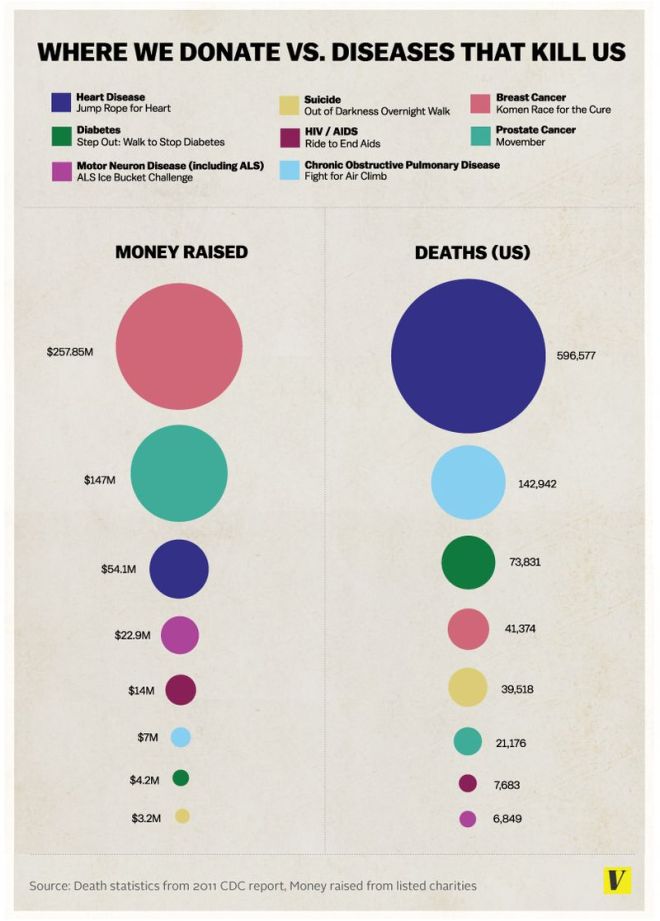
Unfortunately, this leads to us (in theory) misallocating our resources. Vox did an illustration of the types of cancer people donate to, versus what they die of.

fundrasing4disease

Image credit here.

This seems to focus on special events and looks at one organization per disease, so it isn’t perfect but is emblematic of this problem. In 2010, the humanitarian aid response to the Haiti earthquake (which affected 3 million people) was more than 3 billion dollars. The flood in Pakistan (which affected an estimated 20 million people) received only 2.2 billion dollars. (study here)  People donate relatively the same amount to save 2,000, 20,000, and 200,000 birds.

So the rule you could get from this is to tell only one story at a time. Which is not a bad rule.

However, your organization likely has a scope you want to achieve. You don’t just want to help one person. You want to help one person, then another, then another, etc., until your problem is solved and you can take up golf or something.

So how do you talk about scope without turning off your donors?

One way is to talk about scope and statistics, but to do it with the right donors. I would point you to the post I did about a month ago about the study that shows that statistics depress response among smaller donors, but increase it among larger donors. Thus, you can save it for the right audience.

Another solution that was interesting to me came from a study in the Journal of Consumer Research

At first, they just found what we’ve been talking about: single identified victim works better than large numbers of victims. Scope blindness in action.

However, you can get people to donate more to large numbers of victims if the victims are seen to be entitative.

This was the point in reading the study that I had to pull out the dictionary. I thought that entitative meant “similar to a walking talking tree from Lord of the Rings.”***

In reality, “entitative” means how much people consider something to be a coherent whole. This can be helped by group membership. In the study, they found that donations to help children were greater when the children were part of the same family, instead of random so-and-sos.

Similarly, they asked about saving butterflies, showing butterflies either flying randomly (low entitativity) or together (high entitativity). The butterfly flock (is that a thing?) raised 69% more on average.

They also found when that in-group had positive qualities, people were more likely to donate. Specifically, when the starving children in Africa were said to be in the same prison, rather than the same family, the group dynamic hurt donations rather than helping them.

So if you are going to talk about multiple people, try to frame them as part of the same in-group and make that in-group as positive as possible. Then, and seemingly only then, will you be able to tell more than one story and get more donations instead of fewer.
* I’d heard a different pithier version of this also (one where if you kill one person, you are a murderer; if you kill a million, you are a conqueror). However, this one seems to have the greatest basis in fact according to Quote Investigator.

** This is a joke, of course. This seems obvious, but one can not be too careful on the Internet. Clearly, Stalin is the evil twin of Mother Teresa.

*** Yes, I know that the ents aren’t really trees. They are treelike guardians that take on the shape of the trees they herd. But I’m trying to get everyone to read to the end of this, not just people who are as nerdy as I am.

Scope insensitivity and direct marketing: why one beats many

Availability heuristics and direct marketing: what we remember easily is all there is

Today, we’ll look at the availability heuristic. Availability means if you can recall an example of something happening, it must be as or more important than something that you can’t easily recall happening.

A classic example of this from the literature is people overestimate the number of words that begin with the letter R. They also underestimate the number of words where R is the third letter.

Or, similarly, some people will say there are more six-letter words that end in “ing” than end in “g” (which is impossible). We can easily recall things that begin with R or end with “ing.” That’s how they are filed in our brains; thus, we think it happens more often.

This can affect how our causes are seen by the public. Quick: how many people are killed by drunk driving versus cell phone use while driving?

Got your answer?

In 2013, the last year for which we have data for both causes, drunk driving killed 10,110 people in the United States.

Cell phone use and driving killed 445 people

Chances are, if you are like most Americans, you thought these were about equivalent. You almost certainly did not think these two numbers were more than an order of magnitude different.

Why is that? Because you can look at the car next to you at a stoplight and see the driver is texting. It is far more difficult for you to look at the car next to you and see that the driver is drunk. And so our availability heuristic can easily recall cell phone use and driving and that gets moved up in our mental queue.

Incidentally, both are dangerous. If you are reading this on your phone while driving, please stop now.

So how can you use (or mitigate) this effect in your nonprofit direct marketing? The biggest example is take advantage of news. Disaster fundraising is in part successful because it speaks to a desperate, urgent need, and partly because it reminds people that those needs are with us. Similarly, if your issue is in the news, most people think to reach out via fast means like email and text messaging. However, we don’t often think to swap out our telemarketing scripts or send out a direct mail piece for an urgent issue. One solution is to pre-print appeals. You can have stationary with a reply device on hand. If there is something urgent that comes up, customize the copy, laser in the text, and go straight to postage.

It’s also important to build plausible scenarios. Were I to do marketing for an organization fighting drunk driving (you know, purely hypothetically), I shouldn’t say “When was the last time you were driving next to a drunk driver?” It’s very difficult to recall this.

However, what if I say:

“When was the last time you were out on the roads and the driver in front of you just didn’t seem right? You know, they were weaving in their lane, waited too long to brake, or didn’t seem to be paying attention…”

My guess is that you have seen numerous people who fit that description recently. In truth, not all of these people were drunk (they could be stoned, distracted, sleepy, morons, etc.), but puts the frame around something that is instantly recognizable.

A less obvious solution is to ask people for a lot of negative feedback. One study looked at course evaluations for college students and found that if they were asked to provide 10 examples of how the course could be done better, they rated the course almost 10% higher than students who were asked to provide two examples.

The idea is that two examples are easy to come up with:

  1. The professor should consider using an antiperspirant
  2. Ethan Frome sucks; we shouldn’t read it

Boom. Done. Having to come up with 10 examples taxes the brain. Thus, we think the class was better because it’s hard to come up with things that are bad to say about it.

This was a shock to me, because one of my favorite open-ended survey questions is “What is the one thing you would change about X?”. My thinking is this a way of cutting through all of the minutiae to find out what is important to people. What I’ve been unconsciously doing is priming people to focus on that bad thing and making them think it’s incredibly easy to come up with bad things to say.

This is probably also another reason to do search engine optimization and use those Google Grants. If people see your organization’s name associated with an issue in the sponsored listings, news section, images section, videos section, and organic search engine listings, you will be top of mind for them. When people are thinking about your cause, they will more likely think of your organization.

If you liked this post, please consider signing up for our weekly newsletter that bundles these along with other hopefully valuable stuff every Saturday.

And if you didn’t, please send me 17 reasons why not to nick@directtodonor.com.

Availability heuristics and direct marketing: what we remember easily is all there is

Anchoring, ask strings, and the psychology of first impressions

One of the most talked about cognitive biases, for online donations especially, is anchoring. Anchoring means we rely on the first piece(s) of information we get about something more than the last.

Where this comes into play most often, and intuitively, for nonprofit direct marketers is in ask strings. People tend to key on the first value of the ask string most. Ordering your asks from high to low will increase your average gift and decrease your response rate; low to high will do the opposite. In our The Science of Ask Strings post (which is currently the most visited post on the blog, so don’t be left out (we talked about fear of missing out yesterday…)), we saw single givers were more pliable on the anchor than multi givers. Single givers receive an anchor from you; multi givers have their anchor already in their minds.

This piece of information doesn’t have to be an all relevant. People were asked to recall the last two digits of their Social Security number, then tell how much they would pay for an item. Those with higher numbers gave higher prices by 60-120 percent. This is why if you have a focal point number in your piece, it’s good to make it higher than your average gift. If you usually say four people die every hour, move it to 96 people die every day; that 96, if highlighted, will ask as an unconscious anchor on giving.

Anchoring can tie very deeply to social proof. If you give people the impression that most people are doing a thing, that’s an anchor. If you give the impression that most people don’t give, that also is an anchor for not giving. Last time, I picked on Wikipedia’s fundraising for this; now it’s Charity Navigator’s turn:

CN social proof2

I think they think they trying to anchor people to give $50 or more and they may be increasing their average gift with this because of this. However, when the first thing I hear is that less than one percent of people give to Charity Navigator, I’m less likely to give. Or I would be if my personal likelihood were not already a negative number.

The anchoring/social proof crossover also supports letting people know what the average person like them donates. As you might guess, people who have their anchor set by social proof higher give more. What this study found is people are more influenced by what their in-group was doing than their out-group and thus more anchored by their giving. Thus, I would bet good money that “most people give X” beats no anchor and that “most Texans (or whatever) give X” beats “most people give X,” because it’s a closer in-group.

This also manifests in peer-to-peer fundraising. It’s vital to educate fundraisers that the most important gift they get will be their first one (ideally, the one they give to themselves). If that first gift is $100, they will almost certainly raise more than a person who gets a $10 initial gift. Since peer-to-peer fundraising is more giving to a person than giving to a cause, people want to know what a socially acceptable donation is. We want to tell them the right number.

It probably goes without saying, but don’t advertise average gift to people who give more than the average gift.

Finally, there is an anchor you might not think about that falls into the Blink category of quick reactions. You know that first impressions matter, but you may not know how fast is fast. Research shows that people form a solid impression of a Web site in 50 milliseconds.

For perspective, a blink is at least 100 milliseconds. So in the time of half a blink, people have judged your Web site.

So the big question here is what is your first impression? Especially for mobile, what loads first on your site (if anything)?

You may want to make sure that it is your name, what you do (in quick, not in mission statement, form), and a call to action (whether donation or not). Because a second is an eternity now to set your anchor.

Anchoring, ask strings, and the psychology of first impressions

Cognitive biases, loss aversion and your nonprofit marketing

1410734667Last week, I used a magnet strip on a plastic card to buy passage on a giant metal bird. The bird leaders asked me to turn off the thing the size of my palm that connects me to all human knowledge, but I could use my book-size thing.  In two hours, the bird took me to a place that I couldn’t reach in a season by walking.

And yet you and I have the same mental equipment that supported our deep ancestors to decide only the four f’s: fight, flee, feed, and, um, well, when two cavepeople love each other very much (or are just anatomically compatible)…

We may stand straighter with less hair and more clothing; mentally, we haven’t changed as much as we’d like. 

We deal with this by taking mental shortcuts, or heuristics, constantly.  There’s a good, bad, and ugly to these biases.  They allow us to function in a complex world and many of them (e.g., trial and error) are pretty good rules of thumb.  However, many of our worst tendencies are in this primitive coding.  They poison our unconscious mind.  For our ancestors, it was useful to use the heuristic that the more the thing looks like me, the more likely it is a friend.  For us, that’s called racism, sexism, and many other unpleasant -isms.  

Heuristics lead to cognitive biases, where we skip over a number of steps in the thought process  to arrive at conclusions.  That’s what we’re going to talk about this week: cognitive biases and how to either use them or mitigate them in your direct marketing.

One common bias we have is loss aversion.  People hate to lose things more than they like to win things.  This sounds nonsensical, but here’s an example from the literature.

Scientists asked people to imagine preparing for the outbreak a disease expected to kill 600 people. If Program A is adopted, 200 people will be saved. If Program B is adopted, there is a 1/3 probability that 600 people will be saved, and 2/3 probability that no people will be saved.  Seventy-two percent of people opted for program A.

They also asked people about two other programs.  If Program C is adopted 400 people will die. If Program D is adopted there is 1/3 probability that nobody will die, and 2/3 probability that all 600 people will die.  Seventy-eight percent of people opted for program D.

The thing is that programs A and C are the same and programs B and D are the same.

The study is here.  All that changes is the framing device.  People hate the option of program C — that 400 people will die.  And they hate the option of program B, where they can’t lock in gains.

The authors conclude that people faced with choices involving gains are often risk averse.  However, we will take risks to avoid losses.

This is partly intuitive.  Picture two gamblers.  One has an early run of luck and is trying to sit on his lead.  Another has an early run of bad luck; she starts wagering more and more to try to get back to neutral.

So, the obvious implication for nonprofit direct marketing is that you aren’t trying to do good things; you are trying to prevent bad things.  People are more likely to donate to prevent a negative than to preserve a positive.

But you can read other blogs to get the obvious implications of things.  There are two other important implications of loss aversion to nonprofits.

The first has a recent snappy acronym: FOMO or fear of missing out.
 enhanced-13539-1397047008-6

Something doesn’t have to be as dramatic a loss as death for people want to avoid it.  Sometimes it’s as simple as opportunity cost: the idea that you could be doing something other than what you are doing.  This dovetails with the scarcity/urgency persuasion trigger discussed here

You can trigger this fear by:

  • Having a time deadline on your action.  I’ve done this with matching gifts (which is why I’m only testing the lead gift strategy described here and not rolling out with it).  In both mail and email, these are the only communications I see where the follow-ups do better than the initial communication (because they are closer to the deadline).
  • Having unique benefits that belong to an exclusive few.  This could be an invitation to a gala or access to information before the hoi polloi.  
  • Asking people with exclusive access to information to share it.  You can trigger FOMO if juicy tidbits might be shared with someone’s social network (in the broad and specific senses) before one has a chance to share it oneself.

The second is that dollar signs trigger fear of loss.  There is an excellent study of this on restaurant menus, which is why you see high-end restaurants put 38 sans currency market or cents next to that duck a la orange.  They don’t want you to have a fear of losing your money, but rather want you to focus on what you can get.

The problem is that, in my limited experience testing this, forms and reply devices without dollar signs look a little bit silly.  I’m hoping that we can make this the standard over the long term, but for right now, they seem required.

However, we don’t have to do it in the letter or email copy.  Spelling out dollars instead of putting the currency mark alleviates the fear of the recipient until they (hopefully) have already made the decision to make the gift.*

Tomorrow, we’ll talk even more about ask strings with the cognitive bias of anchoring.


* Why is this section green?  Because after I posted this blog post, there’s now some evidence that many of the money priming studies aren’t able to be replicated.  Additionally, there’s evidence that there were negative results that were not reported.  There’s a good write-up of this at Discover Magazine’s Neuroskeptic blog and I learned about it from Andrew Gelman’s blog here.

I feel I owe it to you both to not change my original post (and thus to admit when I’m wrong) and to let you know about the change, so this is my mea culpa.  If you have other ideas as to what I should do in these circumstances, email me at nick@directtodonor.com.

Cognitive biases, loss aversion and your nonprofit marketing

Converting advocates to donors

Let’s say you did the calculation of the value of an online advocate yesterday and it came out to thirty cents per.  Thirty measly cents.

After all the work you put into making sure every advocacy action was liked and retweeted and forwarded to friends.  You’d checked your bucket for holes and plugged them.  You’d dedicated real estate on your site and in your emails to the advocacy action.

But those darn advocates aren’t converting to donors.

Part of it may be your advocacy actions.  Remember the research from Tuesday: actions taken privately convert far better than public declarations that can be used as Facebook aren’t-I-a-good-person-today-so-I-guess-I’ll-have-that-brownie wallpaper.

But more often, the problem is that the communication stream for your advocates looks exactly like your communication stream for everyone else.  Remember our “change one thing” philosophy of expanding constituent horizons: if someone tells you that they like doing advocacy petitions online, your best bets for their next actions are going to be:

  • Doing advocacy petitions online
  • Doing other interactions online
  • Doing other advocacy efforts besides petitions
  • Doing advocacy petitions in other media

The next logical actions are not mailing in a check to support your annual fund or taking a call from a telemarketer who don’t know anything about the constituent or even joining your walk coming up in 42 short days.

And yet that is frequently our next action as nonprofits.  We want to expose people to so many different aspects of our nonprofits we might as well wear a sign that says

This organization doesn’t know who you are
or what you care about,
but they want your money.

A singularly unappealing message.

So how do you convert your advocates?  A few thoughts:

Strike while the iron is hot.  Quick, remember what the last survey you took online was about.  Unless it was in the past week, remembering the when or the what is probably not happening.  The same holds true for online advocacy — people are busy and may not remember they took an action a week later unless the issue is really important to them.

Thus, your communications to them need to start with the confirmation email and take advantages of those first few weeks where they remember you who are and what you do.  This will be easier if you…

Playback their action to them.  This shouldn’t take the form of (I swear I’ve seen this) “thank you for emailing your legislator about the importance of K-12 swimming education on Monday, January 13, 2013 at 8:43 PM.”  This is a conversation — play it just a little bit cool and bring it back to why they did what they did: “Thank you for helping protect kids from drowning by emailing your legislators.”

This playback reminds them that they did act with your organization and primes them for consistency influence: “I am the type of person who does things to protect kids from drowning.  Therefore, I should take this other action to do likewise.”

Report back on their action.  The best thing you can do to keep someone engaged is to make your action more than just a one-time event.  If someone emails their assemblyperson to pass a bill out of committee, let them know when the bill gets a hearing (with that picture of your organization testifying) and when it passes out of committee.  Now, you need that same person’s help to get it passed through the full Assembly.  You are able to get that passed, thanks to this wonderful person and people just like them all across the state.  Now, we need to get the Senate to act: would you email your senator as well?

And so on.  Most actions aren’t a one-time thing (or don’t have to me).  Reporting back on that action lets a person know that their action wasn’t wasted — they are helping to make a difference.  And asking again to help make the same or similarly things happen in multiple ways helps build a pattern: take an action, feel good about yourself, hear that it made a difference, feel good about yourself, take another action, feel good about yourself again…

At that point, it isn’t that big a leap for the final email in that series to say “your support helped pass the Zebra Endangered Animal Law (or ZEAL, because every bill has to spell something now).  Now we need to make sure that judges enforce the laws in place.  Your $17 monthly donation, in honor of the 17 zebras you will be helping to save, will monitor the courts to make sure that zebras will not be poached in our state.”

This leads into…

Customize the ask.  When you ask for a donation, the donation should be to help achieve the same ends that they took an advocacy action about.  If they wanted to save zebra habitats, don’t ask them to stop cosmetics testing on rabbits.

Go multichannel.  A simple campaign that I’ve seen work is mailing online advocates an offline petition for a similar action that they’d taken online, then doing an outbound voice mail campaign to let them know to watch their mailboxes for the petition.  They also received an online version of the same petition and both the offline and online petition asks also asked for a donation to support advocacy efforts.  This tight package can help bolster all efforts.  Similarly, some organizations have seen success telemarketing to advocates post-action thanking them for their action and asking for a monthly donation conversion.  This ties together the idea of a customized ask and striking while the iron is hot.

Any other best practices you have seen for advocate conversion?  Please let us know in the comments or email me at nick@directtodonor.com.  I’d love to publish your success story, whether anonymously or to your greater glory.

Converting advocates to donors

Acquiring new advocates in (and for) direct marketing

There are several services now set up to bring advocates into your organization on a cost-per-acquisition basis. Care2, Change.org, and CQ Roll Call are the main ones that have come across my desk.

In full disclosure, I have not yet tried these services. I hope that anyone who has can tell about their experience in the comments (or contact me at nick@directtodonor.com; I’d love to set up a guest blog opportunity to help correct my vast areas of ignorance).

But I do know what would be required for me to participate in these types of campaigns:

  • Maximizing free/content marketing efforts
  • Optimized advocacy forms and efforts
  • Strong knowledge of the value of each advocate and a strong projection of the value of these externally acquired advocates versus internally acquired ones.

I’ll go through each of these in turn, as these would be valuable whether or not you decide to invest in cost-per-acquisition campaigns.

Maximizing free/content marketing efforts

First, get your Google Grant.  I know, I’ve said it before, but some of you still don’t have one.  So get it.  Consider it free traffic to your advocacy efforts.

Speaking of, after donation forms, advocacy activities are the best thing you can direct search traffic to, as they convert very well.  It’s usually a safe bet that the person searching for “email congress seal clubbing” wants to email their elected officials about seal clubbing.  And if they click through on your ad, they are probably on the con side.

(A note: as of this writing, there are no nonprofit ads for the term “seal clubbing,” but Humane Society and PETA are on the first page of search results.  Opportunity?)

And, as we mentioned last week, now you know something about your constituent’s interest as you work to, one change at a time, probe their interests and convert them to a donor.

That’s on the search engine side, but the more important part is to make advocacy a part of your communications. The more you talk about activities and activations in your blog, enewsletter, social media, and Web site, the more people will interact with it.  Here are some potential topics:

  • Highlight news stories about your issue.
  • And don’t just retweet that article about your issue; add the note that that’s why we have to pass HB1489 (or whatever) with a link for people to take action.
  • Blog a first-person account from one of your volunteers who lobbied legislators and how rewarding it was.
  • Talk about your lobby day (state or national) and invite your constituents to be a part of a virtual lobby day online.
  • Honor legislators who have been champions of your cause.
  • Tell success stories of passed legislation (since you should be doing these for your online and offline petition signers anyway).
  • Post a legislative agenda for the year and report back on it with the legislature(s) is/are closed.

Hopefully, these will increase interests in your petitions or emails to legislators.

Optimize advocacy forms and efforts.  I probably should have mentioned earlier that you need a platform for emailing legislators that allows you to own the constituent, not whatever petition service you are working.  These can range from setting up your own form on your site to ones that come with your CRM to paid solutions of all stripes.  If there’s enough interest (you can let me know by emailing me at nick@directtodonor.com), I can review these solutions in a future post.  For now, suffice it to say that the value in advocacy online is to whom the constituent belongs.  If it’s you, you can ask for future actions — advocacy and otherwise; if it’s someone else, you are helping them build their house, not yours.

Once you have these forms, it’s important that you treat your advocacy form like a donation form (if possible), where you are continually testing and refining your system.  For example, if you are doing a national petition, you may just ask for name and email address in order to maximize form completion.  I would advocate also asking for zip code; if you are going to be asking people to participate in other advocacy efforts, you will have to know in which districts they fall.  That may be it in order to get people into your organization.  Physical address may impair your form activation rates to the point that it is more profitable (side note: we need a term for profitable, but for non-profits; non-profitable sounds like the opposite of what it is) to leave that off and either ask for or append (or, more likely, both) the data afterward.

Further, there are all the usual things to test:

  • Does your petition work better at left or right?
  • Pictures on the page or spartan?
  • One-step action or multi-step?
  • How much copy to sell the petition action?
  • And so on

You definitely want this tested before trying any sort of paid campaign so you are not pouring water into a bucket without a bottom.

You also want to put similar rigor behind what communications you send advocates after their advocacy.  This would include a customized advocate welcome series, what (if any) is the first mailing they would get, what other actions you ask them to take, etc.  More on this tomorrow.

These are significant determinants of lifetime value, so you want these well in place before…

Determining the value of an advocate

For some organizations, having an advocate is its own reward.  For most, however, it’s also an activity on which you will want to break at least even.  Unfortunately, lifetime value is hard and multichannel attribution is its own week of blog posts at some point.  So here’s a quick and dirty hack for figuring out how much you should be willing to invest to get an advocate:

  1. Pull a list of everyone who came into your online database via advocacy action.
  2. Pull a list of the donations these people made online over the past year.
  3. Average the sum of the donations by the number of people in your database via advocacy action to find the one year value of an advocate.

That’s it.

I can hear purists out there screaming at me: “what about future year revenues from an advocate?”, “what about the value these constituents have in recruiting other constituents?”, “what about the gifts made in other channels?”, etc.

I agree: this is not the best way to pull an average advocate’s lifetime value.  It is, however, a quick one.  And it sets a baseline: if you know the average advocate is going to pay for themselves in 12 months, all of their other activities will be gravy.

That is, if you work this equation and it says the average advocate on your file gave you $3 last year, you know that acquiring an advocate for up to three dollars is valuable.  If your advocacy page converts at 10%, you know that you can put up CPC ads on search networks and pay up to $.30 per click.  You can experiment with online petition sites, which charge at least $1.50 per advocate (in my experience).  And you can value your online communications that bring in new advocates versus those that bring in new donors.

So this dart throw, primitive though it may be, can help you determine your communications mix and investment.  Not back for something you can do in Excel in 15 minutes.

If you would like more tips like this one, please sign up for our weekly newsletter. There you will get to pick new topics for the blog, see related content to what you get on Direct to Donor, and get a TL;DR version of the week’s news.  Thanks!

Acquiring new advocates in (and for) direct marketing

Mailing the humble outbound petition

Yesterday, I mentioned how allowing people to take private advocacy actions for your cause helps them take additional actions like donating.

You can think of it as a foot-in-the-door technique if you’d like, but prefer to think of it as a valuable part of cultivation.  If there are people who believe in the rightness of what you do, you are providing them and those you serve a benefit by allowing them to take action in an easy and organized way.

And you can see the planets of social influence aligning in a petitioning strategy.  You are triggering:

  • Consistency by asking people to put their money where their advocacy is
  • Scarcity of time, as petitions frequently have a due-by date to them (e.g., “while the legislature is still in session”, “before we testify on the bill”, “so we can present the petitions at our national conference”).
  • Authority, as you will have to be presenting a strong case for your legislation or action
  • Social proof, as you can talk about the thousands who have already taken an action.

So how can you mail a petition to maximum effect?  Here are some tips:

  • To maximize social proof, you can run an online campaign first, so you can honestly talk about how many have taken action already.  In fact, you can think of it like you would structure a matching gift campaign (or, if you read the study on matching gifts, perhaps a lead gift campaign): we have X petitions already; we want Y to have maximum impact; please send your petition by Z along with your most generous donation.
  • Petitions can be a strong way of driving your offline donors online, so be sure to include a URL where the person can learn more about the issue, take the petition action online, and donate.  After all, if you are building urgency properly, they may want their action to happen now.
  • Let your donors exactly what you are going to do with the petitions.  This concreteness will build trust.
  • Actually do what you say you are going to do with the petitions.  So much the better if you can get a picture of the stack of petitions you are delivering to the governor/senator/congressperson/delegate/etc. and report back to the donor with the impact their voice had.  This can be done through a caging vendor if you wish.
  • Avoid policy speak. I have had the pleasure of working on the US highway bill in years past.  When writing about this, it’s tempting to use the language policymakers use for the bill: e.g., “we don’t want another continuing resolution.  We need to get the authorization through the conference committee, so we can then appropriate the money to the program and distribute the Section 402 funds to the states.”  Here’s what your constituent hears:

    smurf
    If they didn’t cover it on Schoolhouse Rock, don’t expect the person to know it.  Remember, your donor/advocate is likely looking for impact, rather than the minutia.
  • Customize your petition to appeal to opinion leaders.  Let’s say your goal is to get Senate cosponsors for a federal bill.  If you have 12 already, you should ask your advocates for those senators to thank their senators for taking the action you want, rather than sending them the same “do this action” petition everyone else gets.  This helps your organization’s credibility.  And since thanking officials is infrequent, you will get a positive reputation that will help you in the future.
  • Make sure your donation ask is tied to your advocacy ask.  You can get specific here — send in your petition to pass this bill and donate to help us advocate for this and other vital legislation.  Those people who are advocates know that advocacy is important and thus are likely willing to donate to support it.
  • Make this one of your conversion efforts for your online advocates.  This fits with the idea of the “one change at a time” conversion effort I advocated recently.

How have petitions worked for you as an organization?  Please let us know in the comments.

Mailing the humble outbound petition

The science of slacktivism

Online advocacy has a bad name.  Specifically: slacktivism (or clicktivism).  Seth Meyers put the prevailing opinion into funny words on SNL:

o-snl-weekend-update-facebook

“Look, if you make a Facebook page we will “like” it—it’s the least we can do.
But it’s also the most we can do.”

This frames the debate well.  Some think that online activism is a prelude to future action — a way people signal they are interested in your cause and are working to do more.  Others think it is a way for people (and here they will often say Millennials — check out my posts from a couple weeks ago as to why this is bull) to feel good about themselves while doing very little.

So what does science say?

I’ll give you the TL;DR version now: campaigns that are good help future action; campaigns that suck don’t.

OK, perhaps that wasn’t all that satisfying.  But you wanted to read about the science anyway, right?

There are three interesting studies on this that I wanted to highlight.  The first is from Lee and Hsieh here.  They found that people who signed a petition were more likely to donate to a related nonprofit afterward.  This makes sense given what we know about the importance of consistency in persuasion.  

The more interesting part of the study is that they also found that people who didn’t take the advocacy action were more likely donate to another unrelated nonprofit thereafter.  They call this moral balancing.  The idea is that people feel a bit guilty that they didn’t take a pro-social action, so they want to balance this with an unrelated prosocial action.  I’m not sure yet what practical effect this has (unless I can rent a list of another nonprofit’s non-petition signers), but it’s interesting and it shows that people perceive an online petition as a positive thing that they generally should be doing.

The second study I would recommend is from Kristofferson, White, and Peloza. They come right to the question of whether a token action leads to greater action in the future with five different studies.  My favorite, and the easiest to explain, is one where had three groups: one who were given a poppy to wear in honor of veterans, one who were given that same poppy in an envelope so it would be for private support, and one who were given nothing.  At the end of the hallway, the groups were asked to donate.  Those who showed private support (poppy in the envelope) gave an average of $.86, public supporters gave $.34, and the control gave $.15.  They further refined this study in other ways and found that generally, people who gave private support were more likely to support in the future; people who gave public support were either no more likely or less likely to support the cause than those who did nothing.

The third study, from Lewis, Gray, and Meierhenrich, found similarly — that Facebook activism (perhaps because it is public) doesn’t often translate to any further activity.  Looking at a Save Darfur campaign, 99.7% of people did not make a donation and 72.2% didn’t recruit anyone else.  Of those who donated, 95% did only once and of those who recruited, 45% recruited only one other person.  Hardly a sustainable effort.  The authors hypothesize that this is because Facebook is full of both strong and weak social ties, so you want to advertise your best self to this group.

However, there was a committed group of people on Facebook: it was just very small.  The top one percent of advocates made the 80-20 rule turn away in shame, responsible as they were for 63% of membership recruitment and 47% of donations.  The study also found that recruits were more likely to donate and donors more like to recruit.  So once you got someone over a very high threshold, some people would work wonders, but these were unicorns in a world of horses.

So here are the implications that I see for advocacy campaigns:

  • Do them.  A properly run advocacy campaign can increase the likelihood that someone will donate and take other actions for your organization.
  • Make them private.  Public petitions appear to satisfy a person’s desire to manage their reputation, so they were less willing to take other actions.
  • By extension, don’t do them on social networks.  Not only are they not public, but you do not have the easy wherewithal to communicate with them to get the first gift or convert to other activities.
  • Make the ask.  It can be as easy as having an ask for the donation on the confirmation page or receipt for a petition.  Folks who take private actions want to help and are in a mindset of helping.  I personally have seen advocacy campaigns with a soft ask after taking the petition raise more money than a hard ask to a full list.  Crazy, but true.

Hopefully, this has given you the data to incorporate advocacy into your campaigns the right way.  For the rest of the week, I’ll be talking about how to incorporate in the mail, acquiring online advocates, and converting advocates to donors.

If you’d like a weekly digest of these and other topics, please sign up for the weekly newsletter here.  It’s short and has a couple of features that aren’t included on the blog for subscribers only.

The science of slacktivism