Understanding and using Facebook’s algorithm

Facebook is the nexus of a lot of debate as to how best to incorporate social media into other marketing efforts.  My argument will be there is a twofold Facebook strategy: 1) using organic content to engage your superfans and 2) using addressable media to reach everyone else.

the-social-network-movie-poster-david-fincher-381x600

500 million users.  How quaint.

Like Google, the base of the Facebook algorithm (EdgeRank) is fairly easy:

  • Affinity: How close the person creating the content is to the person receiving it.
  • Weight: How much the post has been interacted with it, with deeper interactions counting more
  • Time decay: How long it has been since it has been posted.

These interactions are multiplied together and summed, roughly.

Like Google, however, it has been altered over time significantly.  There are now significant machine learning components baked in that help with spam detection and bias toward quality content.  Additionally, now users can prioritize their News Feeds themselves.  Finally, because of the sheer amount of content available, the organic reach of an average post is single digit percentages or below, meaning that if you have 100,000 likes, maybe 2,000 people will see your average post.

The implications of this base algorithms are stark:


  • Organic reach on Facebook is for the people who really love you.  Many people think of Facebook as a new constituent acquisition system.  However, people who come in dry will almost never see your posts.
  • Consequently, only things that connect with your core will have any broader distribution.  Think of who is in the top two percent of your constituents: employees, top volunteers, board members, and that may be about it.  If those people don’t give the post weight, no one outside of this group will see it.
  • What you have done for them lately has outsized weight.  Research into Facebook interactions shows that Facebook gives outsized weight to what a person as interacted with in their last 50 interactions.
  • Facebook is not for logorrhea like Twitter.  Think of your posts as a currency you spend each time.  If your post gets above average interactions, you will move your average up and interact with more people; if not, your reach will lose.  Posting too many times (which varies from organization to organization) will diminish your audience as average reach will decline).  Additionally, all of the things you have to post for organizational reasons (e.g., sponsor thank yous) are spending your audience and you have to assess how much you are willing to spend to fulfill those objectives.
  • This all adds up to the uber-rule: Facebook is for things your core supporters will interact with quickly.  If they don’t, it won’t reach your more distant supporters and it will lessen the likelihood that your next post will reach them as well.
  • It also relates to the second uber-rule: because Facebook can change its algorithm as it wishes, you should not build your house on rented land.  The best thing you can do with your interactions is to direct them to your site, to engage your content and sign up for your list.

This all sounds a bit dire, so I should also highlight how to reach the other 98%(ish) of your Facebook audience as well as some of your non-Facebook audience on Facebook: addressable media.

Facebook allows you to upload a list of your supporters and target advertising to them specifically whether or not they are current Facebook likers of you.  You can learn more about this on my CPC ads post here.  This also goes into lookalike audiences, a way of getting people who aren’t who you talk to currently, but look a lot like them, a nifty acquisition trick.  Since organic reach won’t get you to these loosely and non-affiliated people, this is the only way to achieve that reach.  And, since it is cost-per-click, you can control your investment and your results.

But like discussed above, these campaigns should be to build your relationship to people outside of Facebook.  For the same reason companies advertising on CBS don’t work to build a greater relationship to CBS, but rather to the advertising companies, your advertising on Facebook shouldn’t be aimed at getting Mark Zuckerberg et al more friends — they have over a billion of them already.

Understanding and using Facebook’s algorithm

How to use Google’s algorithm in your direct marketing

You may say a search engine optimization strategy is not direct marketing. I humbly disagree.  In fact, working with Google and other search engines (but mostly Google) can help you with your warm lead generation, helping you get your direct marketing program started for free as I’ve advocated in the past.  In addition, by knowing what a warm lead same to you for and about, you can customize your approach to that person in interesting ways.

So, how does the Google algorithm work?  It’s been through approximately a googol different versions throughout the years (there’s a good basic list here), but some of the underlying thinking behind it has been largely unchanged.

It’s instructive to think about search engines pre-Google.  There were two different models: directories that were maintained by hand, by either a company (e.g., Yahoo) or by a community (dmoz) and search engines that used textual analysis to determine how applicable a page was to your search (e.g., Altavista, Lycos).  The first model has obvious problems with the scale of the Web.  The second has problems with determining quality. People who would spam every possible keyword for a page at the bottom of the page or create 100,000 pages each focused on optimizing for its own set of terms performed well in these engines, but probably should not.

The fundamental question was how do you have a computer determine reputation?

The basic insight that the Google founders had was from the world of academia, where a research paper’s quality can be estimated by how many papers cite it.  They realized that when someone links to a page, they are voting for that page’s quality.  Looking at the initial linking pattern, you can get a basic view of what important sites are.  Then, you can factor in the quality of the linking sites to alter the quality rankings.  After all, getting one link from, for example, the White House is more important that 100 different links from Jim Bob’s Big House of Internet.


This is the core of the original Google algorithm called PageRank (named after Larry Page, not Web pages, oddly enough).

The changes over the years since have made this influence important, but not the sole criterion as it used to be.  Other factors now include:

  • Machine learning based on what people actually click on (a different type of “voting”)
  • Weighting toward mobile-friendly sites
  • Personalization of search engine listings
  • De-spamming algorithms
  • Devaluation of ads above the fold
  • Incorporation of social signals
  • Situational reputation (e.g., if my blog linked to you, it would help you more for direct marketing terms than with your hummingbird mating pattern blog)

And it’s constantly evolving.  So there are a few implications to this:

The easiest way to get good search engine listings isn’t to optimize for Google; it’s to create quality content.  I know.  This is a bummer.  Or not, if you have quality content.  The goal of Google and other search engines is to evolve to make searching a true meritocracy.  In the beginning, you had a chance of gaming the system.  You don’t have that chance now.

That does include things like not having ad-based content, making it mobile friendly, and prompting social media interactions.

There’s an important corollary to this, which is that anyone who tells you that they have a special sauce either is lying or won’t have their tactics last out the year.  That said, there are a few that you can do that will help both your content quality and your search engine listings.

Make sure you have the terms you want to be found for in your articles.  Not even Google will find the best possible page for “is James Bond a Time Lord?” (hint: it’s this one) if it doesn’t have the words James Bond and Time Lord on it.  Ideally, these will be prominently placed (e.g., in the title or header tags) and frequent (but not spammy frequent).

Check your bounce rates. With machine learning incorporated into the algorithm, you want to make sure people are getting what they came for when they come to your page.  This makes continual testing and improvement of your content will pay dividends.

Create content for the searches you want to dominate. Let’s say you are (or want to be) the premier early childhood education nonprofit in Missoula, Montana.  You find through your keyword research that people don’t necessarily look for “early childhood education”; they look for conditions (e.g., “autism services”, “Down’s Syndrome”) or symptoms (e.g., “child not speaking”, “when starting crawling”, “development milestones”).  Look the volume of search terms, which you can do with Google’s free keyword suggest tool once you have your AdWords account and Google Grant.

You do have a Google Grant, don’t you?  If not, get one ASAP here.  

So, let’s say you want to focus on autism to start — you should be creating content that helps parents in your area learn about autism, what it is, and how you can serve them.  Lather, rinse, and repeat with your other areas of content.  Not only will this help with the Google algorithm (in terms of keyword density and in terms of more people linking to quality content), but it will also help with conversions (as people get content that fills an established need) and in knowledge past conversion (if someone comes in on an autism search term to autism content, you can market to them differently than someone looking for Down’s Syndrome content).

Finally, ask your partners to link to your specific content.  This isn’t link spamming, but rather you linking to people who have good content for your constituents and vice versa.  This will help lift both of your boats.

I’m sorry that there are no magic beans to sell you here from the algorithm. But hopefully this will help you avoid buying someone else’s.

With Facebook, however, there are a few more lessons for organic content that we will cover tomorrow.

How to use Google’s algorithm in your direct marketing

Targeting people online (along with a sneaky trick for low-cost CPC ads)

If you are a privacy advocate who doesn’t believe the Internet should be following you around, this is not the post for you.

In fact, if you don’t think the Internet should be following you around, the Internet may not be for you and you’d probably do well to shut it off now.

There is a famous New Yorker cartoon from the early days of the Internet when you could call it cyberspace or the information superhighway non-ironically.

on-the-internet-nobody-knows-921x1024

That simply isn’t the case anymore.  With cookies and tracking technology, the Internet not only knows you are a dog, but it knows what butts you have recently been sniffing.

OK, that analogy went somewhere unpleasant but suffice it to say that ads follow you around the Internet and learn your behavior.  Read about the uncanny valley-esque level of personalization that can result here.

Additionally, sites with log-in functionality – Google, Amazon, social networks, and so on – not only know where you’ve been going, but who you actually are IRL (in real life, which used to be a cool acronym, but isn’t anymore because I just used it).

As consumers, we can blanch in horror and retire to our fainting couches.  As marketers, there is a significant advantage to be had here.  So here are four tactics that work with the new new media.

Remarketing.  This is what happens when you go to a site, then leave, then ads follow you around the Internet saying “would you like those shoes you were looking at now?  How about now? Maybe now?” until you want to go back to abacuses. While you were on that site, they put a cookie on your computer, which lets that site and other sites know where you were.  They then spread the word to the ad network that so-and-so was this close to buying shoes.

I make this sound sinister, but which would you rather see: an ad for something you are interested in or a random ad?  Personally, I like that advertising is at least trying to be relevant.

What works for shoes can work for your nonprofit.  With a few simple tools provided to you by remarketer (there are a number of them, including AdRoll, Bing, Chango, Google, Google properties like YouTube, Retargeter, Perfect Audience, Wiland, etc.; if you want a review of some of these sites, try this Kissmetrics blog), you can put a cookie on your site and begin asking the people who have come to your site if they’d like to take the next step.

Cotargeting.  Google, Facebook, Twitter, and some outside firms like Wiland will now allow you to upload your list of donors, newsletter subscribers, volunteers, or whatever other group you want to target, with their email addresses.  The match rates for Google and Facebook are really quite impressive (hat tip to Wordstream)

Then, these services will market your message to those specific people.

It’s like we are living in the future.

The next step (and it’s started pilot testing, as I understand it) is for your TV box (whether cable or satellite or cord cut or whatever) to customize as well.  I applaud this development.  I’m a semi-avid football fan who does not drink beer and will never own a truck.  Eighty percent of football advertising is wasted on me.  It would be lovely to say to those companies “you save your money; I’ll save my time” and we part as friends.

You’ve heard me preach multichannel/omnichannel-ness on this blog; now you have a way to replicate and reinforce the messages you are giving out through other media through advertising.  Your broadcast messaging just became a direct marketing one.  Huzzah.

Lookalike audiences.  Remarketing and cotargeting can help you get the people who have already sought you out.  Lookalike audiences are people who are very much like these people, according to the model of whatever ad networks you are using.  This way, you can try to acquire donations from the people who look like your donors and Web traffic from people who look like they would like your site.

The supporter cards that Wagner was processing in Des Moines were feeding into the computers at Strategic Telemetry’s Capitol Hill office.  Those commitments, along with some traditional polling, had already helped to refine Obama’s back-of-the-envelope vote goals in Iowa.  But the real power of Strasma’s black box, like all microtargeting models, was extrapolatory: the names of whose had signed supporter cards went in, and out came the names of other Iowans who looked like them.  These algorithms were matched to 800 consumer variables and the results of a survey of 10,000 Iowans.

– Sasha Issenberg, The Victory Lab: The Secret Science of Winning Campaigns.

Low-budget advertising.  I promised you a trick on Tuesday and earlier in this very piece.  The trick is a two-step process:

  1. Use an ad network that uses cost-per-click advertising rates and places ads by the amount you are willing to bid, rather than on the amount of gross revenue they are going to make (that is, don’t use Google or systems with Google-like quality scores).
  2. Create bad ads. That is, create ads that get your message out, but without the call to action.  Let’s say you target people who are getting your matching gift mail piece, email, and telemarketing with an ad about your organization and the good work that it is doing (think of the ads that run during the Sunday morning news shows that have slogans like “BP: We barely even have oil anymore”), but doesn’t mention clicking, a matching gift, a donation, or anything else that would encourage a click.  This way, you can put up your online billboard and get the awareness and good feelings from it, but not be charged to have it up.

This is certainly a short-term strategy, but can be used to boost a campaign in a pinch.

Hope you enjoyed online acquisition week.  In honor of it, I’d create ads to follow you wherever you go, but since I don’t really have a revenue model yet, that would be kind of counterproductive (“I’m advertising to try to get people to come to a site that I don’t make money on.” “How do you hope to get money from that strategy?” “Volume!”).

Please let me know at nick@directtodonor.com or in the comments what topic(s) you’d like to see in the future.  Thanks!

Targeting people online (along with a sneaky trick for low-cost CPC ads)

6 intermediate cost-per-click techniques

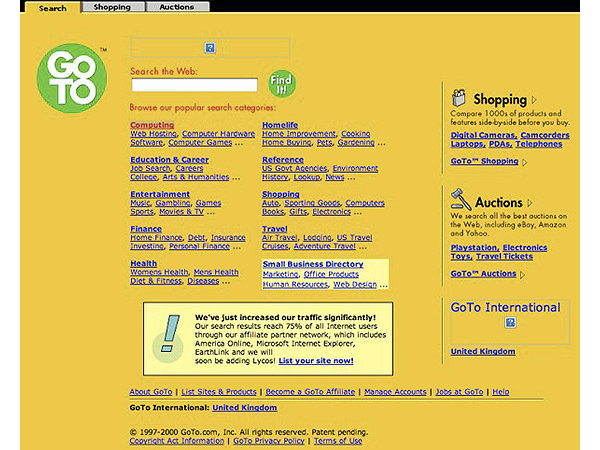
The original cost-per-click (CPC) search engines did their listings strictly by what you were willing to pay per click.  (I actually used Goto.com for CPC listings, before it become Overture Services, before it became Yahoo! Search Marketing.  Nothing like Internet time to make one feel old).

500004804-03-01

Yes. This was once a thing.  A big thing.

Google’s algorithm, however, takes the quality of the ad and the site into account.  This is partly because you will come back if you have positive experiences on the site and partly because it maximizes profits.  For the same reason that you would look at gross revenue per mail piece/phone contact/email/carrier pigeon instead of just response rate in isolation, Google looks at gross revenue per ad shown as the backbone of its infrastructure.

Thus, it is in your interest to maximize your click-through rate (except in one very special case I’ll discuss on Friday); you can pass your better bidding brethren by beating them on quality.  Hence the focus on things like negative keywords and phrase matching yesterday: you want to get your clicks on as few ads as possible.  An average quality score from Google is a 5.  If you are at a 10, your cost per click goes down by 50%; if you are at a 1, it goes up by 400%.

Targeting smarter also helps you get clicks from the people from whom you want to get clicks, instead of those who didn’t understand what they were getting into from your ad.

So here are a few techniques to help get to the next level of pay-per-click success:

Check in on your keywords regularly. This should be at least weekly; daily would be better.  It doesn’t have to be for long, but Google will keep giving you helpful tips on additional strategies and keywords to try.  You can also see what is performing and what isn’t, retooling ad copy for underperforming ads and learning which landing pages aren’t converting as well.

Set up conversion tracking.  In the beginning, Internet advertising was sold in CPM – cost per thousand impressions and the earth was without form, and void.  Then came CPC – cost per click – where you pay for an action, rather than a view.  The ultimate is going to be cost per conversion, where you only pay when you get a donor (or other person you are desiring), and you can set your goals accordingly.  Companies won’t want to do this because they have to rely on you to convert, rather than themselves, but it is semi-inevitable.

You can have this advantage right now if you set up conversion tracking.  You will be able to see how many people convert and, if they give donations, how much you get from the campaign.  Seeing how much you get from a campaign ahead of time, then bidding, is like playing poker with all of the cards face up – it’s remarkable how much better it makes you.

Unbounce your page.  Not every page converts well.  With conversion tracking set up, you can tell if your page is repulsing potential constituents.  Testing with Google solutions or a solution like Optimizely can help you convert more people and lower your CPC costs as your quality score goes up.

Set up dynamic keyword targeting.  A person is more likely to click an ad that has the exact words that they put into the search engine in it.  The trick is that people put all sorts of things into search engines.  With dynamic keyword targeting, it doesn’t matter if they put “rainforest deforestation,” “rain forest deforestation,” “tropical forest deforestation,” “destruction of the rainforest,” “tropic rainforest deforestation,” etc., into the search bar, you can add those specific words into your ad.

Geotarget your ads.  This is especially true if you are a nonprofit with a limited geographic reach.  If you are an early childhood intervention provider in Dallas, you likely don’t want Seattle searchers.  However, this applies even to national and international nonprofits.  If you have chapters, or state-specific content, you can direct those specific searchers to the area more relevant for them.  This works especially well for things like walks and other events, where people will likely only come from a certain distance around to the event.

Go for broke.  If you do get a Google Grant, try to use every cent.  Not only will it get you more traffic, more constituents, and more donors, but it will also allow you to apply for more money.  Your first steps to worldwide nonprofit domination await.

I hope these are helpful.  Please leave any tips you’ve found useful in the comments section below.

6 intermediate cost-per-click techniques

The basics of Google AdWords and Google Grants

I’ve mentioned the need for you to get a Google Grant before.  If you haven’t yet availed yourself of this in-kind contribution of advertising, go for it now – getting that will be significantly more important than anything I write in this post.

Once you have this great tool, here are the basics to get you started with AdWords.

First, find the pages to which you want to drive traffic.  These should be pages that convert – pages that aim to turn a visitor into a constituent.  These include donation forms, surveys, gated white papers, advocacy alerts, pledges – anything that gets someone to put in their email address and opt in.  If it doesn’t have an opt in, you don’t want to set traffic there – your goal is to convert, not to inform.

Then, start writing your keywords.  There’s a good blog post on the types of keywords to start with here.

Once you have you a few basic keywords and your AdWords account set up, it’s time to get suggestions for additional keywordsGoogle’s Keyword Planner is a good way of thinking about phrases and other terms for what you’ve already put in.  In fact, you can put in the URL of your landing page and Google will make suggestions for you based on what is on the page.

The ideal keywords are ones that are searched very frequently and cost very little.  Because there is free market bidding, however, price usually correlates to search volume (but also to the things that people can make money from).

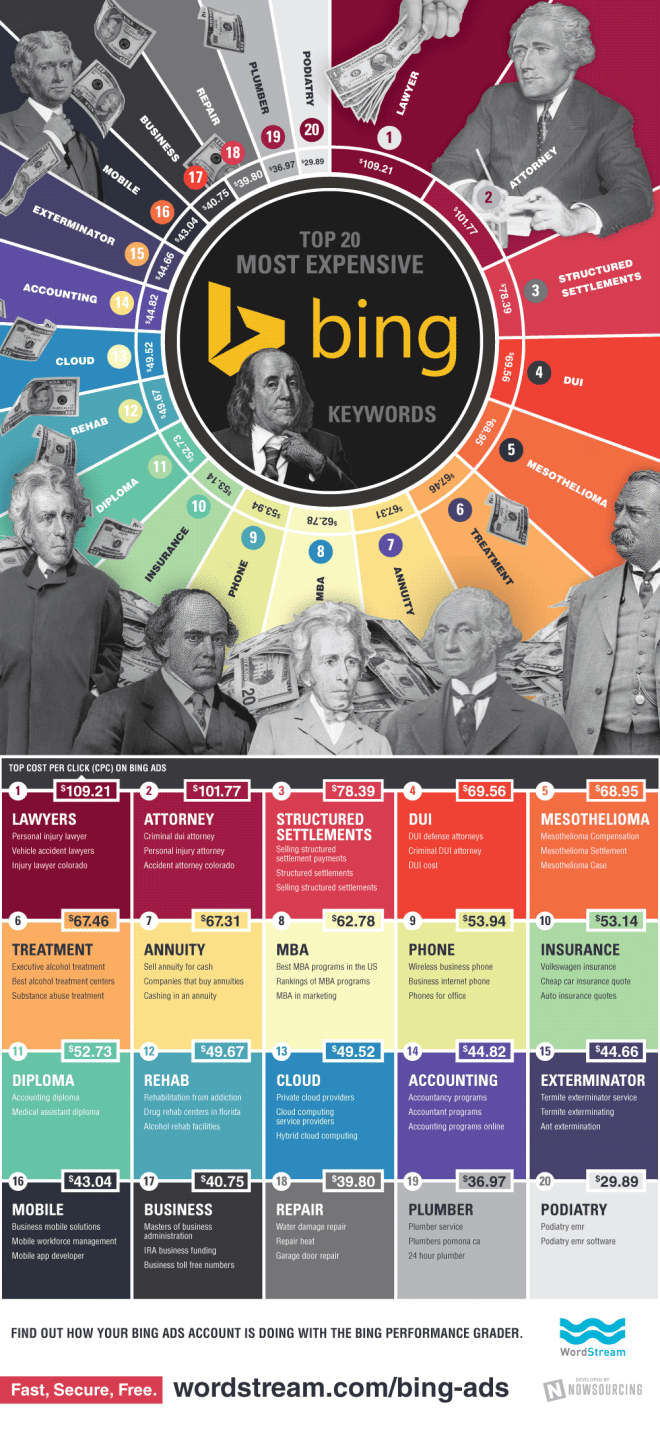
As you look through search terms, you should be selecting not only what you are going to use, but also what you are going to actively avoid.  For example, looking at Bing, the most expensive two search terms are “lawyer” and “attorney” (the fact that these aren’t the same seems like an arbitrage opportunity, but I digress).  Number four is “DUI.”

most-expensive-bing-ads-keywordsThanks to Wordstream for the great infographic.

Obviously, being a DUI attorney/lawyer is really profitable, to the point that you are willing to pay $70-110 for one click to get someone to your site.

If you are Mothers Against Drunk Driving, you don’t want to play in that same pool.  You believe (and this may be shocking to some) that the easiest way not to get convicted of a DUI is not to drive drunk.

So you need to use negative keywords.  These are words that you put into your search terms with a minus sign in front to make sure that you are not bidding on searches that include that term.  MADD might, for example, bid on DUI, but have lawyer and attorney as negative keywords.  These function similar to a suppression list; even if a search does have the positive keywords in it, it will not show the ad if there are negative keywords included..  Generally, you want to decide whether you want to use a term (bid on it) or not to and negate it out, with little wishy-washiness.  Wordstream has a negative keyword generator here that can help out.

You will also want to look at phrase match and exact match.  The former will match if the phrase is in the search term with no intervening terms; the latter will be shown only if the person searches exactly for that one term.

Once you have your keywords, you will want to organize them into campaigns and ad groups.  Generally, ads will perform better if they have similar words to the search itself, so if the person searches for DUI, they get a DUI, and not a drunk driving, ad (and vice versa).

These will help you start with AdWords.  Google also has excellent tutorials here.

Tomorrow, we’ll go a bit deeper, into how Google judges your ads and how to increase your listings without paying more.

The basics of Google AdWords and Google Grants

Acquire your own online donors

I know, it’s an odd title.  But every year, 30% of your online constituents go away not because they aren’t interested in you anymore, but because they changed their online contact information.  Seventeen percent change after six months.  That means that the half-life of your list is less than two years.

halffull.jpgIt doesn’t matter if it’s half full or half empty, just that it’s half of what it was.

This is going to be online acquisition week and I’ll go through a lot of tactics for bringing folks into your organization online.  But because of this, the best and the easiest way to acquire new online constituents is not to lose the old ones.  Conversely, it doesn’t make sense to start acquiring new online people if you aren’t ready to keep them.

So we’re going to go back to that old saw: data hygiene.  If you don’t believe in the necessity of data hygiene, then there’s a PSA you need to read.  We’ll look at the online specific ways to keep your data clean.

Scrubbing user-entered data.  Users will misspell their own names, then blame you when you address them by that wrong name.  Email addresses are no better, but those at least have a standard format that you can check.  Hopefully, you have an email validator on your forms, but you probably have data that predates your validation.  Some things to look for:

  • Does the email address end with a top-level domain (e.g., .com, .gov, .net, .org, .edu, .mil, or a country code)? Many an email has bounced back because it went to aol.con.
  • Does the email address have an @? If the email has a ! or # in it, chances are that, because these are right next to the @ symbol, @ is what was intended.
  • Does it bounce? That is, when you send the email, does it come back to you?  This is one reason that it’s important to send your email from a real email address – so you can change bounced emails or mark them for further work.  (Also, a real email address will help with charges that you are spamming people).

Put an email validator on your forms if you haven’t already.  Just to make that perfectly clear.

Run an ECOA service.  ECOA, or electronic change of address, is a service that functions a bit similarly to the national change of address (NCOA) registered with the USPS.  These services look at innumerable services across the Web to determine where a person might have gone.  You should ideally run both bad email addresses and email addresses that have not opened an email in a certain amount of time (say, six months).  If they haven’t opened an email in six months and they have a good email address…

Suppress chronic nonresponders from most emails.  If people aren’t opening your emails continually, they won’t miss you not sending emails (and, when you do send a very occasional email, it will be a bit more of a surprise).  And they won’t drag down your open rate or mark your emails as spam, making you more likely to survive email providers spam filters.

E-append your file.  Take your offline donor file and give it to an e-append service; they will return email addresses of people who would probably like to interact with you online, but haven’t yet given you their email address.  This also works like ECOA for bounced and non-opening addresses.

This isn’t going to stop your attrition from bad email addresses.  But it will help you hold on a little longer to the people who want to hear from you.

Acquire your own online donors

Breaking down your thank you silos

As mentioned on Wednesday, there are a few different ways to thank your donors.   Thanking donors well, as we know, increases retention, average giving, and good karma in the world.

That said, we too often treat the way someone came into our organization, or the way they made their gift this most recent time, as the entirety of who a person is and how they are going to interact with our organizations.

Most donors have some combination of a mail box, an email box, a phone, a mobile phone, social media accounts, and more.  Yet we insist on assume that mail donors gonna mail checks, walkers gonna walk, phone-ees gonna give over the phone, and haters gonna hate.

If I were to create the stone tablets of nonprofit direct marketing, “Origin ≠ destiny” would be only slightly below “test everything” on the list of commandments.  Of course, I’m not going to create stone tablets, because we tested out of that in ancient Egypt.

It is certainly true that someone who started by donating through the mail is more likely to donate through the mail than someone who has only donated online.  This is because these two people have proven responsive to these two media.  However, it is not true that the mail donor will donate only through the mail.  It’s not even true that the mail donor prefers to donate through the mail – their origin may just have been how you reached out to her first.

Much is invested in creating multichannel donors – e-appends, email captures, telemarketing campaigns, mail conversion series, etc.  Yet we continue to acknowledge offline gifts offline and online gifts online and rarely the twain shall meet.

This is a pity because, while you will receive phone calls if someone is oversolicited by channels they didn’t want to be solicited through, you will rarely receive angry calls resulting from thanking someone too much.  Try to count the number of times someone has yelled at you “YOU ARE BEING TOO DAMN APPRECIATIVE OF MY SUPPORT!”.  If that number is existent, it’s at maximum finger-countable.

So I’ve just started trying some of these and while the juries are still out, early results are showing that they are bearing fruit.  This is in part because some of these are so darn low cost, if you can get the system right up front:

Thank your mail donors by email when you have the email.  I mentioned on Tuesday that speed of thank you is a key predictor of future support.  Let’s say that you are working with a caging vendor that will get acknowledgments out the day after the gift is received.  Chances are you aren’t going to improve significantly on that.  While neither snow nor rain nor heat nor gloom of night stays these couriers from their appointed rounds, neither will these or any other disaster or incentive get them to speed up.

But what if at the same time as your caging vendor sent the letter, they also triggered an email to the donor that said “[Name], thank you so much for your [amount] gift.  We just got it and you are already [the great thing your cause does].  You are going to get your official receipt and thank you in the mail in a couple days, but I couldn’t wait to tell you how much your support means to all of us here at [organization].”

Send an outbound voice mail as a thank you for online and mail gifts.  This is another way to get thank you’s out quickly when you have a phone number for the donor.  This also works for event donors.

Have a mail-based welcome series for online donors and/or constituents. There’s no reason a thank you and welcome needs to stop at the edge of the Internet.

Send a post-event package or series for your event participants.  This will help those participants go beyond donating just to the event and forging a deeper tie with your organization.

Thank you for reading.  Please leave other ideas for multichannel thank you’s in the comments, so we can all learn from each other.

Breaking down your thank you silos

There must be 50 ways to thank your donors

  1. Write them a letter, Eddie Vetter.
  2. Send them a birthday card, Renard.
  3. Remember them on important holidays, Rutherford B Hayes.
  4. Acknowledge their support on important dates like their first gift’s anniversary, Mercy.
  5. Thank them with a prerecorded outbound voice message, Fezzig. (If you can’t tell already, not all of these rhymes are going to be winners…)
  6. Try that prerecorded outbound voice message to see if it will increase fulfillment rates among your telemarketing pledgers, Medgar Evers.
  7. Handwrite them a note, billy goat.
  8. Send them a copy of your annual report with a kind note and their name circled, Erkel.
  9. Make a personal call, Saul.
  10. Ask them to volunteer, dear. (Yes, really, some of your donors may want to become more involved in your organization)
  11. Thank them in person, Orson.
  12. Have a special area/table/zone for them at your next event, Clark Kent.
  13. Send them a member card, Jean-Luc Picard.
  14. Invite them to special briefings that are only for a member, December.
  15. Create a specialized donor thank you newsletter, Irish setter.
  16. Send them a copy of a book written by one of your in-house experts, Howard Kurtz.
  17. Create a year-end statement of their giving and the impact it has made, Sade.
  18. Use a survey to get their thoughts, Don Knotts.
  19. Ask your ED or another luminary to write a card in blue ink, then to make it look handwritten in bulk on a budget, run copies of it on the color printer, Harold Pinter.
  20. Conduct donor telephone calls in a town hall style, Kyle.
  21. Write quality stories, Jason Vorhees.
  22. Make high-quality and personalized online after-action pages and automated emails, Outlaw Josey Wales.
  23. Send them a staff white paper, Don Draper.
  24. Create a personalized support statement in infographic form, Norm. (NORM! How’s it going out there, Norm? It’s a dog eat dog world and I’m wearing Milkbone underwear (laughter from studio audience))
  25. Have excellent donor service, Neal Purvis (screenwriter on six James Bond movies. If you already knew that, you might be interested in one of my books here).
  26. Write them memos about the impact they’ve made and what is left to be done, hon.
  27. Send them pictures about the impact they are making and not of someone handing someone else a giant check, Beck.
  28. Welcome them strategically with a cross-channel series, Aries.
  29. Invite them to share their personal story, Rory (aka Mr. Amy Pond).
  30. Ask for why they give and personalize your thanks to what meaning to them, Clem.
  31. DM them on Twitter, Senator Vitter.
  32. Send them a letter that is written by someone whose life they’ve changed, Danny Ainge.
  33. Wish that the song was about 30 ways to leave your lover, Crispin Glover.
  34. Shoot a thank you video, Hideo.
  35. Throw a donor and volunteer appreciation party, Aarti (Sequeira of Food Network fame, of course).
  36. Ask them to vote on issues where you can live with any of the selections like member card design, Robert Irvine.
  37. Have a donor appreciation wall at your headquarter, Michael Porter.
  38. Message them on Facebook, Captain Hook.
  39. Make it easy for them to tell others about their support, Queen Consort.
  40. Honor and make sure they know you honor their particular and individual connection to your cause, Santa Claus.
  41. Have a phone bank thankathon from your employees and volunteers, Mouseketeers.
  42. Talk to them about the meaning they are giving to people’s lives, Douglas Adams.
  43. Call them for their opinion, Virginian.
  44. Send them an impact-focused news clipping, Rudyard Kipling. (Do you like Kipling? I don’t know; I’ve never kippled.)
  45. Invite them to hear, online or in-person, a guest speaker, Bunson and Beaker.
  46. Thank them with a celebrity if you have one connected to your nonprofit, Stephen Moffit (again, if you know who this is, one of my books might be up your alley).
  47. Reach out on Mother’s Day, Father’s Day, and/or Grandparent’s Day, depending on their gender and age, Larry Page.
  48. Send a February 14th valentine to the donors you love, turtle dove.
  49. Allow virtual access to whatever form of annual meeting you have, be it a conference, jamboree, or lobby day, Auntie May.
  50. Above all, write from, and to, the heart, Bart.
There must be 50 ways to thank your donors

Turning on the online spigot

You have the forms, but now you need the traffic. Well, it’s important to remember that Field of Dreams was a work of fiction – building it is not a sufficient condition for people coming.

To start, you do have Google Grants don’t you? If not, we’ll wait right here while you apply.

(pause)

So, how about that local sports team? I heard they won or lost yesterday. That coach is a genius. Or should be fired.

(pause)

OK, you’re back. I’ll talk more about Google Grants in the future, but suffice it to say it’s a great way to start acquiring warm leads. There are limitations like the $2 cost-per-click maximum that chaff some in the nonprofit world, but try applying for this free money from Bing or Yahoo and you’ll find it doesn’t exist.  So $2 CPC it is.

As part of your Google Grant process, you need to identify some keywords and phrases that are important for your organization.

To do this, you will have to speak like a human being. There is a cognitive bias known as the curse of knowledge – once you know something, it’s really hard to act as though you don’t know that thing. Or, as the original authors of the paper describe it:

“In economic analyses of asymmetric information, better-informed agents are assumed capable of reproducing the judgments of less-informed agents. We discuss a systematic violation of this assumption that we call ‘the curse of knowledge.’”

There is a wonderful irony in this definition.

Anyway, in order to determine how people will find your wonderfully constructed conversion forms, you need to think like they will think. One example is from MADD. The organization teaches that there is no such thing as a drunk driving accident – that each crash is 100% preventable and that drunk driving is a violent crime.

Unfortunately, that’s not how people search for the terms.  Google Trends searches for drunk driving accident are in red; searches for drunk driving crash are in blue:

drunk driving accident crash

So MADD has ads set up for both accident and crash – they won’t say accident in their copy (ever), but they meet people where they are searching.

The same terms that you are advertising on with Google Grants should also be terms that you use in the page that you are looking to optimize. Not only will it help people convert once they come to the page, but it will also improve your performance for those terms in search engines. If you have partners in the space, be sure to link their pages and vice versa. This will increase your traffic and improve your search engine listing as well. There are a number of additional tips for optimizing for search engines that will cover at another time.

If you are developing and driving traffic to your online funnels and communicating with them regularly by email, you’ll have a better idea of what messages work for your audience and what don’t. From there, you can get a feel for whether a more robust direct marketing effort can further increase your net income. And remember, mo’ money means mo’ mission.

Thanks for reading. Please be sure to comment on this first week of blogging below, so that I can better write for your needs and thank you for your support!

Turning on the online spigot

Setting up your online acquisition funnel

Funnel is a bit advanced for what we are going to be doing today. What we mean is “how do we convert traffic to supporters?”

The earliest Web sites were little more than brochures. After all, when you don’t yet know what to do with a new medium, you replicate what worked in the old medium, like generals who continually fit the last war. There was the information and then there was a contact us link. Unsurprisingly, early Web sites were not conversion machines. That and they still used frames and the blink tag.

You, however, are more sophisticated than that. You know that someone that you know and have as a constituent of some type with permission to communicate is far more valuable than someone who simply comes to the Web site once.

Speaking of, did you know you can sign up for this Web site’s email list? Right here, in fact! You’ll get a weekly summary of these posts.

Anyway, you need to be able to get constituents through your Web site. And, since it’s still free-direct-marketing-program week, you need to do it without cost. So what ways can you get emails?

  • Specifically, you want to tell the prospective signee what is in it for them to sign up for emails. If you can link to a good sample email so they can see for themselves, so much the better.
  • Downloadable materials. Whether its program materials or factsheets, you probably have things on your Web site for people to download and print. You can gate these products by asking for a person’s information at this point. (You can also put in a “no thanks; take me to the material” link in there if folks are worried about cutting off access to information)
  • Petitions, pledges, and the like make people feel involved and given them an excuse to get their friends involved in the mission as well. Moreover, while these are an acquisition technique, they are something that makes your new constituent already feel a part of your organization.

There is a common question as to how much information you ask for on these forms, to which I would ask “How much do you need?” Know that generally every additional form field decreases the likelihood that someone will fill out the form. So, thinking of a petition, you logically need first name, last name, email, and state (so that it can go to the right representatives). If you are doing an email action alert to state legislatures or Congress, you may need a full address to make sure you are getting it to the right legislator(s). It’s rare that you would need more than that initially.

Before you turn on traffic to these forms, be sure to have some sort of tracking system set up to measure what percent of people are converting on your firm. If you want free, Google Analytics can be set up. Ideally, you’d also be able to do A/B testing, but the best tools for this involve money, so that’s a different week.

So now you are ready to have traffic come to your site. That will be tomorrow’s post.

Setting up your online acquisition funnel