Using your real estate better: reply devices

When people in your organization review a mail piece, people expend sound, fury, and energy on the teaser copy, the word choice in the letter, and the photographs used.  

But I bet you could send around a reply envelope with the wrong return address on it and have no one notice it.  I’ve actually done this test, albeit unintentionally; I am not immune.  I caught the error in the final proof process, meaning I missed it twice before.

This is where you, as the direct marketing expert, justify your salary.  Anyone can go through a letter with a red pen and choose their own favorite words.  You get to do the unsexy things that will get results.

And the reply device is probably the unsexiest thing in mail, which is saying something.  If your mail piece were the crack spy team, the reply device would the guy in the van.

573-20091

“You know what? I’m sick of being in the van. You guys are going to be in the van next time. I’ve been in the van for 15 years, Harry.”

— Gib,  True Lies

It’s also where a mail piece is one and lost.  And it’s a place where you can implement your priorities where no one will yell boo.

So, some ideas:

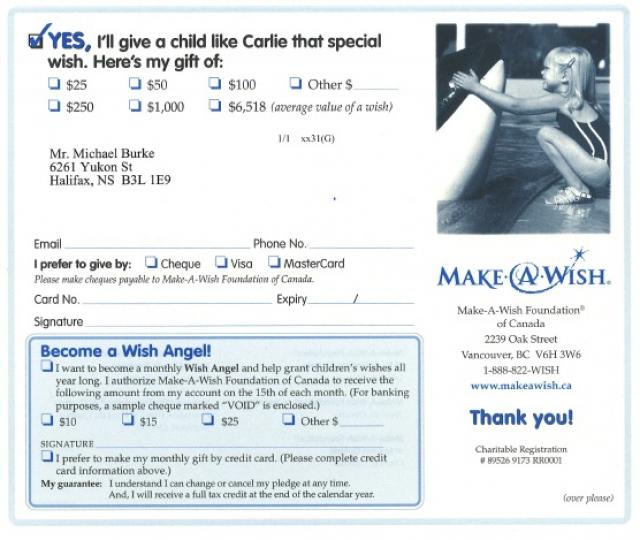
  • Anchoring.  We’ve talked a bit about this here and the science of ask strings here.  However, there’s a wonderful SOFII article about the making of a mail piece here  that explains the below the reply device.
    art_51_reply

    Did you notice the $6518 option?  Not only is that a nice high anchor that people are giving toward, but they find that some people actually give that.  From the SOFII piece:

    There is, however, one twist: there is an option to donate a sum of $6,518. We put that figure in because it is the actual average cost of granting a wish. Every now and then, when I’ve done that before, you find a donor who is willing to donate at that level. We did this once for a hospital when the price point for a piece of equipment was $6,942.73. Thirteen people “bought” this device. These donors upgraded from an average of $65 to nearly $7,000. It never hurts to ask.

    Good for you, Make-A-Wish!

  • Ask for more information about a donor.  Your mind must always be in two places about a donor or prospect: where they are now and where there are the possibilities of them going. One opportunity is for this donor to become a multichannel donor; to do that, you need an email address or phone number.  And, while you can append these data, this has costs both in money and in not learning what method(s) by which your donor wants to be contacted.

  • Ask about other opportunities.  Would this donor be interested in more information about becoming a monthly donor, leaving your organization in their will, or donating a used car?  You will never know unless you ask.

  • Customize based on what you already know.  Usually, reply devices are mass printed, which seems to be a missed opportunity.  If you already have the person’s email address or phone number, you shouldn’t ask again.  Likewise, if someone has ignored your checkbox for planned giving five times in a row, perhaps a monthly giving offer is more her/his speed.

There’s also the reply envelope; if the reply device is the guy in the van, the envelope is the guy in the van’s intern.  Usually these are blank.  However, messaging on the envelope can:

  • Reinforce the person’s decision to donate with trust indicators like the BBB seal.
  • Build urgency with messages like “Rush this envelope to save lives.”
  • Spread program awareness (e.g., “If you or a loved one has been affected by X, please call our hot line at 800-XXX-XXXX”)
  • Help with the program allocation of your mail piece in joint cost allocation.  (For those not familiar with this procedure, you should be looking at each of your pieces and determining what percentage of this content is for each of your programs and what is fundraising for the purposes of your tax returns.  Additional program messaging on the envelope gives a slight boost to the programmatic content.)

Just because the reply mechanisms don’t have as much messaging doesn’t mean that you still can’t make them work for you.  Hopefully, these tips have helped you customize your reply so that you can get more replies.
Using your real estate better: reply devices

Using your real estate better: customization

One of the very few useful concepts I remember from undergraduate economics is the difference between fixed and marginal costs. This is in part because I was taught in the pre-behavioral economics days, so the world the equations described was entirely unfamiliar to me.  But it’s also because this difference reverberates for me even today.

To review, the difference is what you have to pay regardless of the scope of the project (fixed costs) and what you have to pay per quantity generated (marginal costs).  If you want to send out a mail piece, the copywriting costs are fixed — they are the same regardless of whether the piece goes to one or one million.  But the paper, postage, etc., are not.

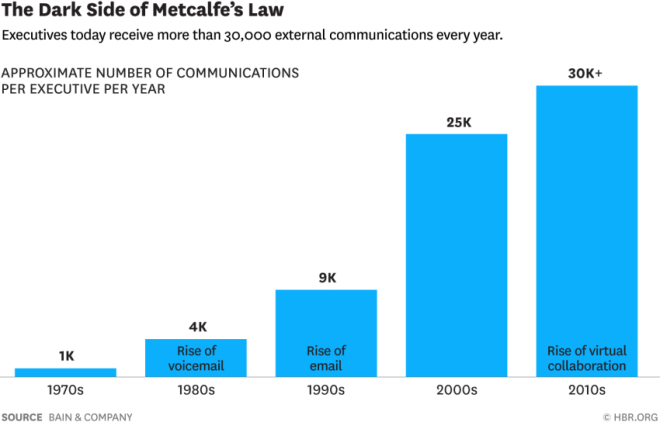
For implications, think of Metcalfe’s law that the value of a communications network is proportional to the square of the number of users connected to it (which is why Facebook will be hard to dislodge — it’s tough to leave a place where all of your friends are).  A recent HBR article showed the dark side of this law when the marginal cost of some communications are so low:

w160219_mankins_darkside-850x544

It’s tempting to look at this graph and say “30,000 messages?  Sounds like Thursday.”  And that’s the challenge — we are inundated as consumers and inundating as marketers.

This means we want to maximize the real estate that we have in our communications.  While we have a constituent’s or donor’s attention, we want to milk it for all it’s worth.

pch-sweepstakes-partsOften, this is done crudely.  When a direct mail envelope is stuffed with so many offers, buckslips, and tchotchkes to make a 1980s-era Publishers Clearing House mailing blush, the effectiveness of any one offer is diminished and the ask can often go missing.  

(Incidentally, the modern Publishers Cleaning House is a great transitional story; look at this case study for a quick idea of just the social media side.)

Similarly, many email newsletters look like nonprofit Christmas trees, where every department wants to hang a few ornaments on them.

But this week, we’re going to explore some untapped resources and hidden gems — places you can put content that are both impacting and low (marginal) cost.

And, since every blog post should have at least one good tip in it and not be full of just introductory material, one of the biggest and easiest of these is:

Customization

When you decide to send a mail piece or make a phone call to a person, the vast majority of the costs of that communication are already incurred. Then, it’s just a question of what you put into that communication.

True, there is an additional cost of customization.  But once you customize anything in a phone script or on one side of a letter, the marginal cost of adding in additional customization is almost nothing — maybe some additional data costs.

The return is almost always positive.  And, since the alternative to getting additional revenues is likely communicating more, which incurs additional costs and has diminishing returns, it’s a preferred route.

So here are some ways to customize your communications that will let your donors know you know them and increase their receptiveness to your appeals:

All of these can cost you little, but bring you significant results.  This is what we’ll shoot for for the rest of the week, so if you don’t think you’ll be back, please sign up for our weekly newsletter here for a digest of these tips and tricks, plus some secret subscriber benefits.

Using your real estate better: customization

Microtargeting and the ABCs of customization

Microtargeting is most often thought of in the political realm, where increasingly granular models are able to predict how people are going to vote and think about various issues.  A good example is how Ted Cruz won Iowa: by microtargeting the interests and issues of voters down to fireworks regulation.

But you don’t have that type of time, budget, or modeling power.  Yet you still want to connect with your donors in ways so that they know that you know them.

Enter the poor person’s microtargeting.  We’re going to slice and dice our control letter in such a way that there’s something in it for everyone.

The important thing to remember is that the cost in customization is largely in customizing one side of a piece of paper in the mail.  Online, it’s virtually nothing.*  There can be some data costs, but while the maximum customization approach below may churn out thousands of different combinations of letter, it still is all very simple variables acting predictably.

So here goes the ABCs approach.  Try as many of these as you can on your appeals and see how different one person’s would look from another:

Age:  Does your older donor want a larger font size?  Different levels of formality?  Two spaces instead of one?  Including the Oxford comma?

Buckslip: What could you put in the envelope, based on what you know about the donor that would make them more likely to donate?  Remember, you don’t have to have it for all donors, just some…

Channel responsiveness: Don’t ask someone for their email if you already have it.  But do sent them an email that support the mail package they just received.

Donation history: Putting last gift in the upper right can help bring back lapsed donors

Event history: “You wanted with us to cure X.  Now we need your help again.”

Frequency of giving: If someone is giving 4+ times per year, might now be the time to ask about that monthly giving program?

Giving history: “your gift” versus “your gifts.”  Also, have they given the same amount year after year?  You probably don’t need to push the upgrade.  However, if they’ve been steadily rising, go for the gusto.

History with this appeal: “As someone who supported our matching gift campaign in the past…

Initiation: “your support has helped X over these past Y years” or “since you joined X years ago.”

Jargon: J is tough, so a reminder to go through your letter and remove anything that sounds like a great buzzword to you, but gobblygook to those outside your organization.

Knowledge: How much explaining do you do?  Is it the same amount for someone who has read 50 letters as someone receiving their second?  

Location: “we’re looking for seven dollars from XXCityXX willing to chip in…”  This works.

Mission area supported: tie your ask to what they want to support.

Nicknames: Does your letter sound like it was written by C3PO: “Dear Dr. Lt. Col. R. Winthrop Huntington III, MD (ret.),”?  If you tell by his checks that he actually goes by Bob, do you want to try saying “Dear Bob”?

Online activity: Mention they were a petition signer as an inducement to get them to sign an offline petition.

Postage: Send your most valuable donors’ mail first class.

Questions they’ve answered: The letter of someone whose survey said they thought it was most important you educate young people should look different from the one who said you should be advocating for better laws as a top priority, no?

Rhythm of pieces: (aka cadence, but I already had a C).  Should this person even be getting this piece or are they likely to make a gift without?

Single versus multi: With singles, you can switch up the ask string. Much harder to do with multis.

Tchotchkes: Are you sending premiums to everyone?  Even those people who have never responded to a premium?

Unique URLs: Not necessarily personalized URLs, but different URLs for different messaging so you can see what creates the greatest online response.

VIPs: If someone is a member of the “Founder’s Circle” or the “Legion of Good Deed Doers” or whatever it is you have, are you referencing that?

Wealth screening: You can do a higher-dollar treatment if you know a person has the capacity to make a larger gift.

seX: You didn’t think I was actually going to get a real X in here?  Appeal to women’s emotions in your ask and to men’s self interest

You: I’m cheating with this, because it’s not a customization.  But it does give me the opportunity to quote Jeff Brooks’ sample fundraising ask letter, which makes me happy:

Dear [name]:

You. You. You. You. You. You. You. You. You. You. You. You. You. You. You. You. You. You. You. You. You. You. You. You. Yes, you. You. You. You. You. You. You. You. You. You. You. You. You. You. You. You. You. You. You. You.

Sincerely,

[Signature]

P.S. You. You. You. You. You. You. You. You. You. You. You. You.

Instructions: Liberally sprinkle in nouns and verbs. Use adjectives and adverbs sparingly. Include specific examples of what the donor’s gift will accomplish. Include true-life stories that demonstrate the need for the donor’s involvement. Be sure to clearly and articulately ask for a gift more than once.

Someday, I’ll write a blog post that good.

Zip selects:  Increase your ask string multiplier if they are from a wealthy ZIP code.


* Get it?  Online?  
Virtually nothing?  I absolutely slay me.

Microtargeting and the ABCs of customization