Scope insensitivity and direct marketing: why one beats many

There is a famous study in nonprofit marketing that shows that an appeal that tells the story of a child does better than an appeal that tells that same story with information about the general problem of poverty in Africa. Even more oddly, a story of one boy did as well as the story of one girl; both did better than the story of the boy and the girl. The study is here and it is both fascinating and disheartening.

We humans think in simple narrative. We are used to hearing a story of a person (then using availability bias, which we talked about, to generalize). When we hear the story of a person, we react to it with emotion and affect. When we hear the story of many people, we react to it with logic and calculation. Or as Stalin put it: “If only one man dies of hunger, that is a tragedy. If millions die, that’s only statistics.”*

engaging-millennials-as-organ-donors-june-13-2011-35-728

Image credit here. Odd that Stalin and Mother Teresa had similar sentiments on this. And I don’t think anyone has ever seen them in the same room at the same time…**

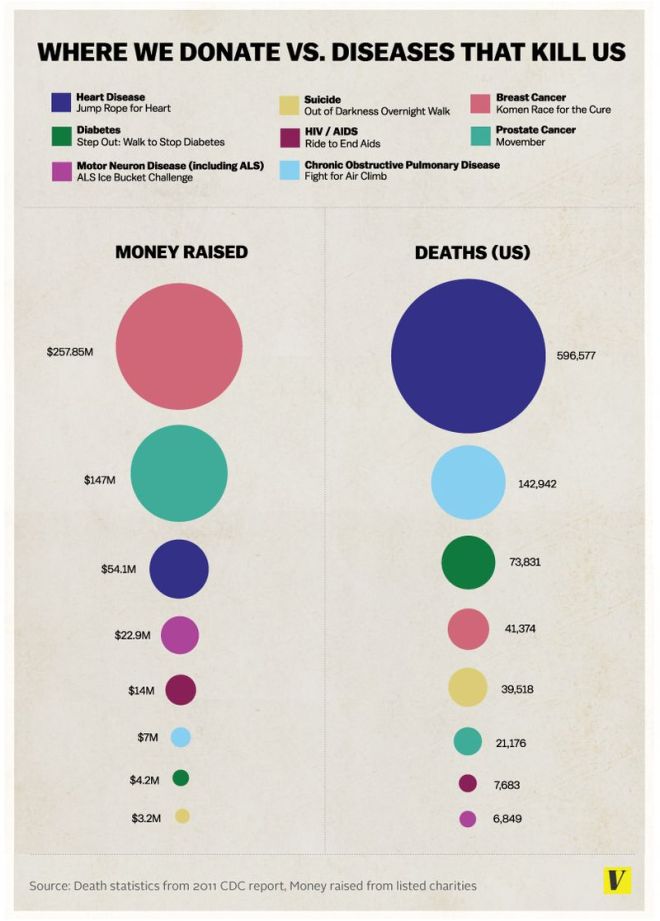
Unfortunately, this leads to us (in theory) misallocating our resources. Vox did an illustration of the types of cancer people donate to, versus what they die of.
fundrasing4disease

Image credit here.

This seems to focus on special events and looks at one organization per disease, so it isn’t perfect but is emblematic of this problem. In 2010, the humanitarian aid response to the Haiti earthquake (which affected 3 million people) was more than 3 billion dollars. The flood in Pakistan (which affected an estimated 20 million people) received only 2.2 billion dollars. (study here)  People donate relatively the same amount to save 2,000, 20,000, and 200,000 birds.

So the rule you could get from this is to tell only one story at a time. Which is not a bad rule.

However, your organization likely has a scope you want to achieve. You don’t just want to help one person. You want to help one person, then another, then another, etc., until your problem is solved and you can take up golf or something.

So how do you talk about scope without turning off your donors?

One way is to talk about scope and statistics, but to do it with the right donors. I would point you to the post I did about a month ago about the study that shows that statistics depress response among smaller donors, but increase it among larger donors. Thus, you can save it for the right audience.

Another solution that was interesting to me came from a study in the Journal of Consumer Research

At first, they just found what we’ve been talking about: single identified victim works better than large numbers of victims. Scope blindness in action.

However, you can get people to donate more to large numbers of victims if the victims are seen to be entitative.

This was the point in reading the study that I had to pull out the dictionary. I thought that entitative meant “similar to a walking talking tree from Lord of the Rings.”***

In reality, “entitative” means how much people consider something to be a coherent whole. This can be helped by group membership. In the study, they found that donations to help children were greater when the children were part of the same family, instead of random so-and-sos.

Similarly, they asked about saving butterflies, showing butterflies either flying randomly (low entitativity) or together (high entitativity). The butterfly flock (is that a thing?) raised 69% more on average.

They also found when that in-group had positive qualities, people were more likely to donate. Specifically, when the starving children in Africa were said to be in the same prison, rather than the same family, the group dynamic hurt donations rather than helping them.

So if you are going to talk about multiple people, try to frame them as part of the same in-group and make that in-group as positive as possible. Then, and seemingly only then, will you be able to tell more than one story and get more donations instead of fewer.
* I’d heard a different pithier version of this also (one where if you kill one person, you are a murderer; if you kill a million, you are a conqueror). However, this one seems to have the greatest basis in fact according to Quote Investigator.

** This is a joke, of course. This seems obvious, but one can not be too careful on the Internet. Clearly, Stalin is the evil twin of Mother Teresa.

*** Yes, I know that the ents aren’t really trees. They are treelike guardians that take on the shape of the trees they herd. But I’m trying to get everyone to read to the end of this, not just people who are as nerdy as I am.

Scope insensitivity and direct marketing: why one beats many

Availability heuristics and direct marketing: what we remember easily is all there is

Today, we’ll look at the availability heuristic. Availability means if you can recall an example of something happening, it must be as or more important than something that you can’t easily recall happening.

A classic example of this from the literature is people overestimate the number of words that begin with the letter R. They also underestimate the number of words where R is the third letter.

Or, similarly, some people will say there are more six-letter words that end in “ing” than end in “g” (which is impossible). We can easily recall things that begin with R or end with “ing.” That’s how they are filed in our brains; thus, we think it happens more often.

This can affect how our causes are seen by the public. Quick: how many people are killed by drunk driving versus cell phone use while driving?

Got your answer?

In 2013, the last year for which we have data for both causes, drunk driving killed 10,110 people in the United States.

Cell phone use and driving killed 445 people

Chances are, if you are like most Americans, you thought these were about equivalent. You almost certainly did not think these two numbers were more than an order of magnitude different.

Why is that? Because you can look at the car next to you at a stoplight and see the driver is texting. It is far more difficult for you to look at the car next to you and see that the driver is drunk. And so our availability heuristic can easily recall cell phone use and driving and that gets moved up in our mental queue.

Incidentally, both are dangerous. If you are reading this on your phone while driving, please stop now.

So how can you use (or mitigate) this effect in your nonprofit direct marketing? The biggest example is take advantage of news. Disaster fundraising is in part successful because it speaks to a desperate, urgent need, and partly because it reminds people that those needs are with us. Similarly, if your issue is in the news, most people think to reach out via fast means like email and text messaging. However, we don’t often think to swap out our telemarketing scripts or send out a direct mail piece for an urgent issue. One solution is to pre-print appeals. You can have stationary with a reply device on hand. If there is something urgent that comes up, customize the copy, laser in the text, and go straight to postage.

It’s also important to build plausible scenarios. Were I to do marketing for an organization fighting drunk driving (you know, purely hypothetically), I shouldn’t say “When was the last time you were driving next to a drunk driver?” It’s very difficult to recall this.

However, what if I say:

“When was the last time you were out on the roads and the driver in front of you just didn’t seem right? You know, they were weaving in their lane, waited too long to brake, or didn’t seem to be paying attention…”

My guess is that you have seen numerous people who fit that description recently. In truth, not all of these people were drunk (they could be stoned, distracted, sleepy, morons, etc.), but puts the frame around something that is instantly recognizable.

A less obvious solution is to ask people for a lot of negative feedback. One study looked at course evaluations for college students and found that if they were asked to provide 10 examples of how the course could be done better, they rated the course almost 10% higher than students who were asked to provide two examples.

The idea is that two examples are easy to come up with:

  1. The professor should consider using an antiperspirant
  2. Ethan Frome sucks; we shouldn’t read it

Boom. Done. Having to come up with 10 examples taxes the brain. Thus, we think the class was better because it’s hard to come up with things that are bad to say about it.

This was a shock to me, because one of my favorite open-ended survey questions is “What is the one thing you would change about X?”. My thinking is this a way of cutting through all of the minutiae to find out what is important to people. What I’ve been unconsciously doing is priming people to focus on that bad thing and making them think it’s incredibly easy to come up with bad things to say.

This is probably also another reason to do search engine optimization and use those Google Grants. If people see your organization’s name associated with an issue in the sponsored listings, news section, images section, videos section, and organic search engine listings, you will be top of mind for them. When people are thinking about your cause, they will more likely think of your organization.

If you liked this post, please consider signing up for our weekly newsletter that bundles these along with other hopefully valuable stuff every Saturday.

And if you didn’t, please send me 17 reasons why not to nick@directtodonor.com.

Availability heuristics and direct marketing: what we remember easily is all there is

Anchoring, ask strings, and the psychology of first impressions

One of the most talked about cognitive biases, for online donations especially, is anchoring. Anchoring means we rely on the first piece(s) of information we get about something more than the last.

Where this comes into play most often, and intuitively, for nonprofit direct marketers is in ask strings. People tend to key on the first value of the ask string most. Ordering your asks from high to low will increase your average gift and decrease your response rate; low to high will do the opposite. In our The Science of Ask Strings post (which is currently the most visited post on the blog, so don’t be left out (we talked about fear of missing out yesterday…)), we saw single givers were more pliable on the anchor than multi givers. Single givers receive an anchor from you; multi givers have their anchor already in their minds.

This piece of information doesn’t have to be an all relevant. People were asked to recall the last two digits of their Social Security number, then tell how much they would pay for an item. Those with higher numbers gave higher prices by 60-120 percent. This is why if you have a focal point number in your piece, it’s good to make it higher than your average gift. If you usually say four people die every hour, move it to 96 people die every day; that 96, if highlighted, will ask as an unconscious anchor on giving.

Anchoring can tie very deeply to social proof. If you give people the impression that most people are doing a thing, that’s an anchor. If you give the impression that most people don’t give, that also is an anchor for not giving. Last time, I picked on Wikipedia’s fundraising for this; now it’s Charity Navigator’s turn:

CN social proof2

I think they think they trying to anchor people to give $50 or more and they may be increasing their average gift with this because of this. However, when the first thing I hear is that less than one percent of people give to Charity Navigator, I’m less likely to give. Or I would be if my personal likelihood were not already a negative number.

The anchoring/social proof crossover also supports letting people know what the average person like them donates. As you might guess, people who have their anchor set by social proof higher give more. What this study found is people are more influenced by what their in-group was doing than their out-group and thus more anchored by their giving. Thus, I would bet good money that “most people give X” beats no anchor and that “most Texans (or whatever) give X” beats “most people give X,” because it’s a closer in-group.

This also manifests in peer-to-peer fundraising. It’s vital to educate fundraisers that the most important gift they get will be their first one (ideally, the one they give to themselves). If that first gift is $100, they will almost certainly raise more than a person who gets a $10 initial gift. Since peer-to-peer fundraising is more giving to a person than giving to a cause, people want to know what a socially acceptable donation is. We want to tell them the right number.

It probably goes without saying, but don’t advertise average gift to people who give more than the average gift.

Finally, there is an anchor you might not think about that falls into the Blink category of quick reactions. You know that first impressions matter, but you may not know how fast is fast. Research shows that people form a solid impression of a Web site in 50 milliseconds.

For perspective, a blink is at least 100 milliseconds. So in the time of half a blink, people have judged your Web site.

So the big question here is what is your first impression? Especially for mobile, what loads first on your site (if anything)?

You may want to make sure that it is your name, what you do (in quick, not in mission statement, form), and a call to action (whether donation or not). Because a second is an eternity now to set your anchor.

Anchoring, ask strings, and the psychology of first impressions

Cognitive biases, loss aversion and your nonprofit marketing

1410734667Last week, I used a magnet strip on a plastic card to buy passage on a giant metal bird. The bird leaders asked me to turn off the thing the size of my palm that connects me to all human knowledge, but I could use my book-size thing.  In two hours, the bird took me to a place that I couldn’t reach in a season by walking.

And yet you and I have the same mental equipment that supported our deep ancestors to decide only the four f’s: fight, flee, feed, and, um, well, when two cavepeople love each other very much (or are just anatomically compatible)…

We may stand straighter with less hair and more clothing; mentally, we haven’t changed as much as we’d like. 

We deal with this by taking mental shortcuts, or heuristics, constantly.  There’s a good, bad, and ugly to these biases.  They allow us to function in a complex world and many of them (e.g., trial and error) are pretty good rules of thumb.  However, many of our worst tendencies are in this primitive coding.  They poison our unconscious mind.  For our ancestors, it was useful to use the heuristic that the more the thing looks like me, the more likely it is a friend.  For us, that’s called racism, sexism, and many other unpleasant -isms.  

Heuristics lead to cognitive biases, where we skip over a number of steps in the thought process  to arrive at conclusions.  That’s what we’re going to talk about this week: cognitive biases and how to either use them or mitigate them in your direct marketing.

One common bias we have is loss aversion.  People hate to lose things more than they like to win things.  This sounds nonsensical, but here’s an example from the literature.

Scientists asked people to imagine preparing for the outbreak a disease expected to kill 600 people. If Program A is adopted, 200 people will be saved. If Program B is adopted, there is a 1/3 probability that 600 people will be saved, and 2/3 probability that no people will be saved.  Seventy-two percent of people opted for program A.

They also asked people about two other programs.  If Program C is adopted 400 people will die. If Program D is adopted there is 1/3 probability that nobody will die, and 2/3 probability that all 600 people will die.  Seventy-eight percent of people opted for program D.

The thing is that programs A and C are the same and programs B and D are the same.

The study is here.  All that changes is the framing device.  People hate the option of program C — that 400 people will die.  And they hate the option of program B, where they can’t lock in gains.

The authors conclude that people faced with choices involving gains are often risk averse.  However, we will take risks to avoid losses.

This is partly intuitive.  Picture two gamblers.  One has an early run of luck and is trying to sit on his lead.  Another has an early run of bad luck; she starts wagering more and more to try to get back to neutral.

So, the obvious implication for nonprofit direct marketing is that you aren’t trying to do good things; you are trying to prevent bad things.  People are more likely to donate to prevent a negative than to preserve a positive.

But you can read other blogs to get the obvious implications of things.  There are two other important implications of loss aversion to nonprofits.

The first has a recent snappy acronym: FOMO or fear of missing out.
 enhanced-13539-1397047008-6

Something doesn’t have to be as dramatic a loss as death for people want to avoid it.  Sometimes it’s as simple as opportunity cost: the idea that you could be doing something other than what you are doing.  This dovetails with the scarcity/urgency persuasion trigger discussed here

You can trigger this fear by:

  • Having a time deadline on your action.  I’ve done this with matching gifts (which is why I’m only testing the lead gift strategy described here and not rolling out with it).  In both mail and email, these are the only communications I see where the follow-ups do better than the initial communication (because they are closer to the deadline).
  • Having unique benefits that belong to an exclusive few.  This could be an invitation to a gala or access to information before the hoi polloi.  
  • Asking people with exclusive access to information to share it.  You can trigger FOMO if juicy tidbits might be shared with someone’s social network (in the broad and specific senses) before one has a chance to share it oneself.

The second is that dollar signs trigger fear of loss.  There is an excellent study of this on restaurant menus, which is why you see high-end restaurants put 38 sans currency market or cents next to that duck a la orange.  They don’t want you to have a fear of losing your money, but rather want you to focus on what you can get.

The problem is that, in my limited experience testing this, forms and reply devices without dollar signs look a little bit silly.  I’m hoping that we can make this the standard over the long term, but for right now, they seem required.

However, we don’t have to do it in the letter or email copy.  Spelling out dollars instead of putting the currency mark alleviates the fear of the recipient until they (hopefully) have already made the decision to make the gift.*

Tomorrow, we’ll talk even more about ask strings with the cognitive bias of anchoring.


* Why is this section green?  Because after I posted this blog post, there’s now some evidence that many of the money priming studies aren’t able to be replicated.  Additionally, there’s evidence that there were negative results that were not reported.  There’s a good write-up of this at Discover Magazine’s Neuroskeptic blog and I learned about it from Andrew Gelman’s blog here.

I feel I owe it to you both to not change my original post (and thus to admit when I’m wrong) and to let you know about the change, so this is my mea culpa.  If you have other ideas as to what I should do in these circumstances, email me at nick@directtodonor.com.

Cognitive biases, loss aversion and your nonprofit marketing

Education versus emotion in direct marketing appeals

You can not educate your donors into giving.  It’s close to a cardinal rule in direct response fundraising.

At the same time, it’s a constant temptation.  You have great programs that save and change lives.  You’ve worked hard to validate that you are making a significant impact.  And you’d love to tell someone about it who cares.

Karlan and Wood tested education versus emotion in mail appeals.  And while the results are a bit more obvious than the last two days’ studies, they are still instructive for direct marketers.

The researchers sent mailers to recent donors (which they define as past three years, an interesting difference between researchers and we direct marketing practitioners, who would likely look at people who made a single gift almost three years ago as lapsed rather than recent).  In the first test, the control group (⅔) received an emotional and personal story about a participant in the nonprofit’s program.  In the test group (⅓), there was an additional paragraph in the insert, which talked about the “rigorous scientific methodologies” that demonstrated the impact of the nonprofit’s program.

For the follow-up, one-third received an emotional appeal, one-third received the control letter plus paragraphs about program effectiveness, and one-third received the control letter plus paragraphs about program effectiveness that explicitly cited Yale researchers as the source of program effectiveness.  This is likely an attempt to use authority influence similar to the Gates Foundation study discussed last week.

The researchers found that the information on program effectiveness had no impact on either likelihood of giving or amount given.

That is a nail in the coffin for those who think we should be talking about program effectiveness and double-blind studies and outputs versus outcomes versus impacts in our fundraising copy.

And we could bury that coffin now except for an interesting split that the researchers found in the data: effectiveness data turned off smaller donors and turned on larger donors.

That is to say, people who had given larger amounts (about $100+ more recently) were about one percentage point more likely to donate when given effectiveness information and donated $4.45 more.  Smaller donors were .6 percentage points less likely to donate when given effectiveness information.  With controls in place for things like household income, previous gifts, etc., the researchers were able to reject the idea that larger and smaller donors behave the same.

This goes to the idea that there are two different mechanisms for giving going on: heart gifts and head gifts.  (Or, if you prefer the Kahnemann nomenclature, gifts that come from System I and System II).

Your smaller donors are potentially giving gifts because of how it makes them feel and how you make them feel as a result.  A $10 gift is something many can do without deep contemplation.  However, if you are dedicating a more substantial part of your income to a gift, you may want to know that Yale researchers (or, better yet, Vanderbilt researchers) have backed up the program’s effectiveness.

The lesson that comes from this, in my mind, is that we should not have the same verbiage in our letters for a high dollar and a low dollar audience.  In fact, this study indicates that you can get more and larger gifts from your high-dollar donors with a simple paragraph addition to your existing emotional impact appeal.

In the unlikely event that there are social scientist researchers reading this, this study presents three questions in my mind:

  1. Does the amount at which the heart/head switch occurs depend on your income?  That is, for some, $100 is a life-changing amount of money; for others, it’s a tip at a restaurant.  My thought would be that everyone has a different threshold for what type of gift is which.
  2. Is this why we see an end to people upgrading their gifts at a certain point?  That is, once a charity has recruited your heart, is there a point beyond which you won’t give to them because they are entering the head realm?
  3. Finally, is this part of the reason sustaining gifts work well is that they break down a gift that, annualized, would require sign-off from the brain into gifts that can be given on an emotional basis?

Please leave your thoughts in the comments.

Education versus emotion in direct marketing appeals

Is your direct marketing hot or not?

You are likely being inundated this week with best of 2015 posts in your feed.  This is not that kind of post.

Rather, I’m looking to spend this week delving into academic studies of nonprofit giving that may have been missed or underreported in the popular nonprofit press.  If this isn’t your cup of tea, I wish you a happy new year and I hope to see you again on January 4th.

However, I like the idea that other people are paying money for me to learn things about nonprofit giving, especially with the alternative is for nonprofits to pay for me to learn things through failed tests.

So today we’ll look at the impact of attractiveness in the photography that you use in your communications.  Think for a moment about the picture that for-profit businesses use alongside their inbound call center’s phone number.

attractive-blond-call-center-rep-13691665

Hi. I care deeply and passionately about your call.
Let’s ignore this stock photo watermark and get down to business.

BTW, you can order this stock photo here, where the intent of the photo is clear from the title they give it: Attractive blond call center rep.

Anyone who has worked at a call center, or thought much about what a call center looks like, or thought much about what the average member of the human race looks like can easily deduce that this is not likely to be on the other end of the photo line/fiberoptic cable.

Yet these images are often used.  Why?  Because for-profits think that attractive people make us want to buy.

A study that came out last month from Jenq, Pan, and Theseria shows this effect works for nonprofits as well.  They looked at direct philanthropy on Kiva, a microlending site of which I am a fan.

The authors asked research assistants from Singapore and the US, male and female, to rate the photos of the people requesting loans on Kiva on several criteria, some of which were:

  • Attractiveness
  • Physique
  • Skin color
  • Whether the person was smiling
  • Neediness of the person
  • Trustworthiness of the person
  • Creditworthiness of the person

They then looked to see if these factors impacted funding.

Let’s pause here to ask ourselves WWSD — What Would Spock Do?*

Spock would not care about the photo.  Rather, he would care 1) maximizing the social impact of his loan, 2) maximizing the likelihood of getting repaid, so he could regift and maximize someone else’s social impact afterward, and 3) there is no number three — he would care only about those two things and certainly not some photograph.

Yet, we are human.  Studies show that attractiveness has an impact on pay, dating profiles, perceived intelligence, perceived competency, tips, success in customer-focused enterprises, etc.  

So it should not be surprising that people take a non-Vulcan approach to photographs.  The study found that, all other measured things being equal:

  • Those people who were one standard deviation more attractive had an 11% shorter time to get full funding.
  • Those people who were one standard deviation heavier had a 12% longer time to get full funding.
  • Those people who had a skin color one standard deviation darker had a 8% longer time to get full funding.

For perspective, asking for 10% more money increased the amount of time to complete the loan by 13%.  So, in essence, being more attractive and skinnier than the average was the equivalent of getting almost 20% more money.  Just on the photograph that you use to ask for a microloan.

It’s important to note two things here:

  • Reporting this is not to justify this.  Attractiveness and skin color have no relationship to need, desire, or any other factor under the skin that would merit investment.  We should interrogate ourselves and our choices to try to dismantle this unconscious bias.
  • This is where we are right now.  I try to be a pragmatist.  In trying to get to the world to where we want it to be, we have to start at or near where it is right now.

So the implications of this study for nonprofits?  There are three in my mind:

  • Put your best foot forward.  Other than those pictures that are designed to show the harm you are trying to solve, the photos on your Web site should largely be smiling, happy people (happy people generally show as more attractive than unhappy).
  • Invest in photography.  Good lighting and posing can take someone like me and bring them to the median.  OK, it can bring me closer to the median.  OK, let’s just say it can help and leave me out of this.
  • Invest in professional retouching.  This is not to advocate for going the full fashion magazine airbrushing and Photoshopping; as Meghan Trainor would remind us, we know that [stuff] ain’t real.  But simple things like increasing the size of pupils can increase trust and attractiveness.  Similarly, increasing the size and darkness of the limbic ring (the ring around the outside of your iris) can increase attractiveness.  Look at that: three more studies for the price of just the original.

So, now you can ask yourself, knowing that (sadly) it matters, is your fundraising hot or not?

* Those of you who prefer can think of it as what econs would do in Richard Thaler’s description or what those thinking slow would do in Daniel Kahneman’s description.  

Is your direct marketing hot or not?

Influence in direct marketing: authority at work

I debated whether to do this one.  I have a bit of an anti-authority, and a definite anti-authoritarian, streak.  When you read about authority as a form of influence, you can delve into some very dark parts of what it is to be human.  There are famous Milgram experiments, where people generally gave shocks to a test subject to the point that the person would be in severe pain or dead just because they were told to.  And the Stanford prison experiments show “absolute power corrupts absolutely” isn’t just an aphorism to be stitched onto the world’s most off-putting throw pillow.

But authority is a form of influence.  And it’s one that nonprofits can and should wield.  After all, quite frequently, nonprofits are experts within their own realms and those with great expertise serve on their boards and as volunteers.

Testimonials in various forms can help validate your nonprofit in the minds of your supporters.  Some of that, as mentioned earlier in the week, can and should be from individuals who support your individuals as close to your target audience as possible.  But an authority pitch, with external validators, can be helpful as well.

So can burnishing your credentials.  One test to run online is whether an online security badge can increase your donation form activations (sometimes it does, sometimes it doesn’t).  A seal from the BBB can likewise be tested (just don’t use your Charity Navigator perfect score – that isn’t a badge of honor).

Talking about influential donors can also help.  Dean Karlan and John List did a study that found two things.  The first, no surprise, was that a matching gift increases response rates.  The second was that identifying the matching donor as the Bill and Melinda Gates Foundation (versus an anonymous matching donor) increased response rates by over 20%.  This effect also lasted past the matching period, which is unusual for often ephemeral nonprofit solicitation.

This would tend to indicate that the Gates authority is rubbing off on the nonprofit they are supporting and that their authority is a signifier for other donors.  Celebrities can also be a nice validator for certain audiences.

Finally, a successful authority technique that I’ve seen is to send copies of positive editorials or stories about a nonprofit’s impact to donors.  It’s one thing for a nonprofit to tell you how great they are and how great you are for making their work possible.  It’s another thing for an unbiased external source validating your choice in cause.

So that’s authority.  I hope you’ll join us for the scarcity discussion tomorrow.  It’s the last in the influence series, so you’ll want to be sure to read it.

(Yes, of course I planned the scarcity post as the last one.  Why do you ask?)

Influence in direct marketing: authority at work

Influence in direct marketing: commitment and consistency

Just like people tend to do what other people do, people also tend to do what they themselves have done in the past.

Emerson said famously that “A foolish consistency is the hobgoblin of little minds, adored by little statesmen and philosophers and divines.”  Of course, that’s probably what he always said.

Our mind is wired to think we were right more often than we actually were.  Moreover, we have cognitive dissonance as a tool to help us justify these feelings.  So if we are right all the time, then why wouldn’t we keep doing what we are doing?

This is especially true for older supporters.  A study called “Evidence of a Positive Relationship between Age and Preference for Consistency” (with Cialdini as a co-author – he shows up a lot of different places) found that as we get older, we tend to want to have consistent thoughts, people in our lives, and patterns.  Since a large portion of most nonprofit direct marketing audiences skew older, this is particularly salient for us.

There are four key ways that consistency can work well for you in your direct marketing efforts:

  1. Getting your foot in the door. A small act toward your cause can cause a person to believe that they are the type of person who supports your cause.  This can be an email to their legislator putting up a sign of support, or downloading your materials.  Any small step can be referenced in asks for further, difference, and more valuable asks.  One of the executives I’ve had the honor of working with and for says “if you want to get money, ask for advice; if you want to get advice, ask for money.”There is a concern among some that so-called slactivism – taking on issues online by the least time-consuming means possible hurts “real” efforts.  I would argue that not only have well-run online campaigns changed hearts, minds, and/or votes, but also that these campaigns lend themselves to commitment-based follow-ups with language like “you’ve stood with us before; will you stand with us again” that uses commitment tactics.
  2. Flattery.  This should be easy, in that your donors and supporters are the people who make your valuable mission possible.  Telling them that, however, is not done often enough.  There was a recent quality study that looked at how recalling good deeds affected giving.  They found that when the study subjects primed themselves by recalling their past good deeds and perceive themselves as strongly moral people, they gave twice as many charitable donations as participants who recalled bad deeds.
  3. Playing back consistency. This can be as simple as variable copy letting the person know you know how long they have been giving.  After all, if you are told that “for 14 years, you have stood alongside poor suffering discarded stuffed animals,” who can resist a 15th year?
  4. Honoring consistency. Sending a communication on the anniversary of someone’s initiation with an organization not only gives them a nice feeling, it also reinforces that they are the type of person who gives to organizations like you.  Similarly, published donor rolls are both a great recognition tool and an advertisement on behalf of that’s person’s donation to you.

You should not rest exclusively on consistency’s laurels – expecting someone to give to you just because they have always given is a fool’s errand.  However, you probably noticed that many of the above techniques mix the reminder of the consistency with a reminder of the impact that someone is having or how good it feels to give.  That’s a good way to mix consistency with liking, which is what we’ll talk about tomorrow.

Influence in direct marketing: commitment and consistency

Influence in direct marketing: social proof at work

Observational comedy sometimes gets a bad rap as people complaining about airline food and never ending string of “what is the deal with X?”.  For my money, however, someone like a George Carlin or Jerry Seinfeld get to greater truths about the absurd reasons and non-reasons why we do what we do.

So for social proof, I’ll turn it over to Jerry Seinfeld to start:

99billion2006-05-20


Why is McDonald’s still counting? How insecure is this company? Forty million eighty jillion killion tillion….is anyone really impressed anymore? Oh eighty-nine billion sold! All right I’ll have one. I’m satisfied.

Who cares? I would love to meet the chairman of the board of McDonalds and say, look, “We all get it, ok, you’ve sold a lot of hamburgers, whatever the hell the number is, just put up a sign, ‘McDonalds, we’re doing very well. ‘”

What is their ultimate goal to have cows just surrendering voluntarily or something? Showing up at the door. “We’d like to turn ourselves in, we see the sign, we realize we have very little chance out there. We’d like to be a Happy Meal if that’s at all possible.”

This sign is here as a signifier of social proof.  The implication here is not trying to get cows to surrender – it’s to get people to surrender.  Social proof is when people assume that everyone else knows what they are doing and, as a result, they should do likewise.

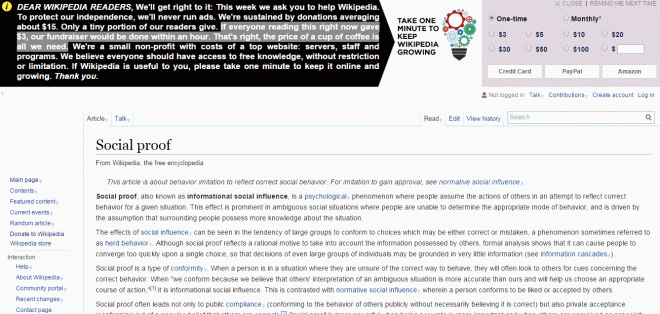
If you want a workable definition of irony, check out the Wikipedia page for “social proof.”  Here’s a screen shot:

social proof

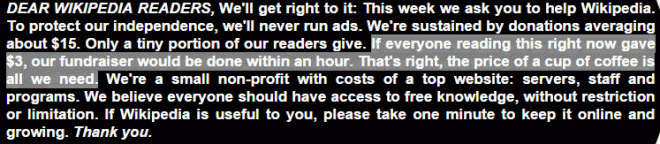
See that banner at the top?

wikipedia header

There’s a key counterproductive sentence in here (although there are other problems with this): “Only a tiny portion of our readers give.”

What Wikipedia is signaling, on top of this article about how people tend to do what other people do, is most people don’t donate to us – you shouldn’t either.

There is a famous study cited by Cialdini and many many other (in fact, it’s part of Yes!, another great book on influence) with the Arizona Petrified Forest.  They found that a sign that has negative social proof significantly increases the likelihood that someone will do something bad. In this case the sign said:

“Many past visitors have removed the petrified wood from the park, destroying the natural state of the Petrified Forest.”

In essence, this sign says out loud what your mom warned you about – everyone else is jumping off a bridge and you should too.

Yet Wikipedia is far from alone in using this tactic.  How many gap appeals have you seen that say, in essence, “not ask many people are donating as they had been; please give generously”?  These types of appeals are fraught with social proof peril.  Personally, I’ve only seen them be effective either when the gap is due to something outside of the nonprofit’s control (e.g., “you and people like you have been more generous this year than ever, but the loss of this government grant imperils…”) or when the gap is due to increased need (e.g., “Hurricane Oberhauser means that more people are homeless; can you help immediately?”).  To admit others aren’t supporting your nonprofit is counterproductive.

That said, social proof can be used for good.  People are more likely to support a nonprofit when the list of people supporting it before them is longer (see, for example, this study).  With major donor campaigns, it is common to have a quiet period where funds are raised to get to around 40% of the overall goal.  Donors during this period are told, correctly, that they will be helping with this effect.

But it works for small donors as well.  A challenge fund, in addition to creating scarcity/urgency, which we will talk more about, also communicates that other people are supporting this cause – you should too.  The thermometer on the side of walk pages works much better when there are people already supporting the cause.

Similarly, you may want to test “Join 324,224 members” instead of your “Become a member” button.  “Join” is in particularly a powerful word in this respect because it implies that you are becoming a part of something larger than yourself.

Pre-seeding campaigns works.  One nonprofit of my acquaintance starts recording donations for their year-end campaign in mid-November, but only puts the thermometer up in December, so that the social proof is in place when it is most likely to be helpful.

Another form of social proof is testimonials from your current donors.  A good donor story can be very effective in a newsletter.  One part of this that we’ll talk about more in the authority post is that it’s especially effective when it is a like person giving the testimonial – similar age, race, name, state, etc.  The message “people support this” is good; the message “people like me support this” is better.

Pictures also work well alongside testimonials.  A great study on what Stephen Colbert called “truthiness” (whether something “feels” true, not necessarily whether it is true) found that having pictures alongside of a truth claim makes it feel more true.  Thus, if you can get the picture of the person making the testimonial, the testimonial will tend to ring more true.

Have you seen strong examples of social proof in action?  Please leave them in the comments – everyone else is.

Influence in direct marketing: social proof at work

Influence in direct marketing: reciprocity at work

As direct marketers, we gradually become experts in why and how our donors give.  But sometimes, we can get into the weeds of control communications (“this matching gift appeal works; let’s send it again”) and forget the mechanisms by which communications work.  At least I’ve done this; your mileage may vary.

So, I’ve found it to be helpful to delve back into first principles periodically.  One of my favorite resources for this is Robert Cialdini’s Influence.  As an insight into why people do what they do, there are few better (although David McRaney’s You Are Not So Smart and You Are Now Less Dumb are great looks into cognitive biases that are a fun read and thus I will get to in other posts).

For the TL: DR version of this book, there’s an HBR summary of it here .  Cialdini articulates six principles of influence that are both core and common across cultures:

  • Reciprocity
  • Authority
  • Social proof
  • Consistency
  • Liking
  • Scarcity

Think of each of these as a way to make yourself more persuasive and have more influence that you can incorporate into your causes’ way of talking with your constituents.

I’ll take each of these in turn to give my thoughts on how these levers can be used in old and new ways.  And, since there are six of them, I’m going to use this as an opportunity to test writing on the weekends.  So for those avid followers of this blog (thanks, mom and dad!), I’ll be skipping Christmas and writing on Saturday and Sunday this week.  We’ll see how it goes.

I’ll start with reciprocity – the idea that doing something for someone makes them more likely to do something for you.  I’m starting here because this was the first one I encountered in spades in my first nonprofit direct marketing program.  In fact, it’s what many people think of when they think of direct marketing solicitations: premiums.  Whether it’s a front-end premium of labels, calendars, address books, pins, or whatever tchotchkes we can figure out how to flatpack in an envelope, or the back-end premiums exemplified by the donate-to-PBS-get-a-totebag model, these have become ubiquitous.

This is because they work; the principle of reciprocity is such that if we are given a gift, we feel obliged to respond in kind.  Add a well-thought out premium to an acquisition package and you will likely see a jump in your response rate.  In fact, this jump will be highly correlated with the perceived value of that premium.  While there are a thousand studies of this hidden behind all of our nonprofits’ firewalls, there’s a good published one here.  It shows a 17% increase in giving when a person is given a small gift and a 75% increase when they are given a large one.

There are cautionary notes to strike, however.  A program build on premiums – back or front – can become a one-note piano.  Ideally, you have a broad mix of communication types and influence levers with your constituents.  Some of the people you will acquire from premiums will be responsive only to those premiums and value your organization only for the things they get from you.  This can preclude effective upgrade and bridging strategies.  Additionally, the donors you get from these efforts can be attracted to other organizations by other premiums (or the same premium as you send).  As a result, they may become prolific tippers of nonprofits.

As a result, a program build on premiums and premiums alone will tend to have lower average gifts, lower retention rates, and a great challenge trying to kick the addiction they and their donors have to these gifts.  This is by no means to say premiums have no place in a nonprofit program, but that it’s best of they are one of the many things you do to attract and retain donors, rather than the sole one.

Cialdini says it well in his HBR article: “Ultimately, though, gift giving is one of the cruder applications of the rule of reciprocity.”

There are higher value forms of reciprocity to be had in your direct marketing program, beyond the labels and the notepads.  The first is that value does not have to be measured monetarily.  As I’ll talk about in the post on scarcity, exclusive information can be something of great perceived value that a person would want to reciprocate (a note here that these forms of influence almost always work better together than alone).  Similarly, a paper clip on a mail piece is an interesting signifier that human hands have touched the mail piece.  This human touch means that a mere machine didn’t just pre-digest this mail piece and spew it out to you; this signifier can be something that helps bring people to you.

It’s also important to look at reciprocity from the donors’ perspectives.  Sometimes you will get gifts that are a perceived payback from a donor, whether they were directly touched by your services or indirectly.  One key point here is to try to capture what a person’s connection is to your cause and customize to this.  It’s important that the principle of reciprocity says that this is something that something people want to do; the need to have our ledgers square is hardwired into us.  You can help these folks given back in the way they want to and thank them for it.

Thank you’s are also an important part of reciprocity.  Research shows that people give to causes not because they expect anything concrete in return.  Rather, they build up two expectations over time.  One is recognition for their gift, whether publicly or not.  This is a reciprocity that the donor will expect of you.  The other is performance – that you will use their donation to make the impact they would like to make.  If either of these comes as a surprise, please read my post on why we thank everyone for their gift.

We started with premiums and that’s the primary reciprocity lever at work in most nonprofits.  But it’s important to remember that just as we give gifts to people in the hopes they will reciprocate, they also expect that we will reciprocate when they give us a gift.

Influence in direct marketing: reciprocity at work