Email metric basics

Every field does its best to be impenetrable to outsiders and the world of online testing is no different.  We measure KPIs instead of “important things.” The differences among CPA, CPC, CPM, CPR, CTA, CTR, and CTOR are all important (for example, one of these can save your life, but isn’t an online metric) and there are TLAs* that I haven’t even talked about.

So this week I want to look at measuring online successes (and not-yet-successes), but first, we need to get our terms straight so we know what we are trying to impact, starting with email metrics.

For me, this is easiest picturing the steps that would go from email to action.  An email is:

  • Sent
  • Delivered
  • Opened
  • Clicked upon (or unsubscribed from)
  • Responsible for a completed action

Almost all of the other important metrics are ratios of the number of people who did this (or the number of unique people who did this — unique meaning the number of people who did something, not the number of total times something was done.  For example, 1000 people clicking on a link once and one person clicking on a link 1000 times will have the same click-through rate, but very different unique click-through rates).

The most important of these ratios are:

Delivery rate: emails delivered divided by emails sent.  This is inexact, as different email providers provide different levels of data back to you as to whether an email was a hard bounce (email permanently not delivered) or soft bounce (temporary deliver issues like full email box or email message too large).  But as long as you are using the same email program to send your emails, you will have consistent baselines and be able to assess whether it’s getting better or worse.

Open rate: emails opened divided by emails sent.  There are a couple minor problems with this.  First, opens can’t be calculated on text emails.  That is, only HTML emails have the tracking to determine whether they were opened or not.  Second, some email clients allow people to skim the contents of an email in a preview pane and count it as an open.  Third, some email clients don’t count an open as an open (even if the person interacts with the message) if it is only in a preview pane.  So it’s an inexact science.

However, open rates are still a good, but not perfect, measure for testing the big three things that a person sees before they open a message:

Why isn’t it a perfect measure?  Because it’s hackable.  Let’s say your control subject line is “Here’s how your gift saved a life.”  If you test the subject line “Your gift just won you a Porsche,” it might win on open rate, but you’ve lied to your donor (unless you have an astounding back-end premium program).  That will spike your unsubscribe rate and lower your click-throughs**.

So you probably want to look at this in combination with click-through rates (CTR).  This is another one of those metric pairs that prevent you from cheating the system that I love so much.  Click-through rate is number of people who clicked (assuming you are using unique click-through rate) by divided by emails sent.  It’s a good way of measuring how well your content gets people to (start to) take action.

Another good way to look at how your email content performs is click-to-open rate (CTOR).  This is number of people who clicked (assuming you are using unique CTOR) by divided by opens.  As you might guess, it fits very nicely with the previous two metrics.  Let’s say two emails both had 1% click-through rates.  One of them might have had a 20% open rate and a 5% click-to-open rate; the other might have had a 5% open rate and a 20% click-to-open rate.  In this case, you’d want to see if you could take the subject, sender, and pre-header of email #1 and combined it with the body copy of email #2.

You also need to look at unsubscribe rate (number of unsubscribes divided by number of emails sent), but not as much as many would think. If it starts going too high, you may want to worry about how you are acquiring your subscribers; likewise, it’s good to compare unsubscribe rates across types of constituents (that is, do your advocacy supporters unsubscribe faster than your white paper downloaders?  Perhaps it’s time for more segmentation and better advocacy content).  But don’t let it drive the boat.

Finally, you want to look at conversion rate: those who took the action divided by those who clicked through.  While not strictly an email metric, I include it here because a person could try the same underhanded tactic with the Porsche to boost click-through rates (to bait and switch the clicker) and because it’s so vital to be measuring and optimizing against.

But that’s another post.

If you want to benchmark your metrics, I strongly recommend M+R’s benchmarks study here.  And please sign up for my free newsletter here.  We have strong metrics (40% open rates and 8% click-throughs) so others are (hopefully) finding it to be useful nonprofit direct marketing content.
* Three-letter acronyms

** Also, it’s wrong.  Don’t do it.

Email metric basics

Toward a linear RFM

In addition to the many challenges of RFM already discussed, the segmentation puts up artificial barriers between segments.  Some of these include:

  • Let’s say someone is one of the people we talked about yesterday that gives every November or December.  If s/he gave in November 2014, then again in December 2015, are you really going to consider them having “lapsed” in the middle?
  • The distinction between frequency groups is artificial. As we discussed on Tuesday, Sandy, who gave you 100 gifts, and Miriam, who gave you two, are both considered multidonors for most RFM segmentations.
  • The distinction between monetary value segments is artificial. Which donor would you prefer – a donor who donates $10 ten times per year or a donor who donates $50 once a year?  RFM prefers the latter; I’m guessing you would prefer the former.

But how to do you create equivalencies among every different segment?  Would you rather have a donor who gave $100 to an acquisition package six months ago or a loyal semi-frequent $20 donor?

The ideal would be to run a model with lifetime value as the dependent variable and your traditional RFM variables, plus as many of the ones that we’ve talked about this week, and determine what your actual drivers of value are.

But lifetime value, as you can tell from the name, takes a long time.

So let’s steal a rule-of-thumb model from the for-profit world.  Connie Bauer first (at least first to my knowledge) proposed this in an influential 1988 Journal of Direct Marketing article called “A Direct Mail Customer Purchase Model.”  Here, I’ve replaced purchases with donations; I think it works in our world with this replacement.  To get the RFM score, you multiply these three things together:

  1. The reciprocal of recency of the last donation in months.
  2. Number of donations
  3. The square root of the total amount of donations the person has made.

There are a few things I like about this shorthand:

  • There’s a reasonable equivalence between recency and frequency.  Would you rather have someone who has given four gifts who gave their last gift a year ago or someone who has given two gifts and their last one was six months ago?  These would be roughly equivalent in this model and that looks about right.
  • It mitigates the artificial distinction between months.  That 12-month versus 13-month difference that in a normal RFM analysis could be the difference between sending and not sending a communication?  In this model, it’s about an 8% difference in scoring.  Important, but not fatal.
  • Because I’ve not seen the effect of the sheer numbers of gifts have a huge impact (once you get above a certain point) on retention rate, it seems intuitive that monetary value is a smaller factor than the other two.

There are some weaknesses.  Donation amounts aren’t linear: if someone has given a $25 gift in the past, the odds that they will go from there to $26 to $27 is not likely.  Some time periods, like a year, are somewhat magical, especially for one-gift-per-year, seasonality-focused donors.  And in an ideal world, you would want more recent gifts weighed a bit more than more distant gifts.  A donor’s behavior tomorrow will be more like their behavior last month than their behavior in 1988.

But given that, it’s an interesting look at the topic.  I hope the week gives you the courage and the tools to take another look at your segmentation strategy and calculations.  You’ll go nuts if you try all of these simultaneously, but conscious and continuous improvement can make huge differences in the long term.

Toward a linear RFM

Vive le donor difference

When Iyoure-killin-me-smalls-quote-1 was but a wee lad, I played youth baseball.  Or perhaps more accurately other kids played baseball at me.  I excelled in three things and three things only:
  • Bunting
  • Getting hit by pitches, to the point that I once got hit by a pitch that was called a strike.  I had to wait to get hit by the next pitch to take my base.
  • Stealing signs.

This last was where my “talent” was.  I would watch the third-base coach and when I thought a steal was coming from the signals, I would yell into the pitcher and catcher from my position in right field.  (Of course I was in right field.  There’s a chance someone might hit the ball to left field.)  I probably caused more outs with catching signs than catching balls (though still far less than I caused by batting).

The trick to stealing signs is to look for what is different from the usual.  The same is true for catching donor signals – the trick is to look for what is unusual and work from there.  Some tips:

Seasonality: Most donors are season agnostic.  They donate when an appeal touches them or strikes their fancy or they hear about you on the news or they found a $20 in a purse in the back of a closet.  However, some will renew membership in January like clockwork.  Others believe in end-of-year giving (this is prevalent among online donors).

Like everything else, there is a way of doing a sophisticated model to determine this.  However, like only some things, there is also a fast, relatively easy, and free way to do it in Excel or similar spreadsheet:

  1. Pull all of the gifts at which you want to look.  I would recommend donors with at least three years of giving history and at least four gifts, so you have a sufficient history to work with.  You want the gifts labelled by a unique donor ID number.
  2. Label all of the gifts by month (1 = January, 12 = December, and everything in between)
  3. Run a pivot table that summarizes the gifts by donor with the min month and the max month.
  4. Subtract the min from the max.

(If you’d like a walkthrough of this in more detail, please email me at nick@directtodonor.com)

Now look at the results.  The majority of donors will likely have a wide spread of 9, 10, or 11 months.  However, you will also see some 0-3 month spreads, meaning that over (at least) a three-year period and (at least) four gifts, they have given to you only in one quarter of the year.  Thus, you can likely reduce your costs on soliciting them in the other quarters of the year (not eliminate, as you don’t want them to forget you exist).

If you want to be very thorough, add six to each month number and repeat to capture those few donors who may focus their gifting around both the end and beginning of the year, but not the middle.

Premium v non-premium: This is actually the same analysis as the months, except instead of coding your gifts by month, you need to code your communications by whether they required a giveaway to give.  Some people will present as exclusively premium or non-premium donors.

This is powerful combined with seasonality analysis; if you find someone only gives at the beginning of the year to your membership campaign and has never given to a premium piece, you don’t need to send them address labels in May or the calendar in September or telemarket to them in June.  Instead, you can use lower cost (and more cultivative) pieces like donor newsletters to maintain the relationship with them.  Yes, this may only be saving $3 per year per donor, but if there are 10,000 of those donors on your file, you are talking about real money.

Out-of-place gifts: Someone has given you $10 times.  They just make their 11th gift to you: a $173 check.  What should you logically ask them for next time?

HPC says you should ask them for $173 (possibly rounding to $175).  Common sense says that the person may not have turned from a generally smaller donor to a prospective mid-major prospect overnight.

Research indicates a better answer is to use average donation of giving for longer-term donors.  Thus, you see the anomaly, take it into account, but don’t let it drive your decision making.

Another potential treatment is to use a continuous, rather than segmented, version of RFM.  We’ll discuss that tomorrow.

In the meantime, if you are interested in more research on ask strings and amounts you should ask for, I’m working on a book/white paper/whatever it ends up being on just that topic.  Newsletter subscribers will get a free PDF copy of it when it comes out, so if you would like one, please sign up for my free weekly newsletter here.

Vive le donor difference

Using non-donor knowledge to enhance segmentation

Yesterday, we introduced you to two special people that a traditional RFM analysis would group as 4-6 month $25-49.99 multis.  To wit:

Since Sandy first donated to your organization in 1992, she’s given over 100 gifts.  Nothing exorbitant – she’s now giving $30 every three or four months – but she also has volunteered, come to three walks, signed up for emails, and taken almost every advocacy action you offer.

On the other hand, you acquired Miriam from an outside list in 2012.  She gave $25, but nothing since then.  You don’t have her email or phone number, but a last chance lapsed package piqued her interest four months ago and she gave another $25.

We talked about how their donation history can and should differentiate them.  There are additional indicators here, however, that can also enhance your messaging and segmentation:

Online interactions.  If someone is active online, it’s relatively simple to group their interests by their activity – what they click on, look at, and interact with.  (Actually, technically, interact with is the easiest, click on is slightly harder, and look at can be a bear with some online tools.)

With Sandy, she is an advocate for you and doesn’t seem to require premiums to donate – perhaps you can replace the labels in that upcoming package with a paper version of an action alert – cheaper, and likely more effective.

Other organizational interactions.  Sandy has been a walker – do you want to mention that your walk is coming up in 90 days in the PS or in a buckslip?  Similarly, you should probably customize the messaging to acknowledge that she has given her time as well as her donations.  Making her feel known will only help her loyalty.

Outside data.  Getting outside data on your donors can help you adapt your tactics.  If you find out that Miriam does all of her banking online, perhaps she’s a better target for an EFT-based monthly gift than you thought (with the right messaging).

List co-operative data may indicate that that she gives to nine other charities far more often and more generously than to you.  Perhaps she’s just not that into you and you might want to cut your losses soon than you might have thought.

You may find out she does a lot of business on the telephone and find that it isn’t your organization that wasn’t lighting her up; it was the means by which you were approaching her.

All this and more can come from data appends.  And you can try to get that email address and engage her online, so hopefully you can learn more about her.

All of this – donor and non-donor interactions – are masked by an overarching RFM category.  But what if we could dispense with RFM categories altogether?  We’ll talk about that Friday; if you don’t want to miss it, or any of our Direct to Donor posts, please sign up for our free weekly newsletter.

Using non-donor knowledge to enhance segmentation

Including loyalty in your beyond-RFM segmentation

Since Sandy first donated to your organization in 1992, she’s given over 100 gifts.  Nothing exorbitant – she’s now giving $30 every three or four months – but she also has volunteered, come to three walks, signed up for emails, and taken almost every advocacy action you offer.

On the other hand, you acquired Miriam from an outside list in 2012.  She gave $25, but nothing since then.  You don’t have her email or phone number, but a last chance lapsed package piqued her interest four months ago and she gave another $25.

What do these two have in common?

They look the same on a traditional RFM analysis: they are both 4-6 month $25-49.99 multis.

And if you use only a traditional RFM analysis, you will treat them the same.

That’s silly.  If you were looking only at these paragraphs to judge, Sandy would seem to be a good candidate for monthly giving, upgrade strategies, and/or planned giving.  Miriam probably has a 50-50 chance (or worse, given industry averages of lapsed reactivated retention rates) of never giving you another gift.

It’s easy to criticize this, but harder to do this analysis writ large, when you are doing five-to-seven-figure list selects.  So how do you draw these lines?  Here are a few ideas:

Lifecycle analysis.  Way back when (November 2015 – ah, those were the days), we talked about how there isn’t just one retention rate – there are several, based on where a person is in their donor journey.

This lifecycle analysis can layer on to your segmentation analysis and on to your messaging.  Some sample categories:

  • New.  What it says on the tin.
  • 1st year.  They have given a second gift, but it’s been less than 12 months since their first gift.
  • 2nd year.  Gifts in their first two years.
  • Core: Donors who have given in each of the past three 12-month periods
  • Lapsed: A gift 13-24 months ago.
  • Deep lapsed: A gift 25+ months ago.
  • Lapsed reactivated: Someone who has given a gift in the past 12 months after a gap of at least a 12-month period

Your mileage and organization may vary – it’s more important to look at this analysis than it is to have the same precise categories.

So you may not have a separate piece for Sandy, but you might want to make sure there is language like “As one of our most loyal donors” or “You’ve stood with us for more than 20 years.” or the like in the existing piece.

As for Miriam, as a lapsed reactivated donor, you are still worried that you might lose her again.  Perhaps you want to stay close to the tactics that recruited her (or won her back or both).  She might also be worth an e-append or phone append to see if you can find a channel that further engages her.  Or maybe you want to use a less aggressive ask string – your goal for a lapsed reactivated donor is to make donating a habit again, rather than to increase their giving just yet.

Gift density.  Take a look at the number of gifts someone has made, then divide by the number of years since a person’s first gift.  This is how many gifts you will get from them in an average year (or at least what you have received).

Sandy’s number is above four.  Four is a bit of a magic number (some would say three or even two– again, having a number is more important than what the number actually is) to indicate strong likelihood of monthly giving.  When someone has a pattern of giving frequently, this ask isn’t nearly the heavy lift it is trying to get someone to go from one gift per year to twelve.

Miriam is below one.  One is a separate magic number, as below one indicates a likelihood to lapse (by definition, they’ve done it at least once)  That should trigger some of the anti-lapse efforts discussed above.

One is also a magic number in that if someone gives you exactly one gift per year (and they’ve been with you a few years), that’s the bucket they see you in.  So, if they look unlikely to upgrade and they look unlikely to increase the frequency of gifts, the only other way to increase their lifetime value (other than increasing their retention rate) is to decrease costs.  Let’s say you send an average of 14 mail pieces per year and do two telemarketing cycles.  This person probably can decrease this substantially and save costs.

Longevity.  Length of donation is something that should be honored.  Not only are milestone anniversary notes and certificates and the like a good thing to do from a moral and ethos perspective, but they will also make sure that your most loyal donors know that you know they are important to you.

Channel responsiveness.  Change your tactics to suit the terrain.

All of these are even more important when looking at borderline segments.  Should you mail the 13-18 $15-$19.99 multis?  Maybe just those that have been with you five years or more?  Or with previous high gift densities?  Or just mail responsive?

But there’s more to it than even that; tomorrow, we’ll talking about using other interactions with your organization to define and customize.

Including loyalty in your beyond-RFM segmentation

RFM segmentation alone must die

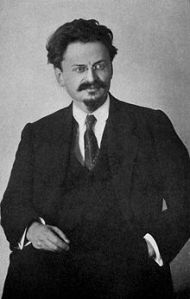
220px-lev_trotskyRecency, frequency, and monetary value (RFM) are the ruling troika of segmentation-land.  And like one of the old Soviet troikas, they brook no challenge to their rule (e.g., Trotsky, pictured at right, was murdered on Stalin’s orders with an ice ax).

But they are simply not good enough alone anymore.  I tried to be civil about this in my post Beyond RFM.  But beyond is not good enough.  We need to let a million flowers bloom in the world of segmentation.

This means taking the “7-12 $15-$19.99 multi-donor” view of segment out for a date with your ice ax.

OK, not really.  It’s still going to be a decent starting point.  But it has to stop being the ending point.  Even for those of us that have to leave complex modeling to people with more letters after their names.

So this week, I’d like to take you through various different ways of figuring out the all-important question “is communicating with this donor in this way going to help achieve my goals of net revenue, quality file growth, and/or world domination?”.

And the first topic that should be layered on is listening to what a donor’s behavior is telling you.

Part of this is non-donor behavior.  You likely already have this information if you have the donor’s email.  You can potentially tell if they’ve been to your Web site, how often, how long they spent, and what they looked at.  You definitely should be able to know how they’ve reacted to emails you’ve sent them in the past.  The difference in a lapsed donor who still regularly opens your emails and clicks on the articles versus one who, according to your email records, may or may not be dead is a significant one.

If you can get robust data, so much the better, because now you can not only include people in a communication they may not have received before, but also customize it based on what they are interested in.

But some of this is donor behavior you already know, but RFM filters out.  Channel is one. Take an online donor who is reliable and frequent at donating online.  If you’ve mailed her/him 25 times over the years to try to get him/her to donate, but s/he hasn’t responded, chances are that s/he doesn’t want to give through the mail.  Personally, I’ve found telemarketing to be the most persnickety channel: those who give through it really give through it; those who don’t, really don’t.

Another is cadence.  If someone has given you ten gifts in the past ten years and all of them have been in November or December, my money is on the fact that you can ease off the gas in May.  One program of my acquaintance runs a membership campaign that starts every January.  There is about five percent of their file that will give a membership gift like a clockwork every January or February and then nothing for the rest of the year.  Should you stop trying to get extra gifts?  No.  Should you cut your cadence way down and save yourself some costs?  Yes.

These are things the donor probably thinks they are telling you explicitly with their behavior.  It’s now incumbent upon you to listen.

Because tomorrow, things get a little bit harder, as we talk about lifecycle and loyalty.


If you’d like more nonprofit direct marketing content like this, please subscribe to my free weekly newsletter. You’ll get all of my blog posts, plus special subscribers-only content.

RFM segmentation alone must die

Addressing the resource challenges of donorcentricity

Getting to an organization that is able to know about its donors and customize communications accordingly is not easy.  We often lack one centralized database that acts as the Truth.  We don’t think we have time to make donor calls to thank people where revenue isn’t attached.  Our budgets are so small that we transcend lean and mean and are now emaciated and ticked off.

But we must start somewhere.  Why?  Remember the old joke about the bear and the sneakers?

For a refresher, two guys are at their campsite when an angry bear comes charging in.  One of the guys immediately bends over to tie his sneakers.  The other one says “You idiot!  You’ll never outrun that thing!”

The guy with the sneakers replies “I don’t need to outrun the bear.  I just need to outrun you.”

So, if you have no better rationale and didn’t read my Monday post about the value of donorcentricity to our business model, remember:

  1. Donors to our organizations donate to other organizations.
  2. Other organizations are doing these types of stewardship activities.
  3. BEAR!

colbertbear

So how do you start this journey of a thousand steps?  Here are some tips to first steps to better talk to donors.

Get your database in order. This may mean some time working out of csv files to get your lists in order.  However, this is much better than not trying at all.  It will also help you in the long run, as the fancy pants SQL/database steps to data health are likely just automated versions of what you are doing in your spreadsheet.

Institutionalize calling.  It doesn’t need to be just development employees or just employees.  But any part of your culture that you can get to call donors to thank them – do it.  Even if it’s one call per month.  The practice of hearing donor stories helps whoever here them take what was once a figure on a spreadsheet and turn it into an understanding of why people outside your organization think you exist.

And it helps them to feel your gratitude as well.

Ditto for thank you notes.  The more these can be a cultural touchpoint, the better.

Try an unconventional thank you strategy.  We have 50 ways to thank your donors here, most of them unconventional and many of them very poorly rhymed.

Finally, once you have data from a good number of people who have randomly received thank you calls or notes or the like, run the numbers.  You should be able to see from an increase in retention rate (I hope) the impact that calling can have on your donors and your retention rate.  Sometimes that number will be enough to continue your random calling.  Sometimes it will be large enough to justify significant resource allocations changes.

After all, the quickest solution to a small budget is to get a big one.  This can help you prove it out.


If you’d like more nonprofit direct marketing content like this, please subscribe to my free weekly newsletter. You’ll get all of my blog posts, plus special subscribers-only content.

Addressing the resource challenges of donorcentricity

Lessons in donorcentricity from the for-profit world

In 2008, Walmart asked its customers what they wanted.  They said they wanted wider aisles and less cluttered shelves.  So Walmart spent hundreds of millions of dollars to recreate their stores in this image.  Eight straight quarters of sales decline later (for the first time in Walmart’s history), the aisles narrowed and the shelves cluttered once again.  The total cost of the experiment was $1.85 billion.

Or put another way, they basically lost almost all of St. Jude for two straight years.

Fortunately or unfortunately, no one in the nonprofit sector is capable of losing that much money.  But that doesn’t mean we aren’t making similar decisions with ill-researched (see my commentary on donor surveys from yesterday) or non-researched forays that have no basis in what works (coughcouchbrandguidelinescoughcouch).

But there are customer-centric companies that can teach us something about how to get revenues from our donorcentric strategies:

Acceptance of non-total loyalty.  Coke is a company that has customers so loyal that the one time it messed with its formula over three decades ago is still synonymous with “marketing failure.”  Yet 72% of Coke customers also buy Pepsi.

What Coke drives for is what it calls “share of throat” – how much of what you drink can Coke own?  By using this metric, they know that if they can increase your loyalty and experience, they can increase their revenue with you still not giving them your unswerving obedience.

The same is true for us.  As I’ve talked about, our donors are good people who do good things in the plural sense.  Almost all of them support multiple causes and organizations.  That’s fine.  What we want to be able to do is create an experience for that donor that makes them want to give us more (share of donations) than other nonprofits.

Realization that your most loyal donors and your best donors aren’t necessarily the same thing.  The top 10% of most loyal Harley-Davidson riders – are probably the people you think of when you think of Harley riders.  They have the tattoos.  Their bikes are pristine.  They are a part of the Harley Owners Group (HOG) and have Harley merchandise.

And they are only 3.5% of Harley’s net revenue.  The reason is that these riders probably own “only” one Harley and likely a lower end model.  On the flip side, the (wealthy) motorcycle aficionado may have ten bikes, three of which are Harley’s.  A less loyal customer, but a more valuable one.

Harley’s strategy is a premium strategy.  Not in the sense that they mail their potential owners with Harley address labels and stickers (although I would love to see that!), but that they intentionally make sure they have fewer bikes produced than are desired.  As a result, they can charge a premium price.

They could realign their business about the most loyal customers.  This would likely involve producing more bikes so these loyalists, who are likely to be price-sensitive in their other purchases, are able to have an easier entry level into the market.  But they don’t, because that is not where their bread is buttered.

Similarly, you likely have a frequent tipper audience.  They give you $5 or $10 often when you mail them.  They have been on your file for a number of years.  They are loyal.

But they aren’t for whom you are designing your high-dollar donor newsletter or your handwritten CEO letter.  You are looking for the folks who are capable of making a large or transformative gift.  And high-touch efforts require this level of upside to be worthwhile.

Design around experiences.  I strongly recommend Experiences: The Seventh Age of Marketing by Robert Rose and Carla Johnson.  I won my copy thanks to my knowledge of Firefly/Serenity, but would gladly have paid.

malcolm-reynolds

Thank you, Captain Malcolm Reynolds

In it, they talk about how what we are seeing more and more are how microexperiences (and micromoments) are adding up to create the totality of our brand impressions.

So, as we urged with our donor surveys, it’s good to measure what your donor’s experience is with your organization (and former donors) to make sure it ties to what matters to your donors.  There’s a reason people go to Disneyworld, when you can go to a closer and cheaper amusement park.

Lessons in donorcentricity from the for-profit world

Creating useful donor surveys

In my DMA Leadership Conference talk, I said that people who listened to what donors say they want in donor surveys deserve to be lied to.  That was obviously too harsh – what I should have said is that they deserved to be misled.

Because people (not just donors, but all human beings*) aren’t meaning to lie to you; they just don’t know what their true motivation is.  As we’ve seen, emotional reaction happens 6000 times faster than rational thought.  So unless someone is doing System Two thought, where they are rationally considering all alternatives, the role reason plays in this process is coming up with the best possible justification of a decision already made.

Consider a study that asked people to rank their top 16 motivations.  Sex was rated #14; wealth was dead last.  Then they looked at actual subconscious motivators of decisions.  Sex was rated #1 and wealth was rated #5.

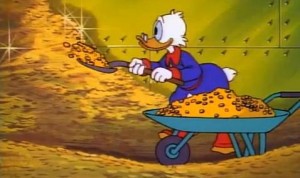
This should be considered no surprise to people who have met, well, ya know, people.  But it was a surprise to people themselves, who think themselves chaise and uncorruptable, but in reality dream of having very special moments in Scrooge McDuck’s vault.

0pu-08jzteemwvmsx

But that doesn’t mean all donor surveys are bad – far from it.  It just means that, in a statement that may get me arrested by the Tautology Police**:

Bad donor surveys are bad.  Good donor surveys are good.

Common traps in donor surveys:

  • Talking only to current donors. You want to talk to people who stopped giving as well, to the extent that they will talk to you.  After all, you are looking for the difference between these two groups.  Trying to define who your good donors are without talking to former donors is like saying the reason that Fortune 500 companies are successful is because they have employees and offices.
  • Asking donors to analyze why they did what they did. They don’t know.  So they are going to try to figure out what answer someone like them would generally say or what they think you want to hear.  Neither is helpful to you.
  • Asking donors what is most important to them. Clearly, from the above, the answer is sex.  Looking only at your limited options, however, they will probably make mistakes in determining what is important to them, similar to the poor people who thought that sex and wealth (aka Genie Wishes #1 and #2) didn’t impact them.

So how do you construct a survey that gets to these important points?  You are going to set up your survey so that you can run a regression analysis.****  If you need help with how to do this, check out our post on basic regression.

You will need a dependent variable.  Ideally, this will be donation behavior because it is a clear expression of the behavior you are trying to impact.  If not, an overall satisfaction score with the organization will be generally OK, as it should correlate strongly with donation behavior.

For your independent variables, ask about aspects of your organization.  So, for example, “have you ever called X Organization about your donations?”, “did you receive a thank you note for each donation you made?”, “have you been to X Web site”, “how many days did it take for you to get your thank you note on your last gift?”, etc.

The powerful thing about regression analysis is that it will help you figure out both how people feel about their experience and how important that experience is to them?  For example, my guess is that for most organizations, the number of days it took to get a thank you will be a good predictor of retention.  Since the analysis tells you the strength of that association, you can invest the right amount of resources into that area versus new donor welcome packages or donor relations staff or database infrastructure and the like.


* Yes, non-donors are also considered human beings – just slightly lesser ones.

** Motto: Enforcing through enforcement since Socrates.***

*** Former motto: Our motto is our motto.

**** Or other modeling if you are feeling fancy.

Creating useful donor surveys

Quantity versus quality of pieces in donorcentric fundraising

Food for the Poor, the DMA’s Nonprofit of the Year last year, sends 27 mail pieces in its control donor series throughout the year.  These are all very good donorcentric letters, focused on the impact that you as a donor are having in saving people in their times of desperate need.

Another nonprofit of my acquaintance that will remain nameless, sends out one appeal per year.  When they asked me whether they should send a second piece, I told them that they should make their one piece work first, because it was not a compelling appeal.

There are wonderful donorcentric people who argue that nonprofits need to reduce the amount they communicate across the board.  I would argue that they need to reduce the amount they communicate badly.

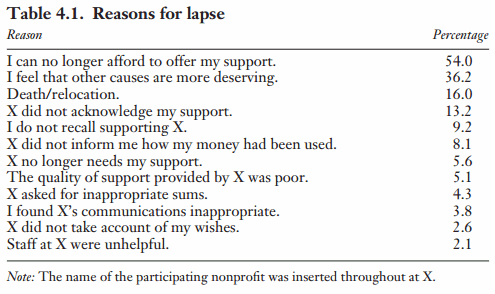
Let’s take a look back at the reasons that people give for stopping giving to a nonprofit from Dr. Adrian Sergeant (first covered in Wherefore Segmentation):


reasons-for-lapse

As you can see, 72% of the reasons were related to not getting our message across like “other causes are more deserving” or “I don’t remember donating” or “they don’t need money any more.”  Less than four percent said inappropriate communications.  People are leaving because we persuade too little, not too much.

And as for the sentiment you may get about mailing too much, Van Diepen et al looked at irritation from nonprofit mailings.  They found that irritation can be incurred from mailings, but that it had no impact on revenue per mailing.  That is, people kept donating at the same rate per piece.

As Jeff Brooks put it in his wonderful book The Fundraiser’s Guide to Irresistible Communications:

[A] typical donor gets at least 10 pieces of unsolicited mail every delivery day.  That’s 3,000 pieces a year.  If you write to a donor twelve times a year, you’re sending 0.4 percent of her yearly total.  If you stopped mailing, the daily average would drop from 10 to 9.96.  Not a meaningful difference for you and your donor.

But for you, that cutback would mean lost revenue, forever.  A loss of hundreds, maybe thousands, of dollars from each donor.

You’ll never solve the Too-Much-Mail problem if you treat it as a numbers game.  The real issue is the relevance of the mail, not the volume.

All of that said, you could be mailing too much, as measured by both your net revenues and a true donor focus.  Here are some of the symptoms:

  • Channel mismatch. It is correct and laudable to try to get an online donor to give offline and vice versa.  However, there is a point of non-response (that varies by organization) at which the online donor is very unlikely to give.  For example, if someone gave their first gift online, continues to give on online, and hasn’t so much as looked at 10 mail pieces from you, you might be wasting money in sending those appeals (note: I say those appeals – perhaps a mailing that encourages her to go to the Website and make a donation is just what the doctor ordered).
  • Seasonality mismatch. If someone donates every November or December like clockwork, but never a second gift in the year over five years, you are probably safe in reducing the mailings they receive in spring and summer.  Note that I don’t say eliminate.  It could be that the updates they are receiving in the summer are the reason they donate in the winter.  But you can probably save some costs here.
  • Mismatch of interests. As we’ve advocated in the “change one thing” approach to testing, you can find out what messages people will respond to and what they won’t.  One you learn that, for example, a person only gives to advocacy appeals, you can safely cut some of the other types of messages they get.  Or someone who only gives to premium pieces get premiums (but for whom they are a turn-off don’t).
  • Systemic waste. Additional mailings should do two things: increase retention rates and increase total program net revenue.  That is to say, it’s not enough to say “this piece is a good one because it netted positive”; you need to be able to say that without the piece revenues would have been down overall.

To make the math simple, let’s say you mail three pieces, each of which gets $100K net revenue.  If you eliminated one of them and two pieces started making $150K net, that third piece was not netting program revenue (unless it was a cultivate piece that set up future year’s revenues or had an upgrade component or the like.

What this nets out to is that in a donorcentric future (or, at least, in my donorcentric vision of the future), people will ask how many control pieces you send and you will have to say that it depends greatly on the donors themselves (or give a range like somewhere between two and 30 pieces per person).

And, of course, that each of these pieces is customized and crafted to appeal to that particular donor or segment.  That, in my mind, is listening to the donors and not trying to let a Platonic ideal donor get in the way of each precious unique donor snowflake.


If you’d like more nonprofit direct marketing content like this, please subscribe to my free weekly newsletter. You’ll get all of my blog posts, plus special subscribers-only content.

Quantity versus quality of pieces in donorcentric fundraising