Why welcome your donors?

I’ve read a lot about online and offline welcome kits, packages, and series.  These are almost always treated in separate articles by separate people in separate universes.  If your organization is sufficiently large, chances are they are written by separate people; if it’s even larger, they are written by separate people in separate departments.

In studying, I’ve found one deep and profound difference between welcoming donors and constituents online versus offline:

One is made of dead trees; the other is made of electrons in tubes.

Other than that, not much difference.  There are four major purposes for welcoming someone:

  1. To appreciate them in a way that makes them like you.  Online, there’s research from Powerthru Consulting from their work with Environmental Action that is worth a read.  They found that everyone who opened an email from their welcome series, it increased their likelihood of opening an email over the next six months by 20%.  Further, it increased their likelihood of opening all of the emails over the next six months by 1-3%.

    Welcoming emails also are well-opened and clicked on, far more than regular emails, according to MarketingSherpa

    It’s more difficult to get such data on mail pieces, but I’d wager they run the same way.  This first post-thank you mail piece is going to be (if you are doing it right) in the honeymoon phase of the relationship and thus affect the trajectory from there.

  2. To learn about the person and engage with them.  If you doubt why should know about your donors, sneak over to my Winter is Coming end-of-times prediction about nonprofits who do not know their donors.  Suffice it to say, your best chance of getting future donations from someone are by making sure you are customizing your asks to their desires.  You won’t know how to do that if you don’t know them.

  3. To allow them to learn about and engage with you.  In this honeymoon period, you are still a bit new to them as well.  Maybe they are actually more interested in something that you do than the one they donated to.  Maybe they are interested in advocacy, volunteering, downloading materials — who knows at this point?

  4. To get another gift, perhaps an upgraded one.  A one-time giver is not really a donor.  About a quarter will give another gift.  While this is better odds than putting your finger on a name in the phonebook (side note: we really need a new analogy for this), it’s not someone who is committed to the organization.  Double this for online donors, who are even more fickle on average.

    A donor who gives a second gift early in the process is more than twice as likely to retain as a long-term donor than someone who waits.  Do not be in the “oh, they just gave; let’s not ask them” crowd that does not strike hot iron.  The debate over whether or not to ask in thank you’s is a legitimate debate (I say you should, but other smart people say no), but not asking in the welcome series at some point is simply incorrect.

This should not be restricted by medium.  I’ve already talked about this extensively in the post on breaking down your thank you silos.  So, I’ll just add two quick things here:

  • You usually will have someone’s mail address when they donate online, but not their online address when they donate through the mail, so this is easier to do from online to mail.
  • fMRI studies show that reading from dead trees causes more emotional processing than reading from electrons.  Roger Dooley and his Neuromarketing team have the story here.  So there probably is greater applicability of these techniques going from online to mail.

This week, I’ll go through each of these purposes in turn for a welcome strategy that is medium-agnostic.  Personally, I view hitting all of these points as more important than whether you send two emails or five or the exact timing of when the mail gets out, so we will focus on technique and usable tips.

Why welcome your donors?

The power of a lead gift

Back in late December, we looked at a study that indicated that a lead gift is a better direct marketing strategy than a matching gift.  While it seemed to slightly depress response, the extra authority and social proof helped increase average gift significantly.  With a matching gift, the reverse seemed to happen: response rate went up, but average gift dropped significantly, with people thinking that they didn’t need to give as much to have the impact they wanted.

Now, there is another study that may show another impact of lead gifts, but at a cost.

The title of the article is Avoiding overhead aversion in charity, which should give you some idea of why I have some uneasiness about the cost of the tactic.  Gneezy et al found that many people are averse to covering overhead expenses of a nonprofit, wanting to fund only the work of that nonprofit.  (This, of course, leaves aside how the work of the nonprofit will get done without that overhead, but it is a concern expressed by some donors, so it is worth considering.)  So donations decreased when the percent of overhead increased.

Then, the study looked at whether having a lead donor, matching donor, or lead donor covering overhead influenced donation rates to increase.  Here were the conditions:

  • Control: “Our goal in this campaign is to raise money for the projects. Implementing each project costs $20,000. Your tax-deductible gift makes a difference. Enclosed is…”
  • Seed money: “A private donor who believes in the importance of the project has given this campaign seed money in the amount of $10,000. Your tax-deductible gift makes a difference. Enclosed is…”
  • Matching gift: “A private donor who believes in the importance of the project has given this campaign a matching grant in the amount of $10,000. The matching grant will match every dollar given by donors like you with a dollar, up to a total of $20,000…”
  • Seed money to cover overhead: “A private donor who believes in the importance of the project has given this campaign a grant in the amount of $10,000 to cover all the overhead costs associated with raising the needed donations…”

Here were the results, in response rate and revenue per piece:

  • Control: 3.36% with $.80 revenue per piece
  • Seed: 4.75% with $1.32 revenue per piece
  • Match: 4.41% with $1.22 revenue per piece
  • Seed covering overhead: 8.85% with $2.31 revenue per piece

So, having a donor or donors to cover the overhead of an endeavor raises the likelihood that someone will donate significantly, seemingly combining the benefits of authority and social proof from a lead gift and the direct donation to the cause from low overhead.

I would encourage you to tread lightly here, however.  The concern is that it could reinforce the (in my opinion) mistaken notion that overhead is bad or something to be avoided.  Not only is it necessary for organizations to exist, it’s necessary for them to grow.  Too often, nonprofits avoid investment that will bring back rewards for their cause and for their organization because it gives the perception of high overhead.

I believe in this so strongly that I dedicated all of last week to discuss overhead and vent my spleen on this.  However, if you want the TL;DR version, I strongly recommend overheadmyth.com, which goes into the mistakes of this approach.

My concern is that there will be a tragedy of the commons with regards to this.  If nonprofits choose to compete on overhead, then everyone will have to compete on overhead and it drags the industry down.

So my counsel is to be cautious with this.  It’s one thing to say that a lead donor has covered the infrastructure costs of a campaign.  It’s another few steps down the slippery slope, however, to say that this nonprofit is good because they spend 92.2% on programs, versus this one that only spends 89.3%.

The power of a lead gift

Men donate from Mars; Women donate from Venus

I recently spent a solid week trying to dispel the notion that Millennials are the most unique possible of all generations and, in fact, the idea of generational dynamics entirely.  Millennials are people and should treated like people, no better, no worse.

Since then, the Detroit News and San Diego Magazine have both done canonization pieces about Millennials and charitable giving.  I have tried not to roll my eyes, but I have not succeeded.

One of the many points in those blogs that almost any other point of demographic differentiation is better than generation for determining people’s viewpoints.

So today, I’d like to look at sex differences in giving.  To give credit where credit is due, Indiana University / Purdue University Indianapolis has a wonderful initiative called the Women’s Philanthropy Institute.  They have done a lot of the research into this; my job here is largely to present it and to try really hard not to mess it up.

On that positive note, here are some of the differences (the studies behind these are all found here):

  • Women give more to charities than men and specifically single women give significantly more than single men.
  • That said, marriage significantly increases giving of both men and women.
  • Women tend to give more to women’s issues, human rights, and environmental causes.  Men give more to issues around security, the economy, and sports.
  • Interestingly, these differences subside as women and men get wealthier, with their tastes merging a bit more.   A potential hypothesis is that larger gifts from wealthier people also tend to me more the product of familial consultation.  Thus, it may be a more literal merging of tastes.
  • Men tend to give to fewer charities; women tend to spread out their giving more.
  • Women are more likely to volunteer and more likely to donate to the organization they are involved with as a volunteer.
  • There is little difference in bequest giving patterns.

But you want to know what will cause men to give and what will cause women to give.  Well, I won’t disappoint.

A Social Science Research study  found that men have lower empathy scores when not watching Glory, Brian’s Song, Rudy, or Field of Dreams. (They omit this last part, but it’s implied.)  Given this, they looked to see if there was a way to get them to donate (noting that emotional appeals were not working as well).

The researchers tried four frames:

  • Social proof: “When you give to CRP, you join your fellow citizens in helping to fight poverty. The poor are now being helped by record numbers of charitable givers across the country. You can join the movement to eliminate poverty with your contribution to CRP.”
  • Efficacy: “When you give to CRP, your donation counts. Multiple external audits confirm that more than 98% of donations to CRP go on to directly benefit the poor. You can be assured CRP will put your contribution to work by using your donation to fight poverty effectively.”
  • Clear injustice: “When you give to CRP, you help fight the injustice of poverty today. Of the millions of people who fall below the poverty line, many of them were born into poverty and never had the opportunities that other Americans did. You can help address the injustice of poverty through your donation to CRP.”
  • Aligned self-interest: “When you give to CRP, your donation addresses a problem that hurts us all. Research shows that poverty weighs down our interconnected economy, leading to greater government spending, and exacerbating many social problems like crime. You can benefit everyone, and help make the economy strong and productive for us all through your donation to CRP.”

The aligned self-interest framing worked significantly better than the others with men.  However, this was also the worst performing with women.

So, to oversimplify, the traditional emotional appeal works best with women and appealing to “what’s in it for me” works best with men.

Has anyone has experience with testing this type of messaging?  Would love to hear your experience in the comments or at nick@directtodonor.com.

Men donate from Mars; Women donate from Venus

Priming with donation history and localization

I realized while preparing this post that I have used the phrase “play back” donation history in four different posts — in measuring retention, in the power of commitment and consistency, in my first post on customization, and yesterday.

But I realized I had not provided the intellectual background for why, other than as an example of commitment and consistency.

That ends today.  Kessler and Milkman of the Wharton School did a study of identity in charitable giving.  As they are from Wharton, they gussy up the paper with all sorts of stuff likewharton

But the paper is basically did two split tests with the American Red Cross.  The first was with lapsed (25+ month) donors, where the test version added the line “Previous Gift: [Date]” at the top of the letter (this was the only change).  Lapsed donors renewed 20% better when this statement of their donor status up front.

Also, response rates were 6-8 percent.  Can someone tell me what Red Cross was mailing to lapsed donors in 2010? Because if it wasn’t gold bricks, I want to test it.

I would wager that this is part the idea that the nonprofit knows who I am and what I’ve done.  It’s nice not to be treated anonymously, especially in this day and age.


farside

Copyright: someone who isn’t me. My apologies.
If it helps, I owe all of the Far Side books…

Part of this is reminder: “oh, goodness me, I meant to send a check, but I forgot.  Has it been that long?”.  Part is almost certainly shame.  Like we said yesterday, people want to feel good about themselves and a donation four years ago likely isn’t enough to cut it.

The second test looked at community identification.  People received solicitations for one of four efforts: the annual drive, the state drive, the winter drive, and the city drive (with the name of their state and city filled in).  Customizing this down to the city level significantly helped response rate:

  • City: 5.51%
  • State: 4.12%
  • Annual: 4.01%
  • Winter: 3.82% — proof that people hate winter

There was also a 4.8% higher average gift for those who received the city mailing.

The authors went a step further and looked at community size.  Sure enough, people from smaller communities were even more influenced by having the drive be about their city than people from larger ones.  After all, it’s easier to have community pride for Greendale, WI, than the entirety of Chicago, IL.  In part because Greendale is awesome, but mostly because of size.

So these two types of priming work and are thus things that can work for us in the mail, on the phones, and online, considering that the costs of these types of tweaks are typically low.  So go forth and customize!

Priming with donation history and localization

Read this article for less than the price of your Starbucks coffee

OK, you got me.  This post is actually free.

But it’s a phrase that is often used in DRTV spots: “you can X for less than the price of your morning coffee.”  The goal is clearly to get a monthly donation and to make the pain of spending money less by breaking it into smaller chunks.

But since my two most popular posts so far have been the study of ask strings and the anchoring of ask strings, I did want to update it a bit with new research on reference points in asks for donations.

In the American Marketing Association journal, there was a study that looked at referencing an indulgent product as a reference point for your ask.

This worked pretty darn well.  In each test, there was a control with no reference point, a hedonic (related to pleasure, usually with no socially redeeming value) reference point, and a utilitarian reference point.  So for example, they asked people to donate $1 to UNICEF.  People who got the hedonic version had the ask followed by “One dollar is the cost of downloading one top-ten song off of iTunes, such as the current #1 hit ‘Hallelujah’ by Justin Timberlake.” (Which dates this paper very nicely).

justin-timberlake-trolls

Image credit.  This is what comes up when I Google “Justin Timberlake hedonic condition.”  I’m really hoping I’m the first person ever to Google this…

People who got the utilitarian version got “One dollar is the cost of downloading one top-ten podcast lecture from iTunes U, such as MIT Professor of Physics Walter Lewin’s lecture, ‘Electricity and Magnetism .’”

Less than half (47%) of the control group donated, 57% of the utilitarian folks donated, and a whopping 88% of hedonic folks donated.*  

They replicated this with donations of time, where two hours was either “how long it takes to watch the season finale of MTV’s Jersey Shore” (hedonic) or “to watch the season premiere of House” (utilitarian).  Before I go to the results, I’ll say here that I will donate any amount of time you want if the only alternative is to watch Jersey Shore.**

In this case, 12% of the control group volunteered, 14% of utilitarian folks volunteered, and 30% of hedonic folks volunteered.  

They also tested with similar results in increased donations with an online $10 donation to UNICEF, which I mention only so I can repeat the hedonic condition:

“Remember, $10 is about the cost of a hand blender, which is great for making exotic cocktail drinks and is a good tool for a luxurious lifestyle.”

I love science.

The authors hypothesize this is because we feel the need to signal to ourselves that we are good people.  I’d agree.  The same element is at work as in the slacktivism study that people who didn’t take a petition were more likely to donate to an unrelated non-profit.  They were compensating for their lack of action on one thing with another action.  A similar mechanism seems to be at work here.  We like Ben and Jerry’s (because it’s gosh-darned delicious) but we also know that it is a selfish act to eat it.  Thus, thinking about it reminds us of our faults and we need to make amends by donating.

How does this work for us in direct marketing?  There’s the obvious point that bringing in a comparison that we know we shouldn’t like, but we do, can increase our giving.  It’s a good solid and now proven tactic.

I think there’s a side note to this, however.  I’m hugely in favor of the donorcentricity movement.  I think we should be learning about our donors, telling them the impact they are creating, and customizing their experiences to them.

However, sometimes we can overdo it in our copy, making it seem as though our $10 donor from 24 months ago has moved a mountain and is a saint among men.  When we do this to extreme, we trigger the opposite of this effect: people who feel very good about themselves tend to do hedonic, not charitable, things.  So, yes, customize your ask to what the person wants to give to, play back their donation history to them, and treat them well.  But when it comes to flattering copy, like Ben and Jerry’s, too much of a good thing is not an even better thing.

* This brings up the tantalizing, but not entirely relevant, possibility that for about 10% of the population, a physics lecture is a hedonic good.  Whoever you are, find me, as I long to be among my people.

** In case you think this is snobbery, let me disclose for the record that if the question had talked about Impractical Jokers on TruTV, not only would I not have volunteered, but I wouldn’t have finished the survey because I could be watching Impractical Jokers.

Read this article for less than the price of your Starbucks coffee

Revisiting social proof: does liking or doing matter more?

One of my favorite Stephen Colbert lines is from the 2006 White House Correspondents Dinner:

hqdefault

Image credit 

“He believes the same thing Wednesday that he believed on Monday, no matter what happened Tuesday.”

Not only is it a great piece of writing, but it also is a nice indictment of a certain type of worldview.  Evidence and continued questioning are the signposts along the path of ascent of our species, with willful ignorance its downfall.

So, as this week will contain my 100th blog post, I wanted to take a look back at some previous posts and bring new evidence to bear on them.

In December, I did a week on the principles of influence and how you can use them in direct marketing.  Social proof — the idea that people tend to want to do what other people do — can be a large part of this.

But what makes for good social proof?  The answer surprised me, at least.

An article in Advances in Consumer Research looked at whether we are more influenced by what other people like or what other people do.

My thought was that this is a slam dunk.  We have the answer in maxim form: actions speak louder than words.  But that’s not what the researchers found.

They took basic consumer goods (chewing gum, hangers, etc.) and had one person in a dyad either express her/his preference or take one of the two items.  The second person would then choose an item for themselves.  They were more likely to choose the same item as the first person when the person said what they like instead of taking one of the items.

The researchers then replicated this on Amazon and YouTube; when both preferences (ratings or likes) and consumption (sales or number of views) of other people were available, people were more likely to choose the item/video that related to preferences rather than consumption.

So what does this mean for us?

First thing is that a lot of us are doing social proof wrong.  

And I should be the first to put my hand in the air for this.

I’ve advocated for putting the number of people that are subscribed to your newsletter on the sign-up as an inducement to sign up.  But what if that read “Join the 146,233 people who enjoy our monthly newsletter” instead of “Join the 146,233 people who get our monthly newsletter”?  

This also argues for more privileged places for testimonials and other forms of liking social proof.  We talked about scope blindness and how people are more likely to donate to one good story than the story of several disparate people.  Perhaps what we see in liking social proof is that there is also scope blindness — knowing that someone (who is like them) liked this content is enough to get them to engage as well.

Anyone out there have experiences with this type of test?  I’d appreciate any insight because if you wait for me to test it, you may have to check back around my 200th post.

Revisiting social proof: does liking or doing matter more?

Trust indicators in direct marketing

Another challenge with overhead ratios is that they are proxies for trust.  People trust XX% of the dollar goes to the mission because it seems honest (even though a scam can fake this number along with all of the others).

People want to believe in something bigger than themselves.  This credulity means that we fall for cons.  But it also means that the real thing is that much more inspiring.

There are five sources that I would hold up as ways to prove yourself to someone you just met — that new constituent that you are on a first date with:

  • Charity Navigator’s Accountability and Transparency measures.  I know.  I gave Charity Navigator a very hard time on Wednesday.  But that’s only because they deserve it.

    But their accountability and transparency measures come from a really good place (other than privacy policy: running an opt-in only list exchange/rental campaign would hamper much of the good that nonprofits do nationally). They are a good starting place for your efforts.

    And if you do well there, you can point there when donors complain about your low scores on the financial side of things, where you should be aiming for about two stars, maybe three.

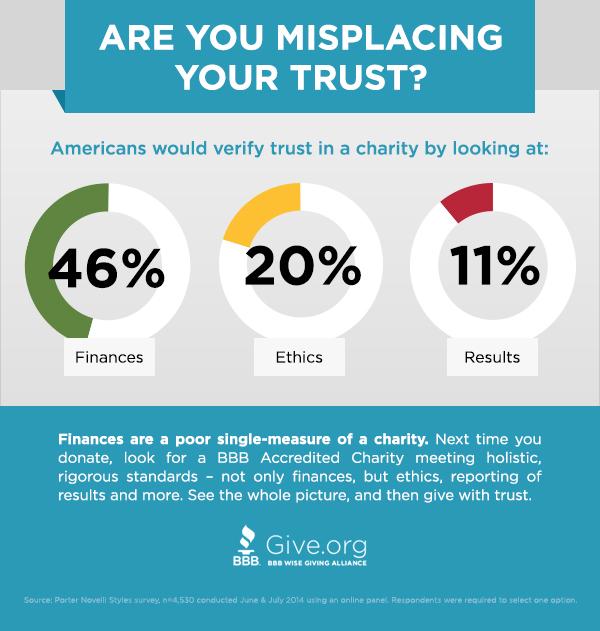
  • The Better Business Bureau Wise Giving standards here.  BBB is a known name and their seal can help as a trust reinforcer online and off.  I wouldn’t put it on your outer envelope since plainer envelopes get opened more, but on reply devices can help.  There’s good stuff here on cause-related marketing standard as well that other ratings don’t go into as much.

    They also made this great chart:

0dac383

  • GuideStar.  If you haven’t been there in a while, they have a beautiful new redesign that helps nonprofits lay out their logic models and the way they are making an impact.  Moreover, they don’t have a bunch of pseudo-experts spending five minutes trying to understand and judge the work of actual experts’ lifetime of experience on a topic like some organizations who will remain nameless (*cough*cough*CharityNavigator3.0*cough*cough).  Instead, they let you lay out your arguments and let educated donors decide.

  • Independent Sector.  While I don’t know of a rating system or a seal that comes from this, the 33 principles are really good and worthy for board governance.

  • Great Nonprofits.  A different model where your constituents let you, and everyone else, know what they think of you.  At first, it can be a little heavily weighted toward the loud disgruntled (as can any rating system: read Yelp lately?), but once you make it a part of your marketing, testimonials will come in, building trust and social proof.

These are all good ways of building trust without resorting to the overhead rate that cheapens us all.

Trust indicators in direct marketing

Inputs, activities, outputs, outcomes, and impacts in direct marketing

I’ve made the case to avoid the easy, seductive, and wrong-headed use of overhead rates as a way of assessing and marketing nonprofits.

However, this rejection can not be nihilistic; we need to be able to communicate what we do and why that matters.

And, more specifically, since we know that people donate more and more often to prevent a bad thing than to create or sustain a good thing, we need to be able to communicate it in this way.

Our activities can fall into four buckets:

  • Inputs: what resources do we have to get our job done?  The biggest of these, of course, are time and money, but people and expertise also fall into this category.  Picture the Apollo 13 scene where they have to turn this filter… into this filter… with this box of stuff.  Inputs are the box of stuff.
  • Activities: what do you do with your resources?  We love to talk about these.  We give our programs fancy trademarked names and want our donors to care about these.
  • Outputs: what do you get by using your resources?  A training program creates people who are trained.  A research effort creates a white paper and a study.  Everyone loves to talk about outputs because there is a number: we filled X beds, we had a Y% graduate rate, we served Z meals.
  • Outcomes/impacts: what is the effect of your outputs?  A humanitarian delivery of food doesn’t end when the food reaches the dock — the output is reduced hunger among this target population.  Some people look at outcomes and impacts as separate things, with outcomes being a short-term implication and impacts being the long-term impact.  For me, there’s short-term, medium-term, and long-term impacts of the action.

Impacts and outcomes are hard.  Did your delivery of food reduce hunger or was it an improvement in overall economic conditions?  Once you increased the graduation rate, did those people go on to live better lives as a result?

Donors provide us inputs.  Their goal is to buy an impact.  They think that with their donation, they can buy a little more good in the world.

And they care not at all about the name of your trademarked program or the number of outputs that you have.

Your job is to connect the dots between the donor providing the input and what change they will help create.

If you are trying to sell someone on buying a hammer and a nail, it’s easy to talk about the hammer allows you to put a nail in a wall.  Someone might say that the goal is really to hang a picture.

But what the person really wants to do is have a feeling of family, nostalgia, and memories.  To do that, you need to hang a picture and to do that you need a hammer and nail.

So, how do you present your programs without resorting to the destructive “88% of your donation goes right to the people we are trying to serve?”

You cut as much out of the middle part as possible.  In Stephen King’s On Writing, he talks about cutting the parts of the book that people skip over reading (even cutting a section he loved but that his wife Tabitha thought was not necessary).  You must do this too.

You need to cut the activities and outputs to the bone.  Your support keeps the boot of despair off of young people, allowing them to succeed as productive adults — and succeed they do: look at Brian’s story.  You will prevent empty chairs at Christmas dinner.  You make sure that our country doesn’t forget those who served us when they have a time of need.

There’s nary a program name or a 14% percent this or a discussion of logic models.  Start with the end in mind.  That’s what lights a fire in someone and causes them to care little for how much an overhead ratio goes up or down.

Inputs, activities, outputs, outcomes, and impacts in direct marketing

Charity Navigator and the overhead myth

The then-President and CEO of Charity Navigator signed on to a letter about the Overhead Myth that you can read here if you wish.  

There are a couple of key quotes in this piece:

We write to ask for your help to end the Overhead Myth—the false conception that financial ratios are a proxy for overall nonprofit performance.

While overhead can help us identify cases of fraud or gross mismanagement and serve as a part of an organization’s dashboard of financial management metrics, it tells us nothing about the results of your work (i.e., how you meet your mission).

So, financial ratios are good for catching really egregious cases of negligence and help nonprofits with their internal metrics but aren’t really something that you should base your decision to donate to a nonprofit on if they are making an impact in their community.  So says Charity Navigator.

Now, let’s look at Charity Navigator’s rating criteria for financial effectiveness:

  • Percent of expenses spent on programs: a variant of overhead ratio
  • Administrative expense percentages: part of overhead ratio
  • Fundraising expenses: part of overhead ratio
  • Fundraising efficiency: the reciprocal of fundraising expenses and thus the same thing twice, just phrased differently
  • Primary revenue growth
  • Program expense growth
  • Working capital ratio

Four of Charity Navigator’s seven rating financial effectiveness are subsets of the overhead ratio that they claim to disavow.  If using overhead ratios to measure effectiveness is an evil practice, meet the practitioners.

Not only this, but they make the overhead ratio more arbitrary by taking out joint cost allocation.  For those who aren’t direct marketing nerds, what this means is if a mail piece is half to get a donation and half to get someone to sign a petition, 50% of the costs go to fundraising and 50% go to mission (and lobbying).

Charity Navigator says “as an advisor and advocate for donors, when we see charities using this technique we factor out the joint costs allocated to program expenses and add them to fundraising.”

The problem with this is only mail and phone scripts are joint cost allocated.  Efforts like walks are determined by the nonprofit to have a certain programmatic and fundraising component (let’s say 90% mission, 10% fundraising).  So if you put a stamp on a mail piece that asks for a donation, it’s 100% fundraising according to Charity Navigator.  If you hand it out at your walk, it’s 10% fundraising.  Were it possible to make an actively negative measure worse, they did it.

It also ignores that millions of Americans relate to nonprofits only through the phone or mail.  It’s where they learn about issues and act on the causes important to them.  To mark all of this as transactional is whatever the opposite of being an advocate for donors is.

Not surprisingly, this distorted view of charity’s financials is used by the general public and the media to perpetuate the overhead myth.  Consider CBS News’ piece on Wounded Warrior Project:

What caught our attention is how the Wounded Warrior Project spends donations compared to other long-respected charities.  For example, Disabled American Veterans Charitable Service Trust spends 96 percent of its budget on vets. Fisher House devotes 91 percent. But according to public records reported by “Charity Navigator,” the Wounded Warrior Project spends 60 percent on vets.  Where is the money is going?”

Thus, Charity Navigator may talk about the problem of the overhead myth, but it’s a problem that they help keep alive.

It should be noted that days after it contributed to the CBS News hit job on Wounded Warrior Project, Charity Navigator launched on its site and email to its constituents a new piece on “finding charities that support our troops.”  A quote:

“Donors can be confident that contributions made to the higher rated charities will be spent efficiently as these charities have low overhead and fundraising costs enabling them to use more of their resources in carrying out their mission.”

But Charity Navigator abhors the overhead myth.

And Brutus is an honorable man.

Going one step further, another thing that overheadmyth.com decries is the myth that charity CEOs are overpaid.  Here’s a snippet from their FAQ:

“This question gets at the heart of one of the most common misconceptions about overhead: that employee and executive salaries are considered “overhead” expenses. In reality, compensated staff members carry out all of the organization’s functions. Specifically, the applicable portion of employee and executive salary expense are recognized or “allocated” to three functional expense categories based on the estimated time staff members devote to carrying out each of these functions: program service activities, administration, and fundraising. While there are some paid staff (such as accounting and human resource personnel) that usually devote all their time to overhead responsibilities, the vast majority of paid staff members cumulatively devote most of their time to carrying out program service activities.

As for the question of extreme salaries, our data indicate that these circumstances are relatively rare. Rather, it is far more of a problem that mid- and lower-paid direct service nonprofit employees are underpaid than overpaid. As a matter of law, tax-exempt organizations are required to ensure that the salaries and benefits they pay their executives meet the IRS’s definition of “fair and reasonable.” That definition varies from nonprofit to nonprofit; to determine what is “fair and reasonable” for a position at a specific organization, you must research what people in comparable jobs earn at nonprofits that are of similar size and that have similar missions and programs.”

Remember, Charity Navigator signed on to this.  Thus, Charity Navigator should be talking about a holistic view of executive pay, right?  They would never conflate executive pay and overhead rates, imply that CEO salaries are all overhead, or use overhead as one simple criterion for valuing a charity…

Not really.  Their page on “10 Highly-Rated Charities with Low Paid CEOssays:

The leaders of these 10 organizations run highly-rated charities, yet they earn far less than the average compensation of $150,000 reported by the over 7,000 charities rated by Charity Navigator. The low salaries help these charities, which have earned at least two consecutive 4-star ratings, devote more than 80% of their budgets to their programs and services. That means that less than 20% of your dollars are going to such costs as fundraising and administration, including the salary of the CEO.”

Not only are they looking at executive pay in a vacuum, but they are also tying it directly to — you guessed it — the overhead rate.

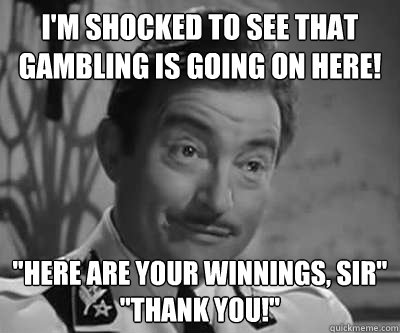
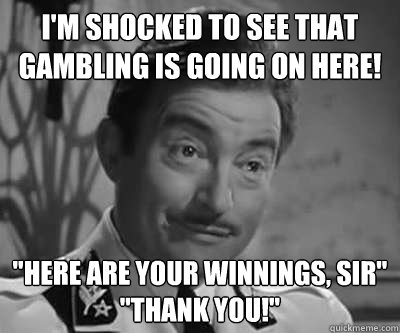
gambling

Image credit here

One hopes that in the long-term, Charity Navigator will either change to meet its purported beliefs, or that they are exposed for what they are: ambulance chasers if ambulance chasers also helped cause the crashes.

So if you are going to crow about your Charity Navigator ranking, please make sure it’s only the part that matters: the Accountability and Transparency sections that, other than their idiocy on privacy policies, are benign at worst and actively positive in many cases.

Because a high score on their Financial section of Charity Navigator means that you are starving yourself.  And I know that’s true because I read it from Charity Navigator.

Charity Navigator and the overhead myth

The seductiveness of overhead rates

As you saw yesterday, I’m partly biased on the issue of overhead rates, because I’m professionally overhead.

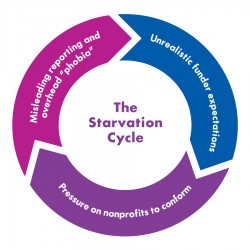
However, overhead ratios are not just a suboptimal way of evaluating charities.  If that were the case, you could say stand them being part of the mix as people evaluate nonprofits.  In reality, they are actively negative ways of evaluating nonprofits — to a point, the nonprofits that do the “worst” on overhead are actually better and more effective organizations.  They avoid the starvation cycle outlined in Gregory and Howard’s article and are investing enough to build the infrastructure of a vital, vibrant organization.  

the-starvation-cycle-e1374848049660

Credit to DNA Creative Communications

Additionally, consideration of overhead crowds out consideration how much impact a nonprofit is having.  Leaving aside for the moment the obsession with overhead that caused Charity Navigator to rate an active scam of a cancer charity with three starsthere is research to bolster this negative impact of overhead.

The journal Judgement and Decision Making called this the evaluability bias: people look for and want one easy number that tells them how good something is.  They found that when people are presented with a charity, they look for a low overhead rate and value it for its own sake.  However, when presented with two charities and both overhead and effectiveness ratings, they valued effectiveness over overhead ratios.  This means that people actually care more about whether a charity is effective or not at what they are trying to do.

In other words, they look at overhead ratios because they are easy, not because they are good.  

One is reminded of the man who is looking for his car keys under a streetlight.  A policeman comes over and asks what the man is doing.  After the explanation, they both look under the streetlight together. After a few minutes the policeman asks if he is sure he lost them here, and the guy replies “No, I lost them in the park.”

“So why are you searching here?”

“Because this is where the light is.”

Part of the obsession with overhead rates is because Americans believe nonprofits spend far more on overhead than they do.  This is no doubt spurred by news stories about the grossest abuses of nonprofit status and, because we can remember these, the availability bias kicks in.  We forget that the reason that the story is news is that it is the exception and not the rule.

Part of this obsession is self-inflicted.  We nonprofits are the ones who talk about how XX cents out of every dollar goes to the mission and not about how giving to others is life-affirming and one of the most powerful positive things about being human.  We plant trees so that those who come after us can sit in shade.  It’s a beautiful thing with real impacts, cheapened by a discourse of whether you spend 6.2% or 6.7% on administrative costs.

And part of it is that overhead ratings and discussions of CEO compensation are baked into some “charity watchdogs.”  I’ll cover Charity Navigator and their hypocrisy on overhead ratios tomorrow.

The seductiveness of overhead rates