Anchoring, ask strings, and the psychology of first impressions

One of the most talked about cognitive biases, for online donations especially, is anchoring. Anchoring means we rely on the first piece(s) of information we get about something more than the last.

Where this comes into play most often, and intuitively, for nonprofit direct marketers is in ask strings. People tend to key on the first value of the ask string most. Ordering your asks from high to low will increase your average gift and decrease your response rate; low to high will do the opposite. In our The Science of Ask Strings post (which is currently the most visited post on the blog, so don’t be left out (we talked about fear of missing out yesterday…)), we saw single givers were more pliable on the anchor than multi givers. Single givers receive an anchor from you; multi givers have their anchor already in their minds.

This piece of information doesn’t have to be an all relevant. People were asked to recall the last two digits of their Social Security number, then tell how much they would pay for an item. Those with higher numbers gave higher prices by 60-120 percent. This is why if you have a focal point number in your piece, it’s good to make it higher than your average gift. If you usually say four people die every hour, move it to 96 people die every day; that 96, if highlighted, will ask as an unconscious anchor on giving.

Anchoring can tie very deeply to social proof. If you give people the impression that most people are doing a thing, that’s an anchor. If you give the impression that most people don’t give, that also is an anchor for not giving. Last time, I picked on Wikipedia’s fundraising for this; now it’s Charity Navigator’s turn:

CN social proof2

I think they think they trying to anchor people to give $50 or more and they may be increasing their average gift with this because of this. However, when the first thing I hear is that less than one percent of people give to Charity Navigator, I’m less likely to give. Or I would be if my personal likelihood were not already a negative number.

The anchoring/social proof crossover also supports letting people know what the average person like them donates. As you might guess, people who have their anchor set by social proof higher give more. What this study found is people are more influenced by what their in-group was doing than their out-group and thus more anchored by their giving. Thus, I would bet good money that “most people give X” beats no anchor and that “most Texans (or whatever) give X” beats “most people give X,” because it’s a closer in-group.

This also manifests in peer-to-peer fundraising. It’s vital to educate fundraisers that the most important gift they get will be their first one (ideally, the one they give to themselves). If that first gift is $100, they will almost certainly raise more than a person who gets a $10 initial gift. Since peer-to-peer fundraising is more giving to a person than giving to a cause, people want to know what a socially acceptable donation is. We want to tell them the right number.

It probably goes without saying, but don’t advertise average gift to people who give more than the average gift.

Finally, there is an anchor you might not think about that falls into the Blink category of quick reactions. You know that first impressions matter, but you may not know how fast is fast. Research shows that people form a solid impression of a Web site in 50 milliseconds.

For perspective, a blink is at least 100 milliseconds. So in the time of half a blink, people have judged your Web site.

So the big question here is what is your first impression? Especially for mobile, what loads first on your site (if anything)?

You may want to make sure that it is your name, what you do (in quick, not in mission statement, form), and a call to action (whether donation or not). Because a second is an eternity now to set your anchor.

Anchoring, ask strings, and the psychology of first impressions

Cognitive biases, loss aversion and your nonprofit marketing

1410734667Last week, I used a magnet strip on a plastic card to buy passage on a giant metal bird. The bird leaders asked me to turn off the thing the size of my palm that connects me to all human knowledge, but I could use my book-size thing.  In two hours, the bird took me to a place that I couldn’t reach in a season by walking.

And yet you and I have the same mental equipment that supported our deep ancestors to decide only the four f’s: fight, flee, feed, and, um, well, when two cavepeople love each other very much (or are just anatomically compatible)…

We may stand straighter with less hair and more clothing; mentally, we haven’t changed as much as we’d like. 

We deal with this by taking mental shortcuts, or heuristics, constantly.  There’s a good, bad, and ugly to these biases.  They allow us to function in a complex world and many of them (e.g., trial and error) are pretty good rules of thumb.  However, many of our worst tendencies are in this primitive coding.  They poison our unconscious mind.  For our ancestors, it was useful to use the heuristic that the more the thing looks like me, the more likely it is a friend.  For us, that’s called racism, sexism, and many other unpleasant -isms.  

Heuristics lead to cognitive biases, where we skip over a number of steps in the thought process  to arrive at conclusions.  That’s what we’re going to talk about this week: cognitive biases and how to either use them or mitigate them in your direct marketing.

One common bias we have is loss aversion.  People hate to lose things more than they like to win things.  This sounds nonsensical, but here’s an example from the literature.

Scientists asked people to imagine preparing for the outbreak a disease expected to kill 600 people. If Program A is adopted, 200 people will be saved. If Program B is adopted, there is a 1/3 probability that 600 people will be saved, and 2/3 probability that no people will be saved.  Seventy-two percent of people opted for program A.

They also asked people about two other programs.  If Program C is adopted 400 people will die. If Program D is adopted there is 1/3 probability that nobody will die, and 2/3 probability that all 600 people will die.  Seventy-eight percent of people opted for program D.

The thing is that programs A and C are the same and programs B and D are the same.

The study is here.  All that changes is the framing device.  People hate the option of program C — that 400 people will die.  And they hate the option of program B, where they can’t lock in gains.

The authors conclude that people faced with choices involving gains are often risk averse.  However, we will take risks to avoid losses.

This is partly intuitive.  Picture two gamblers.  One has an early run of luck and is trying to sit on his lead.  Another has an early run of bad luck; she starts wagering more and more to try to get back to neutral.

So, the obvious implication for nonprofit direct marketing is that you aren’t trying to do good things; you are trying to prevent bad things.  People are more likely to donate to prevent a negative than to preserve a positive.

But you can read other blogs to get the obvious implications of things.  There are two other important implications of loss aversion to nonprofits.

The first has a recent snappy acronym: FOMO or fear of missing out.
 enhanced-13539-1397047008-6

Something doesn’t have to be as dramatic a loss as death for people want to avoid it.  Sometimes it’s as simple as opportunity cost: the idea that you could be doing something other than what you are doing.  This dovetails with the scarcity/urgency persuasion trigger discussed here

You can trigger this fear by:

  • Having a time deadline on your action.  I’ve done this with matching gifts (which is why I’m only testing the lead gift strategy described here and not rolling out with it).  In both mail and email, these are the only communications I see where the follow-ups do better than the initial communication (because they are closer to the deadline).
  • Having unique benefits that belong to an exclusive few.  This could be an invitation to a gala or access to information before the hoi polloi.  
  • Asking people with exclusive access to information to share it.  You can trigger FOMO if juicy tidbits might be shared with someone’s social network (in the broad and specific senses) before one has a chance to share it oneself.

The second is that dollar signs trigger fear of loss.  There is an excellent study of this on restaurant menus, which is why you see high-end restaurants put 38 sans currency market or cents next to that duck a la orange.  They don’t want you to have a fear of losing your money, but rather want you to focus on what you can get.

The problem is that, in my limited experience testing this, forms and reply devices without dollar signs look a little bit silly.  I’m hoping that we can make this the standard over the long term, but for right now, they seem required.

However, we don’t have to do it in the letter or email copy.  Spelling out dollars instead of putting the currency mark alleviates the fear of the recipient until they (hopefully) have already made the decision to make the gift.*

Tomorrow, we’ll talk even more about ask strings with the cognitive bias of anchoring.


* Why is this section green?  Because after I posted this blog post, there’s now some evidence that many of the money priming studies aren’t able to be replicated.  Additionally, there’s evidence that there were negative results that were not reported.  There’s a good write-up of this at Discover Magazine’s Neuroskeptic blog and I learned about it from Andrew Gelman’s blog here.

I feel I owe it to you both to not change my original post (and thus to admit when I’m wrong) and to let you know about the change, so this is my mea culpa.  If you have other ideas as to what I should do in these circumstances, email me at nick@directtodonor.com.

Cognitive biases, loss aversion and your nonprofit marketing

Influence in direct marketing: scarcity at work

Scarcity as an influencer should be of no surprise to those who know basic economic theory – as a good gets more scarce, assuming demand remains the same, the price will rise.

Given this, you might think it has no impact on nonprofits, as we sell no goods.  Even the corollary to the supply and demand argument – the idea that there is a psychological fear of missing out that makes people want an item more – doesn’t work for nonprofits, given that one person’s donation makes you no less able to donate.

And yet scarcity can be a powerful motivator in nonprofit direct marketing when harnessed correctly.  Here are five ways how:

Back-end premiums.  This is a way of mixing scarcity with reciprocity.  In the reciprocity piece, I mentioned that back-end premiums (aka the public radio tote bag model) can help increase your donations.  Now, what if there were only so many of those tote bags, calendars, or whatever other premium you have available to go around?  By limiting the premium to only the first X number of people who donate (or take whatever other action you are aiming for), you can have scarcity working for you.

I would recommend layering on a third influencer – social proof – and setting the number of giveaways above what you would expect to get in terms of actions.  This not only mitigates the likelihood that people will take your action and not get the potential reward.  It also has the benefit of making it seem like many people will be taking this action.

Matching gifts.  A matching gift deadline can create scarcity of time – by limiting the amount of time someone has to make a gift in order for it to double, you create urgency in the desire to give that gift.

Exclusivity of information.  In reciprocity, I mentioned that giving someone information that they wouldn’t be able to get elsewhere is a good way of creating the desire in them to reciprocate.  The key part of this is that the information must be scarce – giving someone something that the general public would or could know does not trigger the desire to reciprocate.

Done well, you can also build in authority and/or social proof to this.  Let’s say you do a conference call with a select group of high-dollar donors (scarcity).  The lead speaker is an expert on the harm that your cause is trying to end (authority); supporters can ask questions of him/her (reciprocity and scarcity, as you are providing a unique experience for them) and hear that there are other interested donors on the call (social proof).  Then you follow-up with a transcript of the call for everyone who was invited but couldn’t attend to make sure they can this important information.

Exclusivity of opportunity.  This can also work well with social proof.  Which one of these volunteer opportunities is more appealing:

  • We desperately need more people to help serve lunches this week to the homeless.
  • There are only six slots left to help serve lunches this week; we may have more opportunities available next month, but it is first come, first serve.

Through a reframing, you have turned your lack of volunteers into an exclusive experience for those people looking to help.

Event exclusivity.  Many of your high-end type events are exclusive in terms of guest list, but there are opportunities for exclusive beyond just this velvet rope effect.  Table sponsorships are one: as you will only have so many tables, you can advertise the number left (and, if you are doing well, ask sponsors to reserve their spots for the following year).

Then there are auction items. In a traditional (non-Dutch) auction, auction winners are like the Highlander: there can be only one.  The exclusivity of a package leads to higher prices as both the auction structure, which economics shows is the way to get the good to the person willing to pay the most, and the fear of missing out on an exclusive good conspire to maximize the price achieved.  The best nonprofit auction images are experiential items that cannot easily be purchased on Amazon – this exclusivity makes it so that only one person can possibly get the item.

The exception to this was a nonprofit I worked with that had an auction item go far beyond the expected price.  Apparently, while the bidding was ever-increasing, they were able to talk with the person providing the experience and negotiate another package.  Thus, at the end, they were able to provide a package to the second-place bidder as well, doubling their rewards.  This was a brilliant strategy – using exclusivity to get the maximum possible price, then expanding the pool (only slightly, so as not to cause regret among the first-place bidder) to maximize returns.

This week has been dedicated to the idea of major influence levels you can use in your direct marketing and development areas.  I would be remiss if I didn’t once again recommend the original book itself, as it has examples behind what I’ve provided here.  Thanks for reading and I’d love to hear examples you have from influence in the comments section or (if you are willing) in a guest blog post – just email me at nick@directtodonor.com if you’d like to post your success story.

Influence in direct marketing: scarcity at work

Influence in direct marketing: authority at work

I debated whether to do this one.  I have a bit of an anti-authority, and a definite anti-authoritarian, streak.  When you read about authority as a form of influence, you can delve into some very dark parts of what it is to be human.  There are famous Milgram experiments, where people generally gave shocks to a test subject to the point that the person would be in severe pain or dead just because they were told to.  And the Stanford prison experiments show “absolute power corrupts absolutely” isn’t just an aphorism to be stitched onto the world’s most off-putting throw pillow.

But authority is a form of influence.  And it’s one that nonprofits can and should wield.  After all, quite frequently, nonprofits are experts within their own realms and those with great expertise serve on their boards and as volunteers.

Testimonials in various forms can help validate your nonprofit in the minds of your supporters.  Some of that, as mentioned earlier in the week, can and should be from individuals who support your individuals as close to your target audience as possible.  But an authority pitch, with external validators, can be helpful as well.

So can burnishing your credentials.  One test to run online is whether an online security badge can increase your donation form activations (sometimes it does, sometimes it doesn’t).  A seal from the BBB can likewise be tested (just don’t use your Charity Navigator perfect score – that isn’t a badge of honor).

Talking about influential donors can also help.  Dean Karlan and John List did a study that found two things.  The first, no surprise, was that a matching gift increases response rates.  The second was that identifying the matching donor as the Bill and Melinda Gates Foundation (versus an anonymous matching donor) increased response rates by over 20%.  This effect also lasted past the matching period, which is unusual for often ephemeral nonprofit solicitation.

This would tend to indicate that the Gates authority is rubbing off on the nonprofit they are supporting and that their authority is a signifier for other donors.  Celebrities can also be a nice validator for certain audiences.

Finally, a successful authority technique that I’ve seen is to send copies of positive editorials or stories about a nonprofit’s impact to donors.  It’s one thing for a nonprofit to tell you how great they are and how great you are for making their work possible.  It’s another thing for an unbiased external source validating your choice in cause.

So that’s authority.  I hope you’ll join us for the scarcity discussion tomorrow.  It’s the last in the influence series, so you’ll want to be sure to read it.

(Yes, of course I planned the scarcity post as the last one.  Why do you ask?)

Influence in direct marketing: authority at work

Influence in direct marketing: liking at work

you-like-meHat tip to The Interview Guys for the image

Liking sounds like it is exclusively the property of face-to-face asks, where you work to be liked so as to directly solicit a gift.  There’s a reason that we direct marketers stay behind a desk while our glad-handling extrovert brethren ask for major gifts. (In my case, it’s introversion, a love of numbers, and a face most suitable for print.)

Did that self-deprecating humor make you like me more?  Good!  Then we can continue with the post.  (Also probably for the best that you think it is self-deprecating; there’s a reason this blog has no picture of me.)

There are three major areas in which the psychology of liking can give us a significant advantage, even when we aren’t physically with a person.

The first is in persona.  Not the hip marketing term where you put a name, face, and demographic/psychographic profile of your constituents, also that’s a bit of the idea.  Rather, it’s who the virtual faces to your brands are in your various communications.

In The Audacity to Win, David Plouffe talked about their digital strategy for fundraising and who quality signers were for various content:

To keep things fresh, we varied the length and tone of the messages–some were long and informative, others quite short and informal. Perhaps most important, we learned that people responded very well to e-mails from Michelle Obama and that we needed to use Barack somewhat sparingly–when he signed an e-mail it always produced by far the biggest response, but we did not want this to become a stale event. So many of the e-mails came from me, though when we needed a big response to an ask–for money, volunteer time, or to watch an event–we made sure the e-mails came from the Obamas.

To me, this speaks to a compartmentalization of voice: Barack Obama was the primary persona in the campaign, used for speeches, policy positions, debates, etc. etc.  Because he was everywhere and in every media, a communication needed to feel special.  However, Michelle Obama did not present in the same way.  A communication from her was able to touch different emotions, make different points, and, frankly, be liked in a way that you can’t like a person that you agree with even 90% of the time, because that 10% will always be in the way.

So who are the different voices in your organization and how do you use them?  I would recommend an inventory of people and uses.  For some, a victim/survivor is one certain type of voice.  A head of policy or government affairs can be the attack dog that your advocacy supporters and donors want to hear from.  A development staff member or volunteer can be used for institutional appeals – renewals of membership or reminders to fulfill pledges – so that your passionate voices aren’t drawn into this bureaucracy.  A celebrity can bring in his/her followers to the fold, even if they are loosely affiliated at first.

And so on.  Some even might want to transcend the human – would an animal charity want to have an official spokesdog?  I recommend using a person as a mouthpiece for a specific type of communication to a specific type of person who wants to receive that communication and will like the person who is the messenger. 

Don’t have institutional messages that aren’t from someone.  So many e-newsletters fall into this  trap.  They are from the National Conglomeration for the Amelioration of Sesquipedalianism, when they could be from Rachael.  I don’t know Rachael, but because she’s a human, people will generally like her more than the monolithic NCAS.

The second is in being liked by liking.  As with consistency, praise for past actions will get you everywhere.  People generally like people who like them.  Similarly, flattering works and since I mentioned that yesterday, here’s another study that shows this, lest I not be giving you sufficient value.

The third major impact of liking is that people are more likely to like people like them.  I’ve seen a 30%+ increase in response rate to a communication when people were told that the story they were hearing happened in their own state – and that includes states like California or Texas, where the case may not have even been within a full day’s drive.

Similarly, people reaction better to communications from, and about, people of similar age, background, religious persuasion, racial or ethnic breakdown, educational background, and so on and so on.  This is not to say that you should go out and create “the Hispanic mail package.”  In fact, please don’t.  But customization can help you talk about how the problem you are trying to solve affects the people like the person you are talking to.

These rich details given a good picture of a person and the more someone can picture a person, the more they like and empathize with that person.

So these help your communications make your voices, and you, more liked and bring in donations.  After Christmas, we’ll talk a bit about authority in influence.

Influence in direct marketing: liking at work

Influence in direct marketing: commitment and consistency

Just like people tend to do what other people do, people also tend to do what they themselves have done in the past.

Emerson said famously that “A foolish consistency is the hobgoblin of little minds, adored by little statesmen and philosophers and divines.”  Of course, that’s probably what he always said.

Our mind is wired to think we were right more often than we actually were.  Moreover, we have cognitive dissonance as a tool to help us justify these feelings.  So if we are right all the time, then why wouldn’t we keep doing what we are doing?

This is especially true for older supporters.  A study called “Evidence of a Positive Relationship between Age and Preference for Consistency” (with Cialdini as a co-author – he shows up a lot of different places) found that as we get older, we tend to want to have consistent thoughts, people in our lives, and patterns.  Since a large portion of most nonprofit direct marketing audiences skew older, this is particularly salient for us.

There are four key ways that consistency can work well for you in your direct marketing efforts:

  1. Getting your foot in the door. A small act toward your cause can cause a person to believe that they are the type of person who supports your cause.  This can be an email to their legislator putting up a sign of support, or downloading your materials.  Any small step can be referenced in asks for further, difference, and more valuable asks.  One of the executives I’ve had the honor of working with and for says “if you want to get money, ask for advice; if you want to get advice, ask for money.”There is a concern among some that so-called slactivism – taking on issues online by the least time-consuming means possible hurts “real” efforts.  I would argue that not only have well-run online campaigns changed hearts, minds, and/or votes, but also that these campaigns lend themselves to commitment-based follow-ups with language like “you’ve stood with us before; will you stand with us again” that uses commitment tactics.
  2. Flattery.  This should be easy, in that your donors and supporters are the people who make your valuable mission possible.  Telling them that, however, is not done often enough.  There was a recent quality study that looked at how recalling good deeds affected giving.  They found that when the study subjects primed themselves by recalling their past good deeds and perceive themselves as strongly moral people, they gave twice as many charitable donations as participants who recalled bad deeds.
  3. Playing back consistency. This can be as simple as variable copy letting the person know you know how long they have been giving.  After all, if you are told that “for 14 years, you have stood alongside poor suffering discarded stuffed animals,” who can resist a 15th year?
  4. Honoring consistency. Sending a communication on the anniversary of someone’s initiation with an organization not only gives them a nice feeling, it also reinforces that they are the type of person who gives to organizations like you.  Similarly, published donor rolls are both a great recognition tool and an advertisement on behalf of that’s person’s donation to you.

You should not rest exclusively on consistency’s laurels – expecting someone to give to you just because they have always given is a fool’s errand.  However, you probably noticed that many of the above techniques mix the reminder of the consistency with a reminder of the impact that someone is having or how good it feels to give.  That’s a good way to mix consistency with liking, which is what we’ll talk about tomorrow.

Influence in direct marketing: commitment and consistency

Influence in direct marketing: social proof at work

Observational comedy sometimes gets a bad rap as people complaining about airline food and never ending string of “what is the deal with X?”.  For my money, however, someone like a George Carlin or Jerry Seinfeld get to greater truths about the absurd reasons and non-reasons why we do what we do.

So for social proof, I’ll turn it over to Jerry Seinfeld to start:

99billion2006-05-20


Why is McDonald’s still counting? How insecure is this company? Forty million eighty jillion killion tillion….is anyone really impressed anymore? Oh eighty-nine billion sold! All right I’ll have one. I’m satisfied.

Who cares? I would love to meet the chairman of the board of McDonalds and say, look, “We all get it, ok, you’ve sold a lot of hamburgers, whatever the hell the number is, just put up a sign, ‘McDonalds, we’re doing very well. ‘”

What is their ultimate goal to have cows just surrendering voluntarily or something? Showing up at the door. “We’d like to turn ourselves in, we see the sign, we realize we have very little chance out there. We’d like to be a Happy Meal if that’s at all possible.”

This sign is here as a signifier of social proof.  The implication here is not trying to get cows to surrender – it’s to get people to surrender.  Social proof is when people assume that everyone else knows what they are doing and, as a result, they should do likewise.

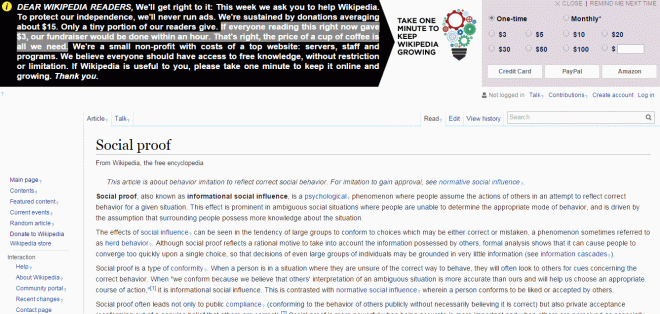
If you want a workable definition of irony, check out the Wikipedia page for “social proof.”  Here’s a screen shot:

social proof

See that banner at the top?

wikipedia header

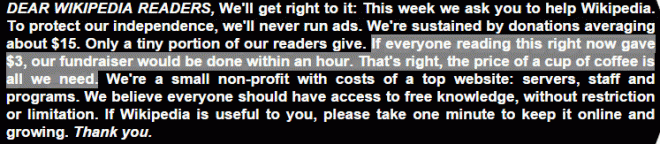
There’s a key counterproductive sentence in here (although there are other problems with this): “Only a tiny portion of our readers give.”

What Wikipedia is signaling, on top of this article about how people tend to do what other people do, is most people don’t donate to us – you shouldn’t either.

There is a famous study cited by Cialdini and many many other (in fact, it’s part of Yes!, another great book on influence) with the Arizona Petrified Forest.  They found that a sign that has negative social proof significantly increases the likelihood that someone will do something bad. In this case the sign said:

“Many past visitors have removed the petrified wood from the park, destroying the natural state of the Petrified Forest.”

In essence, this sign says out loud what your mom warned you about – everyone else is jumping off a bridge and you should too.

Yet Wikipedia is far from alone in using this tactic.  How many gap appeals have you seen that say, in essence, “not ask many people are donating as they had been; please give generously”?  These types of appeals are fraught with social proof peril.  Personally, I’ve only seen them be effective either when the gap is due to something outside of the nonprofit’s control (e.g., “you and people like you have been more generous this year than ever, but the loss of this government grant imperils…”) or when the gap is due to increased need (e.g., “Hurricane Oberhauser means that more people are homeless; can you help immediately?”).  To admit others aren’t supporting your nonprofit is counterproductive.

That said, social proof can be used for good.  People are more likely to support a nonprofit when the list of people supporting it before them is longer (see, for example, this study).  With major donor campaigns, it is common to have a quiet period where funds are raised to get to around 40% of the overall goal.  Donors during this period are told, correctly, that they will be helping with this effect.

But it works for small donors as well.  A challenge fund, in addition to creating scarcity/urgency, which we will talk more about, also communicates that other people are supporting this cause – you should too.  The thermometer on the side of walk pages works much better when there are people already supporting the cause.

Similarly, you may want to test “Join 324,224 members” instead of your “Become a member” button.  “Join” is in particularly a powerful word in this respect because it implies that you are becoming a part of something larger than yourself.

Pre-seeding campaigns works.  One nonprofit of my acquaintance starts recording donations for their year-end campaign in mid-November, but only puts the thermometer up in December, so that the social proof is in place when it is most likely to be helpful.

Another form of social proof is testimonials from your current donors.  A good donor story can be very effective in a newsletter.  One part of this that we’ll talk about more in the authority post is that it’s especially effective when it is a like person giving the testimonial – similar age, race, name, state, etc.  The message “people support this” is good; the message “people like me support this” is better.

Pictures also work well alongside testimonials.  A great study on what Stephen Colbert called “truthiness” (whether something “feels” true, not necessarily whether it is true) found that having pictures alongside of a truth claim makes it feel more true.  Thus, if you can get the picture of the person making the testimonial, the testimonial will tend to ring more true.

Have you seen strong examples of social proof in action?  Please leave them in the comments – everyone else is.

Influence in direct marketing: social proof at work

Influence in direct marketing: reciprocity at work

As direct marketers, we gradually become experts in why and how our donors give.  But sometimes, we can get into the weeds of control communications (“this matching gift appeal works; let’s send it again”) and forget the mechanisms by which communications work.  At least I’ve done this; your mileage may vary.

So, I’ve found it to be helpful to delve back into first principles periodically.  One of my favorite resources for this is Robert Cialdini’s Influence.  As an insight into why people do what they do, there are few better (although David McRaney’s You Are Not So Smart and You Are Now Less Dumb are great looks into cognitive biases that are a fun read and thus I will get to in other posts).

For the TL: DR version of this book, there’s an HBR summary of it here .  Cialdini articulates six principles of influence that are both core and common across cultures:

  • Reciprocity
  • Authority
  • Social proof
  • Consistency
  • Liking
  • Scarcity

Think of each of these as a way to make yourself more persuasive and have more influence that you can incorporate into your causes’ way of talking with your constituents.

I’ll take each of these in turn to give my thoughts on how these levers can be used in old and new ways.  And, since there are six of them, I’m going to use this as an opportunity to test writing on the weekends.  So for those avid followers of this blog (thanks, mom and dad!), I’ll be skipping Christmas and writing on Saturday and Sunday this week.  We’ll see how it goes.

I’ll start with reciprocity – the idea that doing something for someone makes them more likely to do something for you.  I’m starting here because this was the first one I encountered in spades in my first nonprofit direct marketing program.  In fact, it’s what many people think of when they think of direct marketing solicitations: premiums.  Whether it’s a front-end premium of labels, calendars, address books, pins, or whatever tchotchkes we can figure out how to flatpack in an envelope, or the back-end premiums exemplified by the donate-to-PBS-get-a-totebag model, these have become ubiquitous.

This is because they work; the principle of reciprocity is such that if we are given a gift, we feel obliged to respond in kind.  Add a well-thought out premium to an acquisition package and you will likely see a jump in your response rate.  In fact, this jump will be highly correlated with the perceived value of that premium.  While there are a thousand studies of this hidden behind all of our nonprofits’ firewalls, there’s a good published one here.  It shows a 17% increase in giving when a person is given a small gift and a 75% increase when they are given a large one.

There are cautionary notes to strike, however.  A program build on premiums – back or front – can become a one-note piano.  Ideally, you have a broad mix of communication types and influence levers with your constituents.  Some of the people you will acquire from premiums will be responsive only to those premiums and value your organization only for the things they get from you.  This can preclude effective upgrade and bridging strategies.  Additionally, the donors you get from these efforts can be attracted to other organizations by other premiums (or the same premium as you send).  As a result, they may become prolific tippers of nonprofits.

As a result, a program build on premiums and premiums alone will tend to have lower average gifts, lower retention rates, and a great challenge trying to kick the addiction they and their donors have to these gifts.  This is by no means to say premiums have no place in a nonprofit program, but that it’s best of they are one of the many things you do to attract and retain donors, rather than the sole one.

Cialdini says it well in his HBR article: “Ultimately, though, gift giving is one of the cruder applications of the rule of reciprocity.”

There are higher value forms of reciprocity to be had in your direct marketing program, beyond the labels and the notepads.  The first is that value does not have to be measured monetarily.  As I’ll talk about in the post on scarcity, exclusive information can be something of great perceived value that a person would want to reciprocate (a note here that these forms of influence almost always work better together than alone).  Similarly, a paper clip on a mail piece is an interesting signifier that human hands have touched the mail piece.  This human touch means that a mere machine didn’t just pre-digest this mail piece and spew it out to you; this signifier can be something that helps bring people to you.

It’s also important to look at reciprocity from the donors’ perspectives.  Sometimes you will get gifts that are a perceived payback from a donor, whether they were directly touched by your services or indirectly.  One key point here is to try to capture what a person’s connection is to your cause and customize to this.  It’s important that the principle of reciprocity says that this is something that something people want to do; the need to have our ledgers square is hardwired into us.  You can help these folks given back in the way they want to and thank them for it.

Thank you’s are also an important part of reciprocity.  Research shows that people give to causes not because they expect anything concrete in return.  Rather, they build up two expectations over time.  One is recognition for their gift, whether publicly or not.  This is a reciprocity that the donor will expect of you.  The other is performance – that you will use their donation to make the impact they would like to make.  If either of these comes as a surprise, please read my post on why we thank everyone for their gift.

We started with premiums and that’s the primary reciprocity lever at work in most nonprofits.  But it’s important to remember that just as we give gifts to people in the hopes they will reciprocate, they also expect that we will reciprocate when they give us a gift.

Influence in direct marketing: reciprocity at work