6 intermediate cost-per-click techniques

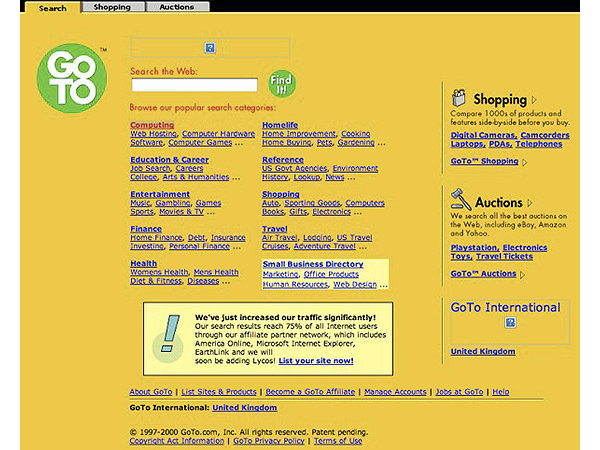
The original cost-per-click (CPC) search engines did their listings strictly by what you were willing to pay per click.  (I actually used Goto.com for CPC listings, before it become Overture Services, before it became Yahoo! Search Marketing.  Nothing like Internet time to make one feel old).
500004804-03-01

Yes. This was once a thing.  A big thing.

Google’s algorithm, however, takes the quality of the ad and the site into account.  This is partly because you will come back if you have positive experiences on the site and partly because it maximizes profits.  For the same reason that you would look at gross revenue per mail piece/phone contact/email/carrier pigeon instead of just response rate in isolation, Google looks at gross revenue per ad shown as the backbone of its infrastructure.

Thus, it is in your interest to maximize your click-through rate (except in one very special case I’ll discuss on Friday); you can pass your better bidding brethren by beating them on quality.  Hence the focus on things like negative keywords and phrase matching yesterday: you want to get your clicks on as few ads as possible.  An average quality score from Google is a 5.  If you are at a 10, your cost per click goes down by 50%; if you are at a 1, it goes up by 400%.

Targeting smarter also helps you get clicks from the people from whom you want to get clicks, instead of those who didn’t understand what they were getting into from your ad.

So here are a few techniques to help get to the next level of pay-per-click success:

Check in on your keywords regularly. This should be at least weekly; daily would be better.  It doesn’t have to be for long, but Google will keep giving you helpful tips on additional strategies and keywords to try.  You can also see what is performing and what isn’t, retooling ad copy for underperforming ads and learning which landing pages aren’t converting as well.

Set up conversion tracking.  In the beginning, Internet advertising was sold in CPM – cost per thousand impressions and the earth was without form, and void.  Then came CPC – cost per click – where you pay for an action, rather than a view.  The ultimate is going to be cost per conversion, where you only pay when you get a donor (or other person you are desiring), and you can set your goals accordingly.  Companies won’t want to do this because they have to rely on you to convert, rather than themselves, but it is semi-inevitable.

You can have this advantage right now if you set up conversion tracking.  You will be able to see how many people convert and, if they give donations, how much you get from the campaign.  Seeing how much you get from a campaign ahead of time, then bidding, is like playing poker with all of the cards face up – it’s remarkable how much better it makes you.

Unbounce your page.  Not every page converts well.  With conversion tracking set up, you can tell if your page is repulsing potential constituents.  Testing with Google solutions or a solution like Optimizely can help you convert more people and lower your CPC costs as your quality score goes up.

Set up dynamic keyword targeting.  A person is more likely to click an ad that has the exact words that they put into the search engine in it.  The trick is that people put all sorts of things into search engines.  With dynamic keyword targeting, it doesn’t matter if they put “rainforest deforestation,” “rain forest deforestation,” “tropical forest deforestation,” “destruction of the rainforest,” “tropic rainforest deforestation,” etc., into the search bar, you can add those specific words into your ad.

Geotarget your ads.  This is especially true if you are a nonprofit with a limited geographic reach.  If you are an early childhood intervention provider in Dallas, you likely don’t want Seattle searchers.  However, this applies even to national and international nonprofits.  If you have chapters, or state-specific content, you can direct those specific searchers to the area more relevant for them.  This works especially well for things like walks and other events, where people will likely only come from a certain distance around to the event.

Go for broke.  If you do get a Google Grant, try to use every cent.  Not only will it get you more traffic, more constituents, and more donors, but it will also allow you to apply for more money.  Your first steps to worldwide nonprofit domination await.

I hope these are helpful.  Please leave any tips you’ve found useful in the comments section below.
6 intermediate cost-per-click techniques

Onboarding for donors and supporters

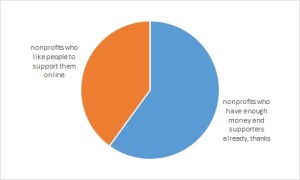
According to the Online Fundraising Scorecard, 37% of non-profits did not send an email within 30 days of a person signing up for emails. Only 44% asked for a donation by email within 90 days.

Let me put this in an approximate pie chart:

online supporter pie chart

We’ve seen this week that getting the second gift (or lack thereof) is where there is the greatest retention leak – people who donate once and don’t get enough out of the experience to donate again. Online donors, in particular, are the most fickle and least likely to retain.

This could be because of the medium. But it also could be that over half of all non-profits do engage people right when they express the most interest in the organization – immediately and unequivocally. To demonstrate this, try to remember what email newsletter you signed up for a month ago today.

Chances are, you can’t. Thirty days is a long time to remember you signed up for something, especially if no one reminds you that you did. Replace “the guy” with “the donor” in this quote and you have a pretty good idea of how people think about your organization, at least initially:

Never assume that the guy understands that you and he have a relationship. The guy will not realize this on his own. You have to plant the idea in his brain by constantly making subtle references to it in your everyday conversation, such as:

— “Roger, would you mind passing me a Sweet ‘n’ Low, in as much as we have a relationship?”
— “Wake up, Roger! There’s a prowler in the den and we have a relationship! You and I do, I mean.”
— “Good News, Roger! The gynecologist says we’re going to have our fourth child, which will serve as yet another indication that we have a relationship!”
— “Roger, inasmuch as this plane is crashing and we probably have only about a minute to live, I want you to know that we’ve had a wonderful 53 years of marriage together, which clearly constitutes a relationship.”

Dave Barry, Dave Barry Complete Guide to Guys

You want to strike while the iron is hot – this person cares about your cause now. So you want to set up a welcome series for your donors online. There are some great guides on how to do this and I promise to write one in a future blog post. For now, here are some key tips:

  • Start with a thank you. This person is interested in your organization. They have given you their time and attention. They sound like a pretty cool person who is giving you a fairly valuable thing. This should be rewarded with good manners.
  • After that, if you have a key offer, lead with it. For some, you may be emailing them a temporary membership card. For others, it’s an opportunity to get involved with advocacy. Surveys are also good. Whatever people like to do with your organization online, use it to build their engagement and learn about them.
  • Yes, within the first 30 days. If they donated already, ask them to become a monthly sustainer. In fact, you may want to test whether a sustaining ask works better generally.
  • Test getting them into your mail, telemarketing, and other direct marketing channels. Just because someone started with your organization online doesn’t mean they don’t also have a mailbox and a phone.

This gap of time can be even acuter in the mail. At least with an online donation, you get (or really really should get) an immediate email receipt. With an initial offline gift, there’s the time that it takes the mail to get to the cager (or another person who will open it), the time to deposit the check, print the thank you, batch it, and send it, and the time it takes to get word back to that donor. That alone is pretty bad.

But what happens next is worse: nothing. Let’s say someone makes a donation on January 1st. They may not get into the data pull for a mail piece until March or April, depending on the lead times you have in printing. Picture making your donation, getting a thank you three weeks later, and then radio silence for months afterward. Doesn’t sound like a recipe for retaining that donor or striking while the iron is hot, no?

So instead, create a couple of mail packages that fill that gap that are sent automatically post the initial gift. The same principles apply here as online – things that help you and that your donors like are the perfect here: petitions, member cards, new supporter surveys, etc. You can expect these pieces not only to help your retention rate but also to provide some additional net revenue as well.

Onboarding for donors and supporters

Customizing your direct marketing (aka Dear Mr. Jenny Roberts:)

In addition to looking for that sweet spot somewhere between “that nonprofit doesn’t know me and takes me for granted” and “that nonprofit has clearly been looking through my underwear drawer again,” the most grievous sin you can make in customizing and personalizing is being wrong.  Thus, a disclaimer that these techniques should really only be used when you are confident in the data used to customize.

When looking at your donor’s sweet spot, there is another optimization to be navigated – the cost of additional personalization versus the return.  Like all else that is good and pure of this world, the way to determine this is through testing.  But there is one way to maximize the bang for your customization buck, which is to customize only one side of, or page of, a letter.  If the printer can do most of your mail piece without variable printing your costs come down substantially.

Of course, these additional costs are nearly non-existent online or on the phones, where your customization is limited only by your imagination, the time you want to invest in creating different versions, and whether your telemarketers will rise up and overthrow you if you have a different script for every call.  I say this last only partly jokingly, in that some experienced callers will use the script with which they are comfortable rather than the script they are asked to use.  Thus, online can have the purest, cheapest testing, so please, please, please test your online asks.

Here are some simple customizations that I have seen increase response rate to the point that they more than paid for themselves:

  • Name: Duh. Infants as young as five months old selectively listen for their own name and this is fully developed by 13 months.  From then until up to 120 years later, we listen, watch for, and seek out our own name.  That name is very, very infrequently Current Resident or Friend.
  • Donation history: If someone has been a long-term donor, it’s great to recognize this. You want to do this casually, as in “You’ve stood for an end to feline boredom for over a decade.  Will you join us again when we need you most”, not as in “Since you joined EFB 13 years and three months ago,” as that gets creepy. If you have something like a member card or supporter club, acknowledging that someone has been “member since 2001” will usually lift response.There is a special version of this that is also very effective – playing back to people that they contributed to the same campaign last year, e.g., “you had your gift matched last year; now is another opportunity to double your impact on adult-onset flatulence.”  Here, you are reminding the person that they are the type of good person that donates to things like the thing they are reading or hearing.
  • Mission area: If you know how someone came into the organization or what they care about, it’s vitally important to play that back to them. Animal organizations, in particular, customize their messages to cat people and to dog people, knowing that each has their own reasons for supporting the cause.
  • Location: I saw a .5% percentage point increase in response rate when someone knew that the story we were using happened right in their state. Of course, this can require 50 different versions, so perhaps you’ll want to start with more easily variabilized copy.  Even easier is to reference the city and/or state in the copy without specifying the story.
  • Contribution level: This is partly for the donor or potential donor. You don’t want to insult someone who would normally donate $20 by asking them for $1000, nor a $1000 for $20.  I once received an acquisition piece from my local Boy Scout organization that asked for $250 as the lowest donation level.  On an acquisition piece.  With no return envelope.  Needless to say, while I was not helpful, friendly, courteous, kind, or obedient, I was thrifty.  This is also for your benefit.  You want to maximize the donation(s) from a donor, gradually increasing their giving over time as their trust in and love for you grows.  That process can be undermine by asking for the wrong gift at the wrong time.

In fact, there is an entire art to ask strings, one that we will cover tomorrow.

Customizing your direct marketing (aka Dear Mr. Jenny Roberts:)

Your first acquisition mailings

The first thing to know is that mail programs will generally lose money initially. Even if you have great donors and good packages at first, the cost of growing the program will likely outstrip the benefits of running it at first, especially because there are significant fixed costs in the mailing space (e.g., it costs just as much to copywrite a letter than does to 100 people as it does one that goes to 100,000).

Acquisition is where you can get into serious money. Acquisition is designed to lose money for all but the most (absurdly) conservative organization. It’s an investment in bringing new people into the organization and getting them to support you financially. Yet, it’s necessary to start to build your file and lower your marginal costs.

One way to do acquisition on the cheap is with warm and conversion leads. Warm leads are people who have engaged with your organization non-financially (e.g., remember those folks we got to download our white paper last week and give us their contact info?); conversion leads are people who have donated, but not through the mail (e.g., online donors, walkers, gala attendees, etc.). These are inexpensive ways to get new donors, as you don’t have to pay list rental fees.

The other way to get names is, not surprisingly, to pay list rental fees. Try to find organizations like yours to test their lists – often people who support an environmental/cultural/health/etc. charity support many of them. It’s much easier to convince someone to support something very like what they already support.

It also behooves you to put your list up for rental/exchange as well. This will lower your list costs because you will be trading lists with some nonprofits instead of renting theirs.

Charity Navigator will ding you for having a privacy policy that allows this, even if you allow people to opt out of list rental/exchange at any time. Like so many things in the nonprofit world, Charity Navigator is wrong about this. They would recommend, in fact, that you not mail your donors because of the cost involved and because they don’t believe that part of the mailing is a program expense designed to educate your supporters about your issue and promote awareness. That said, if you took the same mail piece and gave it out at a walk instead of putting a stamp on it, it could be considered almost entirely a program expense.

If this doesn’t seem burdened by an overabundance of logic, you would be correct. Generally, you would do well to take a George Costanza approach to Charity Navigator and simply “do the opposite” of their guidance.

In addition to rental and exchange markets, you can also work with cooperatives to get additional names. These coops include Abacus, Dataline, Datalogix, DonorBase, I-Behavior, Target Analytics and Wiland. I think I’ve tried almost all of these at some time or another. These coops share names among them and will build a model of response to get the best possible donor lists for your organization. Think of it as not renting from 10 different lists, but rather getting the best from 20 different lists. Some work better for some organizations than others and it may take a few to get it right.

The downside here is that your best names will start to get mail from a lot of different organizations. On the flipside, you have access to the best quality names from other organizations. Be sure to hold out part of your file to determine the impact of this mailing structure on your file.

After you look at your first bill for an acquisition and regain consciousness, you will rediscover the value of warm leads. Just because you started a paid mail program doesn’t mean that the free tips discussed earlier, especially about working to turn your Web site into a constituent generator, don’t still apply. On the contrary, free is often the best possible price. Adding to the original thoughts, now that you’ve run a program, look at lapsed donors as another source of (re)acquisition. Generally speaking, lapsed donors once renewed will be more loyal to your organization than an outside acquired name and they generally acquire more inexpensively.

So far, I’ve been talking about mailings – online and off – as one size fits all. In reality, if time and money were no objects, each communication you would send out would be handcrafted and uniquely personalized and there would be bespoke artisanal direct mail pieces coming out of Brooklyn and Portland in lavender scented envelopes.

In truth, you aim for something in the middle using customization. That will be the topic for the rest of the week.

Your first acquisition mailings

Turning on the online spigot

You have the forms, but now you need the traffic. Well, it’s important to remember that Field of Dreams was a work of fiction – building it is not a sufficient condition for people coming.

To start, you do have Google Grants don’t you? If not, we’ll wait right here while you apply.

(pause)

So, how about that local sports team? I heard they won or lost yesterday. That coach is a genius. Or should be fired.

(pause)

OK, you’re back. I’ll talk more about Google Grants in the future, but suffice it to say it’s a great way to start acquiring warm leads. There are limitations like the $2 cost-per-click maximum that chaff some in the nonprofit world, but try applying for this free money from Bing or Yahoo and you’ll find it doesn’t exist.  So $2 CPC it is.

As part of your Google Grant process, you need to identify some keywords and phrases that are important for your organization.

To do this, you will have to speak like a human being. There is a cognitive bias known as the curse of knowledge – once you know something, it’s really hard to act as though you don’t know that thing. Or, as the original authors of the paper describe it:

“In economic analyses of asymmetric information, better-informed agents are assumed capable of reproducing the judgments of less-informed agents. We discuss a systematic violation of this assumption that we call ‘the curse of knowledge.’”

There is a wonderful irony in this definition.

Anyway, in order to determine how people will find your wonderfully constructed conversion forms, you need to think like they will think. One example is from MADD. The organization teaches that there is no such thing as a drunk driving accident – that each crash is 100% preventable and that drunk driving is a violent crime.

Unfortunately, that’s not how people search for the terms.  Google Trends searches for drunk driving accident are in red; searches for drunk driving crash are in blue:

drunk driving accident crash

So MADD has ads set up for both accident and crash – they won’t say accident in their copy (ever), but they meet people where they are searching.

The same terms that you are advertising on with Google Grants should also be terms that you use in the page that you are looking to optimize. Not only will it help people convert once they come to the page, but it will also improve your performance for those terms in search engines. If you have partners in the space, be sure to link their pages and vice versa. This will increase your traffic and improve your search engine listing as well. There are a number of additional tips for optimizing for search engines that will cover at another time.

If you are developing and driving traffic to your online funnels and communicating with them regularly by email, you’ll have a better idea of what messages work for your audience and what don’t. From there, you can get a feel for whether a more robust direct marketing effort can further increase your net income. And remember, mo’ money means mo’ mission.

Thanks for reading. Please be sure to comment on this first week of blogging below, so that I can better write for your needs and thank you for your support!

Turning on the online spigot

Setting up your online acquisition funnel

Funnel is a bit advanced for what we are going to be doing today. What we mean is “how do we convert traffic to supporters?”

The earliest Web sites were little more than brochures. After all, when you don’t yet know what to do with a new medium, you replicate what worked in the old medium, like generals who continually fit the last war. There was the information and then there was a contact us link. Unsurprisingly, early Web sites were not conversion machines. That and they still used frames and the blink tag.

You, however, are more sophisticated than that. You know that someone that you know and have as a constituent of some type with permission to communicate is far more valuable than someone who simply comes to the Web site once.

Speaking of, did you know you can sign up for this Web site’s email list? Right here, in fact! You’ll get a weekly summary of these posts.

Anyway, you need to be able to get constituents through your Web site. And, since it’s still free-direct-marketing-program week, you need to do it without cost. So what ways can you get emails?

  • Specifically, you want to tell the prospective signee what is in it for them to sign up for emails. If you can link to a good sample email so they can see for themselves, so much the better.
  • Downloadable materials. Whether its program materials or factsheets, you probably have things on your Web site for people to download and print. You can gate these products by asking for a person’s information at this point. (You can also put in a “no thanks; take me to the material” link in there if folks are worried about cutting off access to information)
  • Petitions, pledges, and the like make people feel involved and given them an excuse to get their friends involved in the mission as well. Moreover, while these are an acquisition technique, they are something that makes your new constituent already feel a part of your organization.

There is a common question as to how much information you ask for on these forms, to which I would ask “How much do you need?” Know that generally every additional form field decreases the likelihood that someone will fill out the form. So, thinking of a petition, you logically need first name, last name, email, and state (so that it can go to the right representatives). If you are doing an email action alert to state legislatures or Congress, you may need a full address to make sure you are getting it to the right legislator(s). It’s rare that you would need more than that initially.

Before you turn on traffic to these forms, be sure to have some sort of tracking system set up to measure what percent of people are converting on your firm. If you want free, Google Analytics can be set up. Ideally, you’d also be able to do A/B testing, but the best tools for this involve money, so that’s a different week.

So now you are ready to have traffic come to your site. That will be tomorrow’s post.

Setting up your online acquisition funnel