Acquire your own online donors

I know, it’s an odd title.  But every year, 30% of your online constituents go away not because they aren’t interested in you anymore, but because they changed their online contact information.  Seventeen percent change after six months.  That means that the half-life of your list is less than two years.

halffull.jpgIt doesn’t matter if it’s half full or half empty, just that it’s half of what it was.

This is going to be online acquisition week and I’ll go through a lot of tactics for bringing folks into your organization online.  But because of this, the best and the easiest way to acquire new online constituents is not to lose the old ones.  Conversely, it doesn’t make sense to start acquiring new online people if you aren’t ready to keep them.

So we’re going to go back to that old saw: data hygiene.  If you don’t believe in the necessity of data hygiene, then there’s a PSA you need to read.  We’ll look at the online specific ways to keep your data clean.

Scrubbing user-entered data.  Users will misspell their own names, then blame you when you address them by that wrong name.  Email addresses are no better, but those at least have a standard format that you can check.  Hopefully, you have an email validator on your forms, but you probably have data that predates your validation.  Some things to look for:

  • Does the email address end with a top-level domain (e.g., .com, .gov, .net, .org, .edu, .mil, or a country code)? Many an email has bounced back because it went to aol.con.
  • Does the email address have an @? If the email has a ! or # in it, chances are that, because these are right next to the @ symbol, @ is what was intended.
  • Does it bounce? That is, when you send the email, does it come back to you?  This is one reason that it’s important to send your email from a real email address – so you can change bounced emails or mark them for further work.  (Also, a real email address will help with charges that you are spamming people).

Put an email validator on your forms if you haven’t already.  Just to make that perfectly clear.

Run an ECOA service.  ECOA, or electronic change of address, is a service that functions a bit similarly to the national change of address (NCOA) registered with the USPS.  These services look at innumerable services across the Web to determine where a person might have gone.  You should ideally run both bad email addresses and email addresses that have not opened an email in a certain amount of time (say, six months).  If they haven’t opened an email in six months and they have a good email address…

Suppress chronic nonresponders from most emails.  If people aren’t opening your emails continually, they won’t miss you not sending emails (and, when you do send a very occasional email, it will be a bit more of a surprise).  And they won’t drag down your open rate or mark your emails as spam, making you more likely to survive email providers spam filters.

E-append your file.  Take your offline donor file and give it to an e-append service; they will return email addresses of people who would probably like to interact with you online, but haven’t yet given you their email address.  This also works like ECOA for bounced and non-opening addresses.

This isn’t going to stop your attrition from bad email addresses.  But it will help you hold on a little longer to the people who want to hear from you.
Acquire your own online donors

Onboarding for donors and supporters

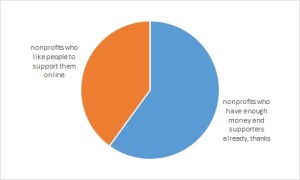
According to the Online Fundraising Scorecard, 37% of non-profits did not send an email within 30 days of a person signing up for emails. Only 44% asked for a donation by email within 90 days.

Let me put this in an approximate pie chart:

online supporter pie chart

We’ve seen this week that getting the second gift (or lack thereof) is where there is the greatest retention leak – people who donate once and don’t get enough out of the experience to donate again. Online donors, in particular, are the most fickle and least likely to retain.

This could be because of the medium. But it also could be that over half of all non-profits do engage people right when they express the most interest in the organization – immediately and unequivocally. To demonstrate this, try to remember what email newsletter you signed up for a month ago today.

Chances are, you can’t. Thirty days is a long time to remember you signed up for something, especially if no one reminds you that you did. Replace “the guy” with “the donor” in this quote and you have a pretty good idea of how people think about your organization, at least initially:

Never assume that the guy understands that you and he have a relationship. The guy will not realize this on his own. You have to plant the idea in his brain by constantly making subtle references to it in your everyday conversation, such as:

— “Roger, would you mind passing me a Sweet ‘n’ Low, in as much as we have a relationship?”
— “Wake up, Roger! There’s a prowler in the den and we have a relationship! You and I do, I mean.”
— “Good News, Roger! The gynecologist says we’re going to have our fourth child, which will serve as yet another indication that we have a relationship!”
— “Roger, inasmuch as this plane is crashing and we probably have only about a minute to live, I want you to know that we’ve had a wonderful 53 years of marriage together, which clearly constitutes a relationship.”

Dave Barry, Dave Barry Complete Guide to Guys

You want to strike while the iron is hot – this person cares about your cause now. So you want to set up a welcome series for your donors online. There are some great guides on how to do this and I promise to write one in a future blog post. For now, here are some key tips:

  • Start with a thank you. This person is interested in your organization. They have given you their time and attention. They sound like a pretty cool person who is giving you a fairly valuable thing. This should be rewarded with good manners.
  • After that, if you have a key offer, lead with it. For some, you may be emailing them a temporary membership card. For others, it’s an opportunity to get involved with advocacy. Surveys are also good. Whatever people like to do with your organization online, use it to build their engagement and learn about them.
  • Yes, within the first 30 days. If they donated already, ask them to become a monthly sustainer. In fact, you may want to test whether a sustaining ask works better generally.
  • Test getting them into your mail, telemarketing, and other direct marketing channels. Just because someone started with your organization online doesn’t mean they don’t also have a mailbox and a phone.

This gap of time can be even acuter in the mail. At least with an online donation, you get (or really really should get) an immediate email receipt. With an initial offline gift, there’s the time that it takes the mail to get to the cager (or another person who will open it), the time to deposit the check, print the thank you, batch it, and send it, and the time it takes to get word back to that donor. That alone is pretty bad.

But what happens next is worse: nothing. Let’s say someone makes a donation on January 1st. They may not get into the data pull for a mail piece until March or April, depending on the lead times you have in printing. Picture making your donation, getting a thank you three weeks later, and then radio silence for months afterward. Doesn’t sound like a recipe for retaining that donor or striking while the iron is hot, no?

So instead, create a couple of mail packages that fill that gap that are sent automatically post the initial gift. The same principles apply here as online – things that help you and that your donors like are the perfect here: petitions, member cards, new supporter surveys, etc. You can expect these pieces not only to help your retention rate but also to provide some additional net revenue as well.

Onboarding for donors and supporters

Your first acquisition mailings

The first thing to know is that mail programs will generally lose money initially. Even if you have great donors and good packages at first, the cost of growing the program will likely outstrip the benefits of running it at first, especially because there are significant fixed costs in the mailing space (e.g., it costs just as much to copywrite a letter than does to 100 people as it does one that goes to 100,000).

Acquisition is where you can get into serious money. Acquisition is designed to lose money for all but the most (absurdly) conservative organization. It’s an investment in bringing new people into the organization and getting them to support you financially. Yet, it’s necessary to start to build your file and lower your marginal costs.

One way to do acquisition on the cheap is with warm and conversion leads. Warm leads are people who have engaged with your organization non-financially (e.g., remember those folks we got to download our white paper last week and give us their contact info?); conversion leads are people who have donated, but not through the mail (e.g., online donors, walkers, gala attendees, etc.). These are inexpensive ways to get new donors, as you don’t have to pay list rental fees.

The other way to get names is, not surprisingly, to pay list rental fees. Try to find organizations like yours to test their lists – often people who support an environmental/cultural/health/etc. charity support many of them. It’s much easier to convince someone to support something very like what they already support.

It also behooves you to put your list up for rental/exchange as well. This will lower your list costs because you will be trading lists with some nonprofits instead of renting theirs.

Charity Navigator will ding you for having a privacy policy that allows this, even if you allow people to opt out of list rental/exchange at any time. Like so many things in the nonprofit world, Charity Navigator is wrong about this. They would recommend, in fact, that you not mail your donors because of the cost involved and because they don’t believe that part of the mailing is a program expense designed to educate your supporters about your issue and promote awareness. That said, if you took the same mail piece and gave it out at a walk instead of putting a stamp on it, it could be considered almost entirely a program expense.

If this doesn’t seem burdened by an overabundance of logic, you would be correct. Generally, you would do well to take a George Costanza approach to Charity Navigator and simply “do the opposite” of their guidance.

In addition to rental and exchange markets, you can also work with cooperatives to get additional names. These coops include Abacus, Dataline, Datalogix, DonorBase, I-Behavior, Target Analytics and Wiland. I think I’ve tried almost all of these at some time or another. These coops share names among them and will build a model of response to get the best possible donor lists for your organization. Think of it as not renting from 10 different lists, but rather getting the best from 20 different lists. Some work better for some organizations than others and it may take a few to get it right.

The downside here is that your best names will start to get mail from a lot of different organizations. On the flipside, you have access to the best quality names from other organizations. Be sure to hold out part of your file to determine the impact of this mailing structure on your file.

After you look at your first bill for an acquisition and regain consciousness, you will rediscover the value of warm leads. Just because you started a paid mail program doesn’t mean that the free tips discussed earlier, especially about working to turn your Web site into a constituent generator, don’t still apply. On the contrary, free is often the best possible price. Adding to the original thoughts, now that you’ve run a program, look at lapsed donors as another source of (re)acquisition. Generally speaking, lapsed donors once renewed will be more loyal to your organization than an outside acquired name and they generally acquire more inexpensively.

So far, I’ve been talking about mailings – online and off – as one size fits all. In reality, if time and money were no objects, each communication you would send out would be handcrafted and uniquely personalized and there would be bespoke artisanal direct mail pieces coming out of Brooklyn and Portland in lavender scented envelopes.

In truth, you aim for something in the middle using customization. That will be the topic for the rest of the week.

Your first acquisition mailings

Setting up your online acquisition funnel

Funnel is a bit advanced for what we are going to be doing today. What we mean is “how do we convert traffic to supporters?”

The earliest Web sites were little more than brochures. After all, when you don’t yet know what to do with a new medium, you replicate what worked in the old medium, like generals who continually fit the last war. There was the information and then there was a contact us link. Unsurprisingly, early Web sites were not conversion machines. That and they still used frames and the blink tag.

You, however, are more sophisticated than that. You know that someone that you know and have as a constituent of some type with permission to communicate is far more valuable than someone who simply comes to the Web site once.

Speaking of, did you know you can sign up for this Web site’s email list? Right here, in fact! You’ll get a weekly summary of these posts.

Anyway, you need to be able to get constituents through your Web site. And, since it’s still free-direct-marketing-program week, you need to do it without cost. So what ways can you get emails?

  • Specifically, you want to tell the prospective signee what is in it for them to sign up for emails. If you can link to a good sample email so they can see for themselves, so much the better.
  • Downloadable materials. Whether its program materials or factsheets, you probably have things on your Web site for people to download and print. You can gate these products by asking for a person’s information at this point. (You can also put in a “no thanks; take me to the material” link in there if folks are worried about cutting off access to information)
  • Petitions, pledges, and the like make people feel involved and given them an excuse to get their friends involved in the mission as well. Moreover, while these are an acquisition technique, they are something that makes your new constituent already feel a part of your organization.

There is a common question as to how much information you ask for on these forms, to which I would ask “How much do you need?” Know that generally every additional form field decreases the likelihood that someone will fill out the form. So, thinking of a petition, you logically need first name, last name, email, and state (so that it can go to the right representatives). If you are doing an email action alert to state legislatures or Congress, you may need a full address to make sure you are getting it to the right legislator(s). It’s rare that you would need more than that initially.

Before you turn on traffic to these forms, be sure to have some sort of tracking system set up to measure what percent of people are converting on your firm. If you want free, Google Analytics can be set up. Ideally, you’d also be able to do A/B testing, but the best tools for this involve money, so that’s a different week.

So now you are ready to have traffic come to your site. That will be tomorrow’s post.

Setting up your online acquisition funnel