Advocacy and nonprofit direct marketing

The most common question about nonprofit advocacy efforts is “can we actually do that with our nonprofit status?”

Absolutely.  I’m not an attorney and this is not a legal opinion, but I can point you to the IRS Web site:

In general, no organization may qualify for section 501(c)(3) status if a substantial part of its activities is attempting to influence legislation (commonly known as lobbying).  A 501(c)(3) organization may engage in some lobbying, but too much lobbying activity risks loss of tax-exempt status.

So what does “substantial part” mean?  There are two ways you can quantify this.  The first is a Potter Stewart-esque “the IRS knows it when it sees it” type test.  The second, and more logical, one is as a percentage of revenues.  The full chart is here.

The thing to note is that it applies to expenditures.  If you set up an online petition about a specific bill and allow constituents to email their representatives, there are no marginal costs — only the costs of the platform that allows for this type to advocacy and your time working on the alert.  This is part of why online advocacy is so popular among nonprofits.

Mail is a little bit more challenging because of the expense involved but attorneys of my acquaintance have said (and remember, I’m not a lawyer), not all advocacy is lobbying.  Mentioning a specific bill number or a highly publicized issue that has a bill on it qualifies, but sending in a petition asking for higher priority for breast cancer research or environmental preservation probably does not qualify.

So now that you know you can do it, should you?  I would answer absolutely.  As nonprofits, we are working to solve social ills.  There is almost always something a governmental entity can do, or stop doing, that will help with some of the underlying parts of the ill you are looking to solve.

Additionally, as you might guessed since I am bringing up advocacy in a direct marketing context, advocacy is often an outstanding way to acquire, retain, and cultivate donors.  Advocacy appeals frequently have outstanding urgency to them (which I’ve noted helps with persuasion) and give you people with a deeper connection to your mission.  Additionally, as we discussed last week, having knowledge of your donors and which like advocacy appeals can be vital for customizing your communications to them.

But they have to be done the right way.  Tomorrow, I’ll talk about the debate on the value of online slacktivism and how to craft your online communications to make sure your advocacy doesn’t end with the Like.  And for the rest of the week, I’ll cover petitions in the mail, acquiring advocates, and converting advocates into donors.

Incidentally, if you would like a free weekly digest of these blog posts, along with previews of coming attractions, and some special subscriber-only benefits that will e cool once I’ve figured out what they are, you can sign up here.

Advocacy and nonprofit direct marketing

Getting donor intelligence by asking your donors

Yesterday, I said you can get a good idea of who your donor is through their actions.  The trick here is that you will never find donor motivations for which you aren’t already testing.  This is for the same reason that you can’t determine where to build a bridge by sitting at the river and looking for where the cars drive in trying to float across it, Oregon-Trail-style.

10-trail_208

Damn it, Oregon Trail.  The Native American guide told me to try to float it.
Don’t suppose that was his minor revenge for all that land taking and genocide?

To locate a bridge, you have to ask people to imagine where they would drive across a bridge, if there were a bridge.  This gives you good news and bad news: good news, you can get information you can’t get from observation; bad news, you get what people think they would do, rather than what they actually will do.

True story: I once asked people what they would do if they received this particular messaging in an unsolicited mail piece.  Forty-two percent said they would donate.  My conclusion — about 40% of the American public are liars — may have been a bit harsh.  What I didn’t know then but know now is that people are often spectacularly bad at predicting their own behavior, myself included.  (“I will only eat one piece of Halloween candy, even though I have a big bucket of it just sitting here.”)

There is, of course, a term for this (hedonic forecasting) and named biases in it (e.g., impact bias, empathy gap, Lombardi sweep, etc.).  But it’s important to highlight here that listening to what people think they think alone is perilous.  If you do it, you can launch the nonprofit equivalent of the next New Coke.

“The mind knows not what the tongue wants. […] If I asked all of you, for example, in this room, what you want in a coffee, you know what you’d say? Every one of you would say ‘I want a dark, rich, hearty roast.’ It’s what people always say when you ask them what they want in a coffee. What do you like? Dark, rich, hearty roast! What percentage of you actually like a dark, rich, hearty roast? According to Howard, somewhere between 25 and 27 percent of you. Most of you like milky, weak coffee. But you will never, ever say to someone who asks you what you want – that ‘I want a milky, weak coffee.’”  — Malcolm Gladwell

With those cautions in mind, let’s look at what survey and survey instruments are good for and not good for.

First, as mentioned, surveys are good for finding what people think they think.  They are not good for finding what people will do.  If you doubt this, check out Which Test Won, which shows two versions of a Web page.  Try to pick out which version of a Web page performed better.  I venture to say that anyone getting over 2/3rds of these right has been unplugged and now can see the code of the Matrix.  There is an easier and better way to find out what people will do, which is to test; surveys can give you the why.

Surveys are good for determining preferences.  They are not good for explaining those preferences.  There’s a classic study on this using strawberry jam.  When people were asked what their preferences were for jam, their rankings paralleled Consumer Reports’ rankings fairly closely.  When people were asked why they liked various jams and jellies, their preferences diverged from these expert opinions significantly.  The authors write:

“No evidence was found for the possibility that analyzing reasons moderated subjects’ judgments. Instead it changed people’s minds about how they felt, presumably because certain aspects of the jams that were not central to their initial evaluations were weighted more heavily (e.g., their chunkiness or tartness).”

This is not to say that you shouldn’t ask the question of why; it does mean you need to ask the question of why later and in a systematic way to avoid biasing your sample.

Surveys are good for both individual preferences and group preferences.  If you have individual survey data on preferences, you absolutely should append these data to your file and make sure you are customizing your reasons to give to the individual’s reason why s/he gives.  They also can tease out segments of donors you may not have known existed (and where you should build your next bridge.

Surveys are good for assessing experiences with your organization and bad for determining complex reasons for things.  If you have 18 minutes, I’d strongly recommend this video about how Operation Smile was able to increase retention by finding out what donors’ experiences were with them and which ones were important.  Well worth a watch.

If you do want it, you’ll see that they look at granular experiences rather than broad questions.  These are things like “Why did you lapse” or “are we mailing too much?”   These broad questions are too cognitively challenging and encompassing too many things.  For example, you rarely hear from a donor to send fewer personalized handwritten notes, because those are opened and sometimes treasured.  What the answer to a frequency question almost always leads to is an answer to the quality, rather than quantity, of solicitation.

Surveys are good when they are well crafted and bad when they are poorly crafted.  I know this sounds obvious, but there are crimes against surveys committed every day.  I recently took a survey of employee engagement that was trying to assess whether our voice was heard in an organization.  The question was phrased something like “How likely do you think it is that your survey will lead to change?”

This is what I’d call a hidden two-tail question.  A person could answer no because they are completely checked out at work and fatalistic about management.  Or a person could answer no, because they were delighted to be working there, loved their job, and wanted nothing to change.

Survey design is a science, not an art.  If you have not been trained in it, either get someone who is trained in it to help you, or learn how to do it yourself.  If you are interested in the latter, Coursera has a free online course on questionnaire design here that helped me review my own training (it is more focused on social survey design, but the concepts work similarly).

You’ll notice I haven’t mentioned focus groups.  Focus groups are good for… well, I’m not actually sure what focus groups are good for.  They layer all of the individual biases of group members together, stir them with group dynamic biases like groupthink, unwillingness to express opinions contrary to the group, and the desire to be liked, season them with observer biases and the inherent human nature to guide discussions toward preconceived notions, then serve.

Notice there was no cooking in the instructions.  This is because I’ve yet to see a focus group that is more than half-baked. (rim shot)

My advice if you are considering a focus group: take half of the money you were going to spend on the focus group, set it on fire, inhale the smoke, and write down the “insights” you had while inhaling the money smoke.  You will have the same level of validity in your results for half the costs.

Also, perhaps more helpful, take the time that you would have spent talking to people in a group and talk to them individually.  You won’t get any interference from outside people on their opinions, introverts will open up a bit more in a more comfortable setting and (who knows) they may even like you better at the end of it.  Or if you hire me as a consultant, I do these great things with entrails and the bumps on donors’ heads.

So which do you want to use: surveys or behavior?  Both. Surveys can sometimes come up with ideas that work in theory, but not in practice, as people have ideas of what they might do that aren’t true.  Behavior can show you how things work in practice, but it can be difficult to divine deep insights that generalize to other packages and communications and strategies.  They are the warp and weft of donor insights.

Getting donor intelligence by asking your donors

And you shall know your constituents by their deeds

There are two ways to know your constituents better: listening to what they do and asking them what they think. Today, I’ll talk about the former; tomorrow, the latter.

Yesterday’s piece talked about how you can roughly define an individual’s responsiveness by medium, message, and action.  The trick is that we often segment by only one, possibly two, of these.  We have medium covered: most large-scale programs of my acquaintance distinguish among people who are mail, telemarketing, online, multichannel, etc. responders.  And many small-scale programs haven’t begun to integrate medium, so in a way this is its own segmentation.

Sometimes, we will use action as a determiner.  We’ll take our online advocates segment and drop it into one of our better-performing donor mail pieces (frequently not customizing the message to advocacy, more’s the pity).

We rarely segment by message, even though picking something that people care about is the most basic precondition of the three.  After all, you may not like telefundraising, but you’d at least listen if it was immediately and urgent about something that you care about.  And it’s much easier to get someone to do something they haven’t done before for a cause they believe in than to get them to do something they’ve done many times if they don’t believe in the message.

The good news is that you have your constituents’ voting records, of a sort.  Consider each donation to a communication a vote for that communication and each non-donation (or, if you can get it from email, non-open or non-clickthrough) as a vote against that communication.

[tangent] This is also a helpful technique for when your executive director comes into your office and says “I’ve had five calls today from people who aren’t happy about [insert name of communication here].”  If you reframe it as five people voted against it by calling and five thousand people voted for it by donating, the noisy few are not nearly as concerning.[/tangent]

A proper modeler would use the data from these votes to run a Bayesian model to update continually the priors on whether or not someone would respond to a piece.  As you can probably tell, I’m not a proper modeler.  I prefer my models fast, free, and explainable.  So here’s how I’d use this voting data:

  • Take all of your communications over a 3-5 year period and code them by message.  So for our hypothetical wetlands organization from yesterday, this might be education, research, and conservation.  Hopefully, you don’t have too many communications that mix your messages (people donate to causes, not lists), but if you do, either take it by the primary focus or code it to both messages.
  • Determine the mix of your communications.  Let’s say that over five years this wetlands organization did 25 conservation appeals, 15 education appeals, and 10 research appeals.  This makes the mix 50% conservation, 30% education, and 20% research.
  • Take your donor file and pull out only those people who donated an average of at least once per year over that 3-5 year period.  This will ensure you are looking only at those people who have even close to sufficient data to draw conclusions.
  • Take the coding of communications you have and apply it to the pieces to which the person donated.  Generate a response rate for each type of message for each person on your file.
  • Now, study that list.

In studying that list, you are probably going to find some interesting results:

  • There are going to be some people (a minority of your file but likely a healthy segment) that only gave to one type of message.  And you’ll see the pattern immediately.  Someone who gave eight times over five years to education appeals and never to conservation or research appeals is clearly an education donor.  You will look at all of the other communications you sent this person and all of the people like her in the X-issue-only segments and you will weep a little.  But weep not.  You can now save your costs and these people’s irritation in the future by sending them only the communications about their issue area (with the occasional test to see if their preferences have changed).  It’s only a mistake unless you don’t learn from it; if you do learn from it, it’s called testing.
  • You can also probably lump people who gave rarely to other messages in with the X-issue only people.  So if someone gave to nine of the ten research appeals and to only one each of education and conservation, they clearly have a strong research preference.  This is why it’s helpful to look at these data by response rates — you can see where people have ebbs and flows in their support.
  • You will also see people who like two messages, but not a third (or fourth or however many you have; I will warn you to minimize the number of buckets, as you will not have a large enough sample size without).  So if someone gave five times, three to education appeals and two to research appeals, education and research both appeal to this person with a 20% response rate.  However, conservation doesn’t apparently appeal to them, so you can reduce communications in this realm.
  • You’ll also see a contingent of folks who donate to communications in roughly the same proportion that you send them out.  These people can probably be classified as organizational or institutional donors.  It will take far more digging than mere file analysis to figure out what makes this donor tick.

This leads into an important point: these will not get you to why.  Even things like how often a person gives for how long or Target Analytics Group’s Loyalty Insights, which can show if the person is giving uniquely to you or to others, are transactional data.  While useful proxies, they can’t tell you the depth of feeling that someone has for an organization or let you know what ties bind them to you.  To do that, you must ask.  That’s what I’ll cover tomorrow.  But hopefully this gets a little closer to information that will help you customize your donor’s experiences.


And you shall know your constituents by their deeds

Learn about your donors by changing one thing

Congratulations!  A constituent joined your organization!  Now what?  

Welcome series!  Then what?

Well, of course, you drop them into the communication channel of their origin right?

As our Direct Marketing Master Yoda* would say:

6a90683cc161c525f9fbc01036b2c5b6

No. No. No.  Quicker, easier, more seductive.

But in this case, not ideal.  It’s not ideal for the constituent and it’s not ideal for learning more about what this person actually wants — you may be freezing what this person “is” before you’ve had a chance to find out.

The person has already told you that they are responsive to three things:

  • Medium: If they respond to a mail piece, for example, they do not hate mail pieces. It may not be their only, or even their favorite means of communication, but it is one to which they respond.
  • Message: Your mission probably entails multiple things.  Your goal may be wetlands preservation and you work to accomplish this through education, research, and direct conservation.  If someone downloaded your white paper on the current state of wetlands research and your additional research goals, you know that they are responsive to that research message.  It may not be their only or favorite message, but they respond.
  • Action: If someone donates, they are willing to donate.  If they sign a petition, they are willing to petition.  You can guess the rest of this about them perhaps being willing to do other things.

Other than welcome series, which I’ll talk about at another time, you are trying to sail between the Scylla of sending the same thing over and over again and the Charybdis of bombarding people with different, alien messages, media, and asks.

Thus, I would recommend what I’d call the bowling alley approach in honor of Geoffrey Moore, who advocated for a similar approach to entering new markets in his for-profit entrepreneurial classic Crossing the Chasm

The idea in the for-profit world is that you enter with one market with one product.  Once you have a foothold, you try to see that same market a different product and a different market your original product, in the same way that hitting a front bowling pin works to knock down the two behind it.

Here, we play three-dimensional bowling**. The idea behind the non-profit bowling alley, or change one, approach is that you should change only one aspect at a time of your medium, message, and action.

Let’s take our wetlands organization as an example — they work to educate, research, and conserve.  They have people who download white papers and informational packets, people who take advocacy actions, and donors.  And their means of communication are mail, phone, and online.

Let’s further take a person who downloads a white paper on research online and provides her mail and email address.  The usual temptation would be to drop her into the regular email newsletter and into the warm lead acquisition mail stream (and maybe to even do a phone append to call her).

But this would not be the best approach: you would be taking someone who, for all you know, is interested only in one medium, message, and action and asking them for something completely different.

Rather, it would be better if at first you probe other areas of interest.  Ideally, you would ask her:

  • Online for downloading additional information about research (same medium, message, and action)
  • Online for advocacy actions and donations related to research (same medium and message; different action)
  • Online for downloading information about education and conservation (same medium and action; different message)
  • In the mail and on the phone for getting additional information about research (same message and action; different medium)

Obviously, this last part is not practical; mail and phone are too expensive to not have a donation ask involved. However, you could make the mail and phone asks specific to “we need your help to help make our research resources available not just to you, but to policymakers across the country” — tying it as directly as possible to where their known area of interest.

Over time, you should get a strong picture of this person.  Maybe they are willing to do anything for your organization by any means as long as it is focus on your research initiatives.  Maybe they are willing to engage with you about anything, as long as it is only online.  And maybe they like research and conservation, but not education; online and mail, but not phone; and getting information and donating, but not engaging their representatives.

Taking it one step at a time not only helps you learn this over time, but also helps you learn it without culture shock.  If someone downloads a white paper and you ask them to take an advocacy action on that same issue online, they may not be interested, but they likely see the throughline to the action they took.  If they download a white paper and get a phone call for an unrelated action, they likely will not.

It’s the difference between a donor response of “I can see why you’d think that, but no thanks” and “what the hell?” (followed by the constituent equivalent of getting a drink thrown in your face).

It’s also why I recommend going back to the original communication mechanism for lapsed donors in the lapsed donor reactivation post.  In that case, it may be literally the one and only thing you know that works.

You may say that you don’t have the resources to do five different versions of each mail piece or telephone script.  But you can do this inexpensively if you are varying your mail messages throughout the year.  For a warm lead acquisition strategy, simply make sure the advocacy people get the advocacy mail piece and not the others for now.  If you find out some of them are responsive to a mail donation ask, you can ramp up cadence later, but for now, your slower cultivation and learning strategy can pay dividends.

This also helps prevent a common mistake: creating groups like “online advocates,” “white paper downloaders,” etc. and then mailing them without cross-suppression.  If you send each of three groups a monthly mail piece and someone is in all three groups, they may end up getting 36 mail pieces if you don’t cross-suppression (so that these groups are prioritized into like packages instead of everyone in a group getting everything).

Tomorrow, we’ll talk about how to get this type of intelligence from what you’ve already done.

* Don’t believe me?  Check Yoda’s outstanding donor newsletter here

** Science fiction always has people playing three-dimensional chess, but not three-dimensional bowling.  Why or why not?  Discuss.

Learn about your donors by changing one thing

Getting to the Truth of one database

the-one-ring

One Database to rule them all.
One Database to find them.
One Database to bring them all
And in the darkness bind them.*

A beloved former boss of mine once asked the best question I’ve even heard and may ever hear about databases: “Which database is going to be the Truth?”

Others may call this the database of record, but the Truth is far more evocative.  It encompasses “which database will have all of our people?”, “which database will have all of our donations regardless of source?”, and “which database will be the arbiter and tie-breaker for all constituent record issues?”

This is a necessary pre-condition of donor knowledge.  You will not have true knowledge of a constituent of all of your data isn’t all in one place.  And working on donor information without the backend systems to back it up could be a waste of time and effort.

If you are like most nonprofits, you are either laughing or crying at the discussion of one database.  You likely have a few different donor databases by donation type.  Then you have records of people you serve, your email list, your event attendees, and so on.

And, sadly, some of them are necessary.  Some databases do things that other databases will not do.  You may not be able to run your direct mail program out of your online database or vice versa.

So here are some steps you can take to get all of your information in one Truth even if there are multiple databases behind it:

Purge unnecessary databases.  And I mean purge them. Ideally it should be as if your unnecessary database displeased Stalin: it just disappears from history, incorporated into other people’s stories.  To do that:

  • Ask whether another database can do what this database does.  If so, bring the data over and train the relevant parties.  The good news is that often the rogue database in question is just an Excel spreadsheet that can be directly imported into your database of choice.
  • Ask whether another database can do what this database does with modifications.  Rarely is something perfect initially.  You will likely have to create reports for people that they are used to running, but if you are bringing them into a good database, that’s a matter of business rules and set-up, rather than technical fixes.
  • If not, ask if the person can do without what the database can’t do.  You’d be surprised how many things are done because they have been done rather than for any rational reason.

Assuming that you have some databases that can’t be replicated in one big happy database, decide what database is going to be the Truth.  This should have the capacity to store all of your fields, run reports, and do basic data entry.  If you are keeping your direct marketing database, it doesn’t need to be able to run a direct marketing program.  But it does need to have the capacity to do the basic functions.

You may say that you don’t have a database that can fulfill this function.  In that case, I would recommend what I call a Traffic Cop database.  This is a database that you can inexpensively put in the center of multiple databases and get data to and from the other databases.  It’s job is to make sure every database knows what every other database is doing and existing to pull out duplicates and host change management.

Now, sync the databases to the Truth database.  Sometimes you may be fortunate and be using a database that has existing linkages.  For example, if you have decided that SalesForce is going to be your Truth, there are some pre-existing syncs you can get from their apps.  If not:

  • Start by syncing manually.  That is, export a report from one database and import it into the other.  Then, reverse (if you keeping a database, syncing it has to go both ways).  This will allow you to figure out what fields go where and more importantly how to translate from one database to the other (e.g., some databases want the date to be formatted 01/18/2016 and woe be unto you if you forget the zero before the one; others may not having a leading zero or have month and date as separate fields or the like).
  • After you have your process down, you can automate.  This can happen one of two ways: through the database’s APIs or through an automated report from one database that uploads to a location followed by an automated import from the other database.  Both are viable solutions — you would generally prefer the API solution, but you do what you have to do.
  • Make sure you have an effective deduplication process.  It almost goes without saying (and if it doesn’t, check out our PSA for data hygiene here), but data can get messy quickly if you don’t have these in place.

Here are some of those common objections and the easiest replies:

  • Cost: “how can we afford to take on a database project?”  Answer: how can we afford not to?  The lost donations from people calling you up asking for a refund and you have to look through five different databases to see where they donate.  The extra time to try to reconcile your donor database and financial systems.  The data that you won’t be able to get or use for your direct marketing and the lost revenues from that.
  • No direct marketing constituents: “I don’t want X (usually the people we serve) to get hit up for donations.”  Answer: We won’t be able to guarantee they won’t get a solicitation unless we know who they are.  We rent acquisition lists all the time and these people could be on there.
  • We’ve already invested in this other database: Answer: point them to this Wikipedia page.  It’s easier than trying to explain sunk costs on your own.
  • Provincialism: “We have database X and it works fine for us.” Answer: actually there are three answers for this one.  First, start elsewhere.  Usually, someone will have a database that isn’t working for them and better you start with them, who will then start singing the praises of both you and the Truth, than with the people who like where they are currently.  Second, usually, there is an “I wish we could do X” list somewhere that will make it worth this person’s time to switch.  Third, go to the highers-up with your business case.  By this time, you hopefully have some happy converters and some results from your direct marketing program (e.g., “we can put the year someone started with us on their member card now!”) to share.

Hopefully, this helps you get to your own version of the Truth.  Now that you have it, let’s talk about what to put in there.  That’s our charter for the rest of the week.

* Since we started with Game of Thrones yesterday, we have to do Lord of the Rings today…

Getting to the Truth of one database

Why know about your donors?

Winter is coming to nonprofits. Unnamed, faceless, cold, sparse, biting, relentless, gnawing winter. And not all of us will survive.

sean-bean

There are more nonprofits than ever before and that number is increasing.

The pie of charitable giving is expanding, but not as a percentage of GDP and not as a much as the number of nonprofits are expanding. Thus, the average nonprofit’s funding will be going down.

Retention rates (when controlling for lifecycle as advocated here) are at best flat and often down. Online donor retention rates are particularly alarming.

And it is becoming more expensive to retain donors. In order to hit net revenue budgets, nonprofits increase the number of communications sent. Communications increase in quantity and decrease in quality of results for each piece.

As retention drops, the need for additional acquisition increases, further increasing donor-by-donor pressure to give broadly and shallowly.

Nonprofits flee to what they believe is quality, recapitulating what has worked for others. Donors see the playbook, whether it is address labels or a compelling story.

Everyone has a story and most can be told compellingly. So we do. But it’s enough less and less of the time.

Most nonprofits do most of their acquisition from lists of people who give to other nonprofits. Few bring in new people to the idea of philanthropy, considering it is easier to get the philanthropic to give more.

The tragedy of the commons plays out in a million different households. Maybe ten million. To give to one is to be solicited by that one and by the many.

The donor pool is now an apt analogy, as we are polluting and overfishing these same waters without restocking.

Winter is coming. So what needs to be done first?

One might say let’s prevent winter. One would be correct. It is necessary for our long-term survival. We will talk about converting people into the idea of giving at another time — it would be called stimulating primary demand in the for-profit world.

But one must survive the short term to get to the long term. And thus, there is something we need to do first.

One might say to be donor-centric and to love our donors. One would be correct. The ones who will make it through this winter will be the ones that have stood out from the crowd. Their envelopes will be opened, possibly partly for the free gift, but mostly for the joy they create and reinforce. Their emails will be read possibly partly for a nifty subject line, but mostly for a human connection that they forge. Their calls will be answered because they thanked and thanked well.

But there is a precondition for donor-centric treatment. And thus, there is something we need to do first.

The first thing is to know. We must know who donates. Yes, we need to know their demographics, but also far beyond that. We need to know the world they dream of creating. And we need to tell them about how they are helping to create that world.

These wonderful people are planting seeds. They are planning them so kids have a place to swing, so there is shade, so that people can breathe easier, so we can have apples. We owe it to apple people to know they in it for the apples. We owe it to them to tell them about neither the tire swing nor the shade if they don’t care. Our story to them will be the deep moist flesh that children will pick from their tree and the juices that will stay on their cheeks until banished by a shirt sleeve. We will speak of shade to shade people and breathing to those who value breathing most.

To do this, we need to know.

This week will be focused on how to know. I’ll go into the sausage-making that is gaining donor intelligence. But it’s important we start with the why.

It’s because winter is coming. Only those provisioned with true friends will make it through.

The good news is that we are nonprofits. We face down demons worse than winter.

Why know about your donors?

The legitimate non-profit trends that Millennials are a part of, but don’t define

Yes, it’s a long title, but I promised nuance.

The most compelling part of the case for Millennials focus is time.  Existing donors are aging to a point when for various reasons they are no longer able to give.  I’ve argued this isn’t a Millennial thing, except insofar as they are the more extreme (so far) leaders of some important trends in nonprofit marketing.  The big ones:

Addressable media.  I remember when I saw my first cost-per-click advertising campaign.  The heavens opened and a choir of angels came down and sang “Behold! You shall not pay to advertise to nonresponders ever again!”

Time may have caused me to exaggerate this slightly, but there simply was no reason to advertise online in CPM form again.

Addressable media will make a similar sea change.  Now, there need only be four types of people you pay to advertise to online:

  • Those who are interested in your particular offering as evidenced by their searches.
  • Those who have expressed an interest in your Web site by coming and perhaps taking an action you are interested in.
  • A custom audience of people you define.
  • People who model similarly to the people above.

You’ve heard about how people seek out news that agrees with whatever viewpoints they have.  We are going to come to an age when you are going to have ads that are similar — your ads will be targeted to things the Al Gore rhythms know you want.

And as an advertiser, you need to coordinate these with your other direct marketing activities, as this will go from novel to expected to required faster than you think.

Personalization.  Millennials especially, but really all of us, are becoming more and more immune to broad brush approaches (hence why addressable media are important).  This is why books like The Cluetrain Manifesto and Permission Marketing sound current and relevant now even though they were written 15-plus years ago.

With the multiplication of media, we are simply not going to have time to pay attention to things that don’t pay attention to use.  That used to mean getting your name right instead of saying Dear Occupant.  However, as my personal law dictates, it’s going to be more and more important to know more and play back what you know about a person.  To learn more about personalization techniques, try this.   In particular, playing back people’s connection to the cause is important.

Impact. It’s often said that Millennials want to see what their gift does.  Doesn’t everyone? People want to see that they are making a difference.  Not that your organization is making a difference, but that they are making a difference.  The best thing that you can do is tell them the story of that difference related to the why that makes them give.

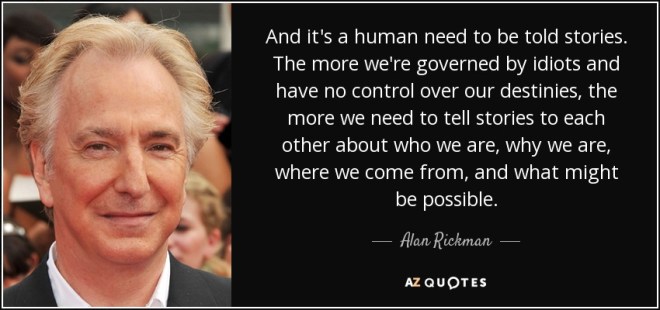
quote-and-it-s-a-human-need-to-be-told-stories-the-more-we-re-governed-by-idiots-and-have-alan-rickman-24-51-27

Requiescat in pace

Content marketing.  In the NonProfit Pro piece, I also said that “Content marketing was highly effective before it was Content Marketing and will continue to be effective long after it becomes lower case again.”  I would work to debunk the hype around that this is a new idea, but the podcast This Old Marketing does a better job than I ever could, showing content marketing schemes that go back to Poor Richard’s Almanack and before.  I’d also love to explain what content marketing is in simple words, free from hype, but Sorry for Marketing did it better than I ever could as well.  And it’s funny; here’s a sample image of the Jargon Monster:

jargonmonsterNote that Millennials is one of those jargon words…

So I’ll simply add that bringing people in through content not only acquires new constituents; it helps you learn about what those specific constituents want so you can deliver it.  

Mobile.  If you aren’t optimizing for mobile already, do so.  It’s now, for many if not most, the primary way that people are looking at your Web site, donation form, content marketing, etc.

Cultivation — valuing people over institution and connections over transaction.  FOTB (Friend of the Blog) Angela Struebing did a nice 2016 intro here talking about getting to real donorcentricity and talking about impact, rather than our usual talking about programs and studies and such.

But this is frequently talked about in the context of Millennials — they want a relationship, not a transaction; they want to fund causes and impacts, not organizations.  Like so many things, this isn’t just Millennial phenomenon, but something we will have to wrestle will from now until I don’t know when.

So, in summary, when someone says they want to target Millennials, start by trying to improve your messaging to humans.  I assure you, regardless of what you read to the contrary, Millennials are human.

The legitimate non-profit trends that Millennials are a part of, but don’t define

Nessies, Bigfeet, and Large Numbers of Millennial Donors

First, thank you to the Golden Globes for honoring my blog post about correlation not equalling causation featuring Matt Damon as Best Blog Post Comedy.

This week, I’m going into detail on my thought from my NonProfit Pro piece that said

We should regard a nonprofit that courts a Millennial audience at the expense of their core like the person who dyes their hair and takes off their ring to hit on people at a college bar: unfaithful to those who love them, uncomfortable with who they are, and ill-equipped to succeed even if success were desirable.

Let me first say that if your nonprofit wants to be around for the long-term, you will have to address younger people.

Because birth, death, and math.

And as we’ve said that past few days, you shouldn’t not target Millennials.  There really is no such generation and, even if you are looking just at the age group, there are enough intragenerational variations that there will be quality prospects in any age group.

My argument is just you can probably ignore all of the “how to talk to Millennials” think pieces you have seen and will see, and refocus on telling your nonprofit’s story well to individuals who will react well to it.

The maxim that we should be following is his:

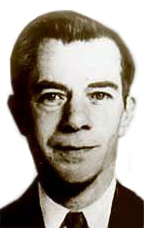
willie_sutton

That’s Willie Sutton and he allegedly said, when asked why he robbed banks, that it’s where the money is.

The height of Millennial absurdity, expressed to me by an otherwise sensical colleague, was the argument that we needed a Millennial-focused planned giving strategy.

So where is the money?  Blackbaud’s The Next Generation of American Giving says it’s:

  • 43% Baby Boomers
  • 26% Maturers (or Civics)
  • 20% Gen X
  • 10% Gen Y

As Blackbaud summarizes “In short, the odds are strong that for the vast majority of causes, your next donor will be over age 50.”

And that donor will be more profitable.  The average gift from a Boomer or a Mature is$454 and $478 respectively.  For Gen Y, it’s $272.

I know, I talked big against Blackbaud sometimes, but they really do good reports.  This one is here and I’m sorry you will have to give them your email to get it, but it’s worth it.

So, in summary:

  • Millennials often don’t have the unique attributes often attributed to them.
  • In fact, the whole generation system is pretty flawed.
  • They are not one coherent group available for targeting; in fact, other attributes like race and gender are far more predictive.
  • Even if they were available for targeting, they aren’t worth targeting for donations right now.

And here I said this was going to be a more nuanced look.

However, we did see that there were some things that are changing over time.  While these are commonly attributed to Millennials, they are likely trends that will change the way we do direct marketing over the long term.  That’s what I’ll take on tomorrow.


Nessies, Bigfeet, and Large Numbers of Millennial Donors

The intragenerational dynamics of Millennials

Monday and yesterday, I argued that many of the so-called Millennial attributes aren’t unique to Millennials and, in fact, that the dynamics among generations are overblown.

I should stipulate here that it seems obvious that people who have significant events at formative times in their lives may have similar reactions.  Those who lived through the Great Depression were more likely to save as a result.  Similarly, many from this generation don’t like to have extended long-distance phone calls because they used to be very expensive.

Ironically, for me, it’s this belief in formative events that makes me less likely to buy into generational dynamics.  It seems odd to me that for whom 9/11 happened while in college will likely think the same way about security issues on average than someone for whom 9/11 happened while in utero.  Further, to say that their reactions would be preordained seems even more implausible.

All of this could be excused, perhaps, if it led to a usable schema.  After all, if something works in practice but not in theory, it simply begs for better theory.

However, looking at Millennials and saying they act one way or the other as a group is not reliable.  In fact, it would likely be better to look at any other factor than age to get an idea of a person.

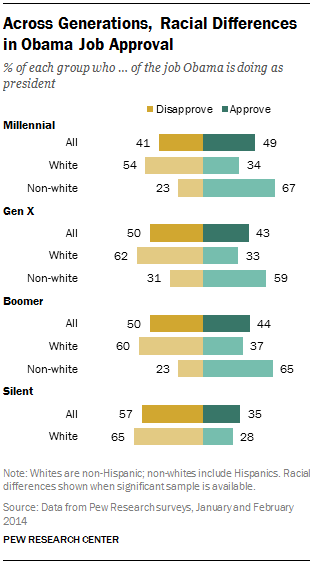
This sounds controversial, but let’s take this chart as an example.  While a sdt-next-america-03-07-2014-0-13simple example, President Obama’s appeal among younger voters was a significant part of the narrative in the 2008 election.  
As you can see, white Millennial’s approval rating of President Obama is between white Gen Xers and white Boomers.  Non-white Millennial approval is slightly higher than non-white Boomers, but within the margin of error.

So if you wanted to predict whether someone supports President Obama, it would be far more instructive to know someone’s race than their age.  Or, put another way, a 25-year-old white person is more likely to be like a 65-year-old white person than a 25-year-old non-white person.

Let’s look at more actionable variables for us as direct marketers.  One thing we do know for sure is that Millennials own social media, right?

Right?

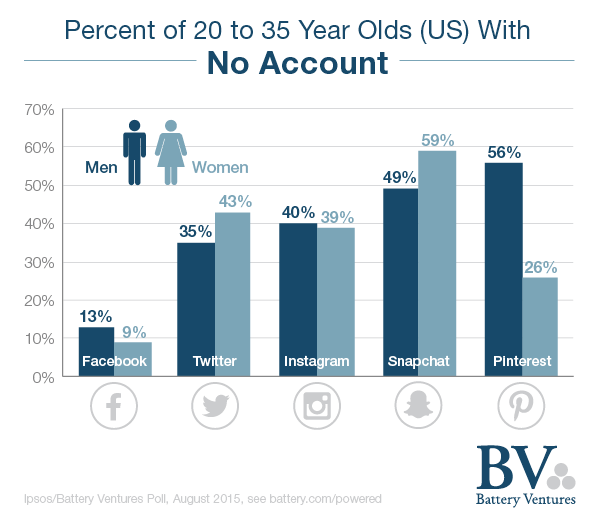
Sort of.  They use social media more than other age groups.  However, 11% have no Facebook accounts and 27% use it less than once per week.  And that’s the most used social network.

And, not a surprise, it’s not the same by sex:

sillsgraphic1 Hat tip here 

And there’s significant age variation within Millennials.  About a quarter (27%) of 31-35 year olds use Snapchat, compared with almost two-thirds (65%) of 21-25 year olds.  I should mention that some of the more enlightened generational theorists of my acquaintance talk about how people on the border of generational categories are tweeners and these are spectra, rather than hard dividing lines.  This warms my heart in part because I’m an Xer and my wife is a Millennial despite only a two-year age gap.

This is something for-profit marketers have caught on to.  The Hotwire PR study of communications trends proclaimed the end of trying to talk to Millennials as a monolithic group and more toward addressable media and direct marketing (including print!) to address as individuals.

So the big question I would have is why would you want a strategy for Millennials, when you could have strategies to acquire online advocates as warm leads, renew lapsed donors, and everything else that is actually related to your organization.  I think you’ll find that your walkers look very much like your walkers, your advocates like your advocates, and so on, than your Millennials like your Millennials.

This brings up another question: is it worthwhile to target far younger constituents as a way to get gifts?  My answer is no, with caveats, and I’ll hit the details tomorrow.

Agree?  Disagree?  Let me know in the comments.

The intragenerational dynamics of Millennials

Mythbusting the millennial mythos

Yesterday, I ranted a bit about the intellectual lassitude of people who talk about the unique attributes of millennials.  Let’s put some of these to the test.

First, a background on where the idea of generations comes from.  Authors William Strauss and Neil Howe created the Strauss-Howe generational theory — that every 20 or so years, there is a new generation.  They further posit that there are four generational patterns in rotation: prophets, nomads, heroes, and artists.  So, for example, according to them, the Silent Generation are prophets, the idealists that helped create the post-war establishments that Baby Boomers, as nomads, rebelled against.  Gen Xers are the heroes, who grow up increasingly protected, but mature into self-reliance.  Millennials are artists, who “grow up overprotected by adults preoccupied with the crisis, come of age as the sensitive young adults of a post-crisis world.”

Of course, it won’t surprise you if you read yesterday’s post that I am switching these around.  According to Strauss and Howe, Silent Generation members are artists, Baby Boomers are prophets, Gen Xers are nomads, and Millennials are prophets.  

In the end, the whole thing reads like the Chinese zodiac readings on a restaurant placemat: vague enough to apply to anything or to nothing.  The generational theory is non-falsifiable.  There are no hypotheses to test.  And thus, there is no science behind it and thus belief in the system is as valid as Roswell or Bigfoot.

In fact, the writing often (to me) smacks of what is called a Jacques statement in cold reading (aka faking that you are psychic).  The Jacques statement is named for the character who gives the Seven Ages of Man speech in “As You Like It”; it means tailoring your prediction to the age of the subject.  Take a look at the very very different things that happen to each generation as they get older:

  • Prophet: “tend to be remembered for their coming-of-age passion and their principled elder stewardship”
  • Nomad: “tend to be remembered for their rising-adult years of hell-raising and for their midlife years of hands-on, get-it-done leadership”
  • Hero: “tend to be remembered for their collective coming-of-age triumphs and their hubristic elder achievements”
  • Artist: “tend to be remembered for their quiet years of rising adulthood and their midlife years of flexible, consensus-building leadership”

Thus, other than the artist, everything rebels when they are young.  And everyone matures when they get older.  These are the alleged “differences” among the generations.

Additionally, in the generational dynamics world, the future is already written.  By definition, a baby born today is a hero and their child will be a prophet.  I don’t have a scientific basis for this, but I find this level of determinism unsettling, especially when there isn’t a compelling reason to believe in it.

So those are the underpinnings of the theory, such as they are.  Now let’s look at some of the more commonly asserted attributes of Millennials.  In order to be a truly Millennial trait, it would have to be something that does not happen to every generation that is this age (because then you can target all 20-somethings similarly across time without generational embroidery or Jacques statements) and something that does not continue over time (because that’s a trend and not a generational commonality.

Take, for example, the technological savvy of the Millennial generation.  All of the data do point toward greater use of social media, greater use of the Internet, greater mobile use, etc.  But this trend seems to be going in one direction: up.  Not only are all age groups showing greater adaptation among all age groups, but there is no sign that the 15 and under set (the to-be-named generation after the Millennials) will not be even more digitally native than Millennials.  For me, then, the statement “Millennials are the most tech savvy generation” has the same meaning as “the youngest adults are Millennials” — something that will eventually be supplanted (perhaps by the Singularity).

Other general trends that you may have heard of as uniquely Millennial:

  • Millennials are the most educated generation.  Same thing as with technology: why would this trend stop with Millennials?
  • Millennials prefer cities to suburbs.  Actually, a 25-30-year-old today is less likely to live in a city today than one in 2000.  This is something that is unique to young people, not to Millennials. 
  • Millennials job hop.  FiveThirtyEight myth busted this one for me here.   Young worker job switching is actually down from both one and two decades ago.
  • Millennials want to see the impacts of their gifts.  Do you think this is not common among other age groups?
  • Millennials want a trophy for every little thing they do.  IBM did a good study of generations in the workplace here.  It found that Millennials were only slightly more likely than Gen Xers to want recognition from their boss and less likely than Baby Boomers to want their views solicited by their boss.  Gen Xers, not Millennials, were the most likely to think that everyone on a team should be recognized.
  • Millennials are uniquely socially conscious.  That same study found that Millennials were less likely than their Gen X and Boomer counterparts to want to leave a job to follow their heart or save the world.  Oxford Economics found the same thing here; only a fifth of Millennials said making a difference is important to their job satisfaction.

So this debunks some of the more common attributes that Millennials are commonly cited to have.  

But this would be all academic if there were a good way to create messages that worked for Millennials generally.  Unfortunately, there isn’t, because of significant intra-generational differences.  We’ll discuss that tomorrow.

Agree?  Disagree?  Let me know in the comments.

Mythbusting the millennial mythos