Customizing your direct marketing (aka Dear Mr. Jenny Roberts:)

In addition to looking for that sweet spot somewhere between “that nonprofit doesn’t know me and takes me for granted” and “that nonprofit has clearly been looking through my underwear drawer again,” the most grievous sin you can make in customizing and personalizing is being wrong.  Thus, a disclaimer that these techniques should really only be used when you are confident in the data used to customize.

When looking at your donor’s sweet spot, there is another optimization to be navigated – the cost of additional personalization versus the return.  Like all else that is good and pure of this world, the way to determine this is through testing.  But there is one way to maximize the bang for your customization buck, which is to customize only one side of, or page of, a letter.  If the printer can do most of your mail piece without variable printing your costs come down substantially.

Of course, these additional costs are nearly non-existent online or on the phones, where your customization is limited only by your imagination, the time you want to invest in creating different versions, and whether your telemarketers will rise up and overthrow you if you have a different script for every call.  I say this last only partly jokingly, in that some experienced callers will use the script with which they are comfortable rather than the script they are asked to use.  Thus, online can have the purest, cheapest testing, so please, please, please test your online asks.

Here are some simple customizations that I have seen increase response rate to the point that they more than paid for themselves:

  • Name: Duh. Infants as young as five months old selectively listen for their own name and this is fully developed by 13 months.  From then until up to 120 years later, we listen, watch for, and seek out our own name.  That name is very, very infrequently Current Resident or Friend.
  • Donation history: If someone has been a long-term donor, it’s great to recognize this. You want to do this casually, as in “You’ve stood for an end to feline boredom for over a decade.  Will you join us again when we need you most”, not as in “Since you joined EFB 13 years and three months ago,” as that gets creepy. If you have something like a member card or supporter club, acknowledging that someone has been “member since 2001” will usually lift response.There is a special version of this that is also very effective – playing back to people that they contributed to the same campaign last year, e.g., “you had your gift matched last year; now is another opportunity to double your impact on adult-onset flatulence.”  Here, you are reminding the person that they are the type of good person that donates to things like the thing they are reading or hearing.
  • Mission area: If you know how someone came into the organization or what they care about, it’s vitally important to play that back to them. Animal organizations, in particular, customize their messages to cat people and to dog people, knowing that each has their own reasons for supporting the cause.
  • Location: I saw a .5% percentage point increase in response rate when someone knew that the story we were using happened right in their state. Of course, this can require 50 different versions, so perhaps you’ll want to start with more easily variabilized copy.  Even easier is to reference the city and/or state in the copy without specifying the story.
  • Contribution level: This is partly for the donor or potential donor. You don’t want to insult someone who would normally donate $20 by asking them for $1000, nor a $1000 for $20.  I once received an acquisition piece from my local Boy Scout organization that asked for $250 as the lowest donation level.  On an acquisition piece.  With no return envelope.  Needless to say, while I was not helpful, friendly, courteous, kind, or obedient, I was thrifty.  This is also for your benefit.  You want to maximize the donation(s) from a donor, gradually increasing their giving over time as their trust in and love for you grows.  That process can be undermine by asking for the wrong gift at the wrong time.

In fact, there is an entire art to ask strings, one that we will cover tomorrow.
Customizing your direct marketing (aka Dear Mr. Jenny Roberts:)

Ellinger’s Peak of Ideal Customization

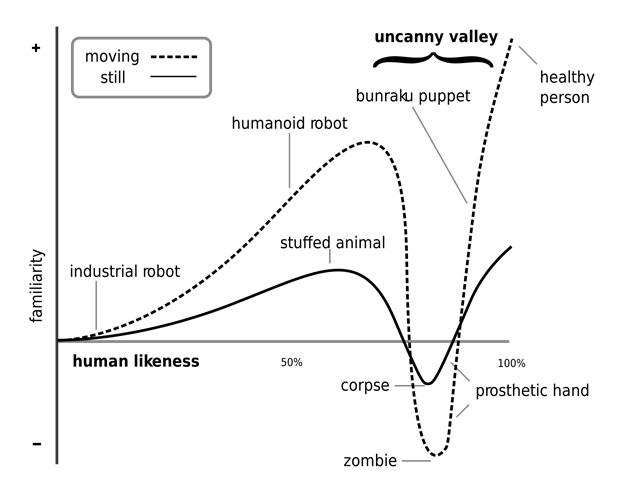
There is a concept in aesthetics called the Uncanny Valley. The idea is that generally we like things to be closer and closer to human likeness to maximize emotion and empathy. That is, until the thing reaches a point that is not quite human, but too close to human, for comfort. So, things that look somewhat human, but clearly are not (think C3PO from Star Wars or a teddy bear) look fine to us. But getting close without quite being right is highly offputting or creepy.

uncanny valleyYour dislike of clowns, explained.

For some, this is part of a dislike for ventriloquist dummies or clowns or porcelain baby dolls. It’s also why even in these days of high-tech CGI, you will see animated movies that make cartoon characters to be, well, cartoony and not human looking. Efforts to make hyperrealistic animations have fallen into the Uncanny Valley (e.g., Polar Express, Beowulf).

polar express

This girl has come for your soul.

I posit that there is a similar dynamic in personalization.

On one side of the spectrum, you have the cable company. Long after most people have heard of the concept of caller ID, the first thing they ask you to do in their automated system is to put in your phone number.

What is the first thing the person on the other end of the line asks for after your brief 47-minute wait listening to the instrumental version of “My Heart Will Go On”? Your phone number. That isn’t just not knowing your customer; that is Memento-level forgetting.

On the other side of the graph, you have the Target Knows You Are Pregnant story. To make a long and interesting story short, there was a man who called Target irate that his minor daughter was getting coupons for items that would imply that she is pregnant. Shortly thereafter, he called back to apologize, letting them know that there were things going on in his house that he didn’t know about. Target “knew” his daughter was pregnant before he did.

This story is a bit creepy: that Target’s algorithms would “know” something like this. After other coupons were a little too overpersonalized, Target has started putting in random dummy coupons into its coupons, so they look a little more random. (Even though they know what you really want).

“Even then, retailers learned early that shoppers prefer their shopping suggestions not be too truthful. One of the great unwritten chapters of retail intelligence programming featured a “personal shopper” program that all-too-accurately modeled the shoppers’ desires and outputted purchase ideas based on what shoppers really wanted as opposed to what they wanted known that they wanted. This resulted in one overcompensatingly masculine test user receiving suggestions for … a tribute art book for classic homoerotic artist Tom of Finland, while a female test user in the throes of a nasty divorce received suggestions for a small handgun, a portable bandsaw, and several gallons of an industrial solvent used to reduce organic matter to an easily drainable slurry. After history’s first recorded instance of a focus group riot, the personal shopper program was extensively rewritten.”
― John Scalzi, The Android’s Dream

So here is the Ellinger Personalization Satisfaction Curve (I figure if I keep trying to name things after myself, one will stick):

ellinger curve3
I spent upwards of 42 seconds on this graph

As personalization increases, you like it, unlike a point where you stop liking it.  The three big implication for nonprofits are:

  1. This curve is moving right. It used to be an innovation to have a person’s name included in the salutation. Now, unless you are going for an ultra-low-cost package, it’s table stakes. Donors used to be OK with the Super Mario Bros. excuse for not knowing entire gift history (“Thank you for calling, donor. But your data is in another database.”); now it is inexplicable. We now live in a world that knows our name and who we are (or can look it up quickly enough to simulate this).
  2. But people generally don’t like you to know things that aren’t logical leaps from their existing relationship. For example, if you are using acquisition lists from advocacy organizations, it’s almost certain fine to send them an advocacy piece from your organization to them. However, you don’t want to say “Because you support other advocacy organizations, you may want to help support our cause.” This is a part of the sausage making people don’t need or want to see.
  3. This sweet spot is different for everyone. Some people still get weirded out when people know who is calling from caller ID. Others wear their digital hearts on their sleeves, inviting everyone to know everything. The best you can do is aim for the middle for the general population at first, but then test up and down to see what each your donors prefer.

I’ll talk about a few positive customization techniques tomorrow.

Ellinger’s Peak of Ideal Customization

Sending your first email

Now you have an email client. And I have a print version of what I’d like to send. I can just put it in a PDF and attach it, right?

No. An effective email is not:

  • An attached PDF. PDFs limit interactivity and frequently exceed attachment limitations on emails, which limit deliverability.
  • An email asking someone to click to go to your newsletter online. Every click you add adds friction to the process and increases the likelihood that people will abandon your newsletter, especially when you don’t have the space to explain what you want them to do.
  • An email asking someone to download your PDF newsletter. All of the disadvantages of a PDF with the additional friction of an added click.

This brings up the question of what it is. A good email is:

  • About the person receiving it. “I” is bad. “You” is good. Me Tarzan. You Jane. Seriously, though, you want to be talking to donors, volunteers, and other supporters what they are doing through you. You are the tool that good people use to do good things. You should brag about yourself about as much as an Allen wrench brags about those Hemnes dressers it made.“We” is controversial. My perspective on it is that it depends on the use of “we.” If “we” is your nonprofit, it’s bad. If “we” is the community of people dedicated to making a cause come to pass, and you can clearly delineate it as such (this is hard to do), it can be good. “We” in the sense of Queen Victoria expressing her lack of amusement: awesome.
  • About a discrete topic. Frequently, email newsletters try to be all things to all people, instead of telling a compelling story.
  • About an interesting topic. This sounds like it would be self-evident, but you would be amazed about email newsletters that talk about the check presentation that just happened or the award from the local Chamber of Commerce the nonprofit received. Most bad topics fail the first test of whether they are about the person receiving it, but some other bad ones are about the person receiving it, but forget that that person is a person and thus is both self-interested and not immortal (thus not having ultimate time to read your newsletter).
  • Equipped with what you want people to do. You do not want to wind up your audience and not have them know what they are supposed to do with their new information.

If you are just starting out, try a few different types of emails to see what resonates with your audience. A few to try:

  • Thank you emails, whether it’s for donating or volunteering or simply being an email subscriber. People generally complain as much about being thanked too often as they hate being too handsome or too rich. Or so I’m told by handsome and rich people.
  • Urgent! Email is the perfect medium to get out timely communications. I’ll talk about ways to take advantage of this with things like matching gifts, but an urgent email is usually a good one.
  • Other ways to support. You will eventually be asking for money by email and if you are doing it right, you will be doing it often. To lay the groundwork for this, be sure to mix in other ways to support your organization that don’t involve a credit card. This can be volunteering, advocating, telling friends about something important, taking a pledge, giving your more information about their preferences, engaging in a cause-related marketing campaign and more.
  • The inside scoop. People love to get exclusive information, to feel like they are inside the velvet rope. One great example of this was chronicled in The Audacity to Win, David Plouffe’s account of the 2008 Obama campaign. In it, he reveals that offering people the opportunity to get the VP pick texted to them increased their mobile subscribers by 1500%. It can work for you too.

These learnings can be the background for your entire direct marketing campaign. Now is the time to find your voice and the issues that work for you, before it costs a lot of money to get that message out.

These are the basics. Now, you need a list. We’ll start that discussion tomorrow.

Sending your first email