Beyond RFM – doing intermediate-level segmentation

By now, hopefully, you have seen the benefits of segmentation and the value of RFM as a preliminary tool.  But you have probably intuited a few of the flaws in it already:

  • The distinction between recency groups is sometimes artificial. Let’s say two people give $20 per year, one at the end of January and the other at the beginning of February.  The former would be at 13 months for a January mailing; the latter at 12 months.  A few days difference could mean that one gets mailed and the other didn’t.  (In fact, I’d love to test a segmentation out to 13 months instead of the standard 12 because of this; please comment or email me if you’ve done this, so I can share and illuminate myself).
  • The distinction between frequency groups is artificial. Your multidonors range from people who donate once a year over a series of years to people who donate to literally every communication they get.  RFM analysis gives these two people the same number of communications.
  • The distinction between monetary value is artificial. You probably saw this one coming, given the first two.  Which donor would you prefer – a donor who donates $10 ten times per year or a donor who donates $50 once a year?  RFM prefers the latter; I’m guessing you would prefer the former.
  • It carries literally no other information. The $25 dollar donation of today could be from someone who clipped coupons to raise the money to donate or Bill Gates divesting himself of what he found in one cushion of his couch.  What a person donates is an indicator of capacity, but it’s a blunt tool when a scalpel is possible.
  • You probably noticed I was talking only about the mail in examples. RFM doesn’t look at channels of donation, nor at the sensitivity of people to those channels.

Let’s address this last one first, as we look for ways to customize RFM more than using it alone.

Separate RFMs by channel. When you do your telemarketing list pull, you will almost certainly want to call deeper into your file to people who have made a previous telemarketing gift than those who you are trying to make their first gift on the phone.  Same thing in the mail: you may be willing to mail multidonors out to 48 months $50-99.999 for people who have given through the mail, but only to 12 months or 18 months $50-99.999 for people who have only given online or on the phone.  Separate RFMs by channel will help you make these determinations.  Remember that you are looking to make sure that you have a strong multi- or omni-channel program, but that doesn’t mean you have to be agnostic as to channel of origin or preference.

Cadence analysis.  This goes to your $10 10x versus $50 1x donor example above.  You have to figure out who likes/needs multiple communications to make a gift or gifts and who doesn’t.  Some ways you can do this:

  • Look at how many types of offers you have going to a person in rotation; hammering the same key on a piano over and over isn’t music, nor will the same approach be music to your donor’s ears.
  • Take a look at how many times you mail someone in acquisition. Sometimes chronic non-responders need a different offer (as with rotating your offers above), but you can also see whether someone after seven or 17 or 27 times of getting a message from you means they almost certainly won’t donate and you can bless and release.  The same holds true for your lapsed donors as well.
  • Test consistent communication versus no communication versus resting periods to see what happens when you try different cadences.
  • Look at frequency of gifts within a certain period of time, rather than ever. You can see dramatic results sometimes by decreasing your mailings to your one-time-per-year donors versus your multi-per-year donors.

Mission area: I mentioned this when discussing customization types, but tailoring your communications toward the area of your donor’s interest is also a legitimate segmentation target.  Why would you send that advocacy alert to people who care only about your work in schools or your calendar with pictures of dogs to your car people?

Income: If you don’t want to ask that millionaire for $17, a wealth append can get you the information you need to customize your ask strings and communications strategy.

Location: Zip codes are the poor person’s income append and can be free-ish, so that’s a potential win.  More often, though, you can use zip code modeling to breathe life into underperforming acquisition lists.  Simply find your top X percent of zip codes from your current file and ask for just those zip codes from the rental list.  It will be slightly more expensive to rent per name this way, but it can provide a 20%+ lift in response rates and/or average gifts.  This is also a way to test new lists while minimizing risk.  One caution: you don’t want to do this for all lists or you risk self-limiting your acquisition strategy.  If a list works well for you across zip codes, use the whole thing – that way you give yourself a chance to be wrong about a zip code long-term.

Demographics: Some nonprofits find that different messages work better for men versus women.  Age can also be helpful, as you work to avoid sending your one millennial donor your planned giving brochure (there’s optimistic and there’s delusional…).  With demographics, backtesting makes initial sense, where you see how people of different demographics responded to previous appeals and messages, then use that data to define your strategy.

Previous responsiveness: It sounds obvious, but it’s ignored by CRM: if someone like getting your calendar three years ago, they may like getting it again.  Replace “calendar” with member card, action alert, survey, etc., and you have the makings of a profitable add on to your usual list mix.

Those are some of the things you can add to spice up RFM.

I said at the beginning that this was intermediate segmentation.  Advanced segmentation is modeling.  The hacks above will help get you many of the benefits of modeling at a fraction of the cost, but it won’t get you all of the benefits, so definitely leave yourself open to building smarter and smarter donor modeling solutions.

Any other segmentation recommendations you’ve seen work?  Please leave them in the comments.
Beyond RFM – doing intermediate-level segmentation

RFM part 2 – segmentation goals beyond net revenue

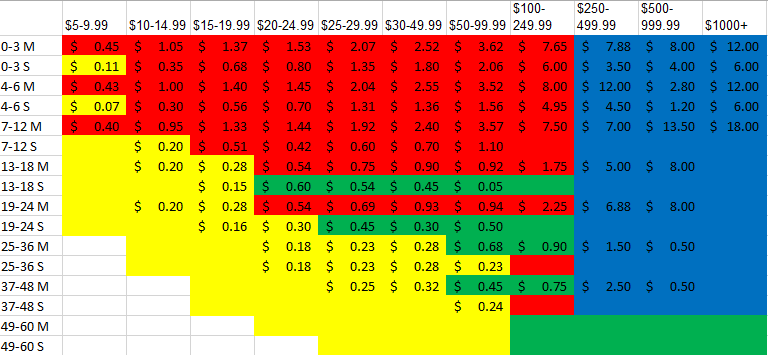
From yesterday, we had a sample membership mailing with these results from last year, and we were going to cut any segment that didn’t get $.33 per piece or more, since that is what the piece costs.

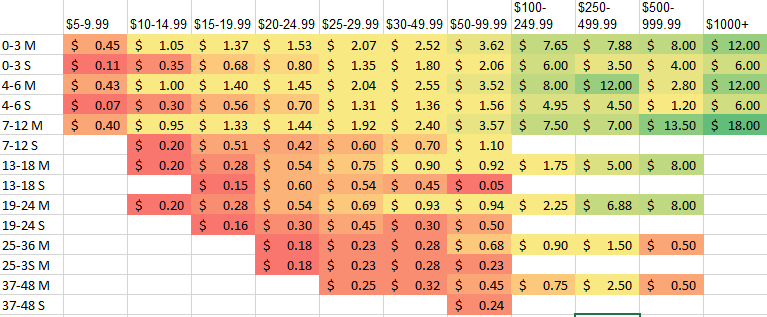
To do so would actually cost us dearly.  As we discussed this week, there are more goals than just the immediate gaining of revenue.  Looking at mail pieces alone with a “here’s a piece; here’s another piece” mentality can ignore what other things a mailing can do for you.  Let’s take a look at this chart of historic gross per piece by segment with two ideas in mind: groups we want to invest in and testing opportunities.

RFM Gross

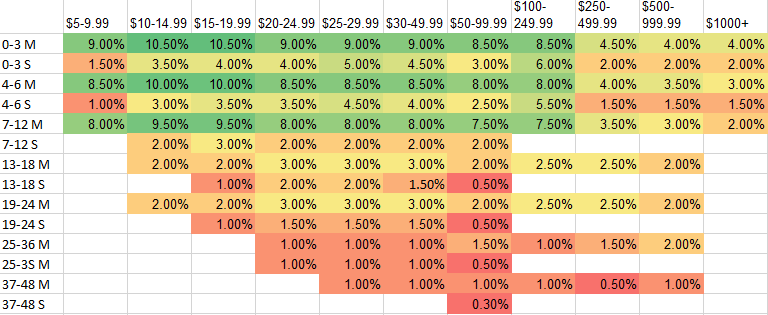
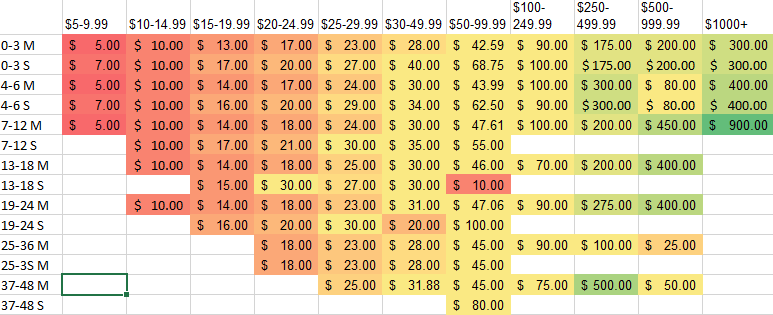
Take a look at our $50-99.99 37-48 single donors.  They have an anemic response rate of .3% and an average gift of $80, so they would only gross $.24 per piece to mail to (and thus lose $.09 for each piece sent out).  Should you mail these donors?

There are some organizations that would say no – they think that every segment should net positively in a donor mailing or that they should only do no net cost acquisition.  I’ll try to demonstrate why I think these people are wrong.

With a response rate of .3%, it would take 333 1/3 pieces to generate one donor.  At a net loss of $.09 per piece, that’s a cost of $30 to acquire that donor.  Chances are that that is higher than you are spending in your acquisition mailings to get new donors.

But you aren’t acquiring just person off the street.  You are getting someone who then slots into the 0-3 $50-99.99 M segment for the next mailing.  You can see if the person got this mailing again for their next one, they would be predicted to gross $3.62 per piece sent to them or people like them, which is very nice.

Let’s run the numbers assuming that their average gift is $50, your retention rate per year for lapsed reactivated donors is 50%, your retention rate per year for multi-year donors is 70%, and it costs you approximately $10 to mail your $50-99.99 donors for one year.  To make the math easy, we’ll assume only one donation per year (it should higher) and we’ll assume that any donation is worth a net of $40 knowing the mailing costs (in reality, you would want to look at both the possibility that someone will give multiple times per year and that you will have to mail someone even when they don’t give).

This works out to:

.5 * 40 + .5 * .7 * 40 + .5 * .7^2 * 40 + .5 * .7^3 * 40 … .5 * .7^n * 40

(Can you see why I simplified the math?)

What this basically says is that there’s a 50-50 chance of getting any future gift from this person and they have a 30% chance of lapsing every year thereafter.  We aren’t using a discount rate because interest rates now are so low.

To simplify, it’s $20 + $14 + $9.80 + $6.68 and so on.  A bit of high school calculus later and this donor will likely return an average of $66.67 to your organization.  All for the cost of $30.

If you had a magic box where you could put in $30 and didn’t know what it would give you back, but knew the return would average over $60, you’d put money in.  I myself would ask if I could put in more than $30 to speed things up, like asking the genie for more wishes.

See the full comic and other fun stuff here

In general, your multi donors are going to be far better donors.  However, you need to communicate to single time donors in order to get those multi donors.  You also need to talk to those people whose last donation has been a while to renew them for future support.

The corollary to this is that you shouldn’t just look at this segmentation and see what to cut; you should also be adding back in.  Looking at these gross revenues per donor, you are probably (hopefully) wondering why you wouldn’t want to mail 7-12 month single donors of $100+, or deeper into your $1000+ donors, or more.  These are all correct thoughts.  Looking farther back into your pieces, you might see that someone has made the previous mistake – they looked at a small sample size of a $1000+ mailing, found that no one responded, and cut the segment.

Thinking further about this, you can see that perhaps the $1000+ donor shouldn’t get this piece, but they probably should be communicated with.  These are your best and best potential donors and there probably is a way to increase their value more so than not communicating with them.

Similarly, you’d love to renew those $15-$19.99 13-24 month donors, but this also isn’t the way to do it.  Now we are going to break out of yes/no segmentation and into using segmentation to create differentiated communications.  For simplicity sake again, we’ll assume that we have four treatments we are going to try:

  • This mail piece, plus a pre and post email, for our “normal” donor segment (red)
  • This mail piece with “lapsed” language, plus a pre and post email, for our lapsed segments (green)
  • A high-touch invitation-style mailing to higher-value donors with first-class postage to invest in getting their gift (with email and higher-touch telemarketing as well) (blue)
  • A prerecorded outbound voice mail campaign, coupled with an email ask to less valuable or less likely donors to attempt to renew them without high marginal costs. (yellow)

I’ve oversimplified here.  With the high-touch piece, we’d almost certainly want to test borderline segments part with the high-touch and part with the control to see if the additional investment is worthwhile.  You’d also want to test what segments telemarketing works best with.  And so on.  But for first steps, it’s directionally correct.

So let’s color in the mail plan with these four layers.

RFM four color

Note that you are able to contact more people with more appropriate language with this strategy.  Segments that a pure net perspective would have ignored are renewed in this new model and our most valuable donors are treated that way.

But that’s still just RFM with some embroidery on top.  It’s a fine model, but there’s more that can be done.  We will go beyond RFM tomorrow to add a few other pointers tomorrow.

RFM part 2 – segmentation goals beyond net revenue

The building block of donor segmentation: RFM

Over 80 percent of nonprofit marketers know the term “communication segmenting” according to a Bloomerang survey.  Over 60 percent say they segment their files.  This means that almost 20 percent of them don’t know what segmentation is and 20 percent more know about segmenting, but don’t.

Let’s see if we can reduce those numbers.

Segmentation, as you can see from my last two posts, really is for everyone, regardless of the size of your file. We’ve talked about, obliquely, two different types of segmentation – yes/no segmentation (will someone be communicated with or not) and segmentation to help create versions or customizations.

RFM analysis can help with both of these.  It stands for:

  • Recency: Usually used as how recent was someone’s last donation to the organization. You may occasionally also look at their last interaction with the organization, but we can put that aside for now.  This is perhaps the primary driver of segmentation and, if there is an answer to the “how many people do we have on file?” question, it’s when it phrased as “how many people have donated to us in the past two years” or the like – with a time horizon and action attached to it.  Do yourself a favor and add “recency” to your Microsoft Word dictionary; you are going to be using it a lot and Microsoft Word doesn’t know that word exists.
  • Frequency: We go from the most often used to the most often ignored – how many times someone has given to the organization (or interacted with in non-donor contexts). This is often simplified to single v multi, as this dyad makes it easier to plan your communication.
  • Monetary value. This is usually measured by another TLA (three-letter acronym): HPC or highest previous contribution – what’s been the highest amount the person has made in any one gift. This is an area of some debate, as if someone makes gifts of $20, $20, $20, $20, $500, $20, $20, $20, and $20, it is fairly predictable that they are probably better grouped with the $20-$24.99 donors than the $500-$999.99 donors and their ask strings changes along with this (more on ask strings here).  One solution is to use a formula like 2/3 of their HPC + 1/3 of their most recent contribution or half of their HPC + half of the average of their last five contributions.  But this is something worth testing how it works best for your file.

Let’s do a yes/no segmentation with RFM.  We have a membership mail piece that has historically very well with a number of segments.  It costs $.33 to mail and you are looking for segments that net.  Here are what your RFM response rate, average gift, and gross revenue per piece would look like from last year.

Response rate:
RFM RR

Average gift:
RFM AVG

Gross per piece:
RFM Gross

(these are intentionally realistic, but false, data)

To explain, the first numbers are the months (so 0-3 is someone who last gave a gift in the past three months), S & M stand for single and multi (get your mind out of the gutter), and the dollar amounts across the top are that person’s highest previous contribution.

Looking at this, to maximize net revenue, we can cut some of the segments to lower HPC groups and to one-time donors.  Anything under $.33 per piece isn’t going to net us money.

This is a decent baseline that answers the question “I have this mail piece going out in February; to whom should it go to maximize the net revenue of the mailing?”.

However, we are going to look at it as “how do we maximize the value of this donor by treating them appropriately?” and layer in some treatment segmentation tomorrow.

The building block of donor segmentation: RFM

Wherefore segmentation?

Yes, wherefore.  As long as we are starting from first principles, we can go a little bit Elizabethan.  In the one and only famous “wherefore” quote, Juliet isn’t asking where Romeo is (below the balcony).  Hers are existential questions – for what reason does Romeo exist and what cruel twist of fate made him a Montague, her family’s mortal enemy?

For more of this, check out my likely-never-going-to-be-written book The Bard Does Nonprofit Direct Marketing (All’s Well that Ends with a Donation).

But wherefore segmentation – why does it exist?  We covered a lot of this in the last post, but we’re going to be going into them more granular than that as to who gets what communication when.  Why are we doing this?

The simple answer is “to maximize revenue.”  In this world, every mail piece would be opened and responded to, every phone call answered, every email and online ad clicked upon and donated to.

In this world, the ideal model would be one that gets this 100% response rate – it would read people’s minds and get them the lowest possible cost means of communication to get the maximum gift at the precise right moment.

This is not a horrid definition and, in fact, that would be a really cool (if magical) model to apply.

But it ignores two things: how people give and what your goals are.

Let’s say you have a person who, every year, like clockwork, gives to your membership mail appeal every January.  She’s on your email list, gets your e-newsletter, and a number of other mail pieces each year, but only gives to that one membership mail pieces every single year.

Do you think she would still give to you if that was the only communication she got from you throughout the year?

Probably not. I once walked each year for an organization that will remain nameless.  Every year, I started getting emails from them a couple months before the walk encouraging me to walk (whether I’d already signed up or not) and I would stop hearing from them after the final walk email for another 10 months.

Please notice I say I “once” walked for this organization, not that I still do that.

The bottom line is that even the most loyal of donors (especially the most loyal of donors!) want to hear from you.  Look at Professor Adrian Sergeant’s surveyed reasons why someone stopped giving to an organization:

reasons for lapse

The full study is here; it’s real and it’s spectacular.

Many of these involve someone not being communicated with enough (not acknowledging support, don’t recall supporting, no longer needs my support) or not being communicated with effectively (other causes more deserving, not informing how money was used).  Now look at the bugaboo of many an ED or board member: inappropriate communications is less than 4%.  More people defect because we don’t talk to them than defect because we talk to them too much.  So we can’t do just the pieces that “work” for a person without cutting the heart out of our communications.

As mentioned earlier, it also ignores other goals you have for your direct marketing program.  In a classic, Mal Warwick’s The Five Strategies for Fundraising Success articulates there are five goals you can set:  Growth, Involvement, Visibility, Efficiency, and Stability (GIVES).  He further says these are to a large extent mutually exclusive.

I’m not going to ruin the book for you, but this is just to say that there are things you want beyond maximizing short-term revenue.  You may want to get long-term revenue, volunteers, advocates, awareness of your causes, and more.

So how do we restate our goal?  How about:

The goal of the direct marketing program is to maximize the lifetime value of each of your constituents.

This isn’t just financial lifetime value if you have other non-financial goals, but it likely helpful to help quantify what you are willing to pay to get, for example, an advocate in order to put everything on the same scale.

This is important to have as a definition because it will help you transcend many obstacles.  When should your direct marketing donors get a major gift officer working with them?  When it will increase the donors’ lifetime value (and shame on you for saying “your donors” – donors belong to no individual within an organization). Should your national office or field offices do communications to donors?  Well, which mix will maximize lifetime value? These will likely need to be tested, but won’t it be nice to have an objective answer to some of these?

We’re going to initially talk about RFM analysis, which takes a look at which donors should get which communications.  This is absolutely necessary as a baseline.  However, if you are looking to maximize the lifetime value of each constituent, you will have to look at things differently.  It’s a minor difference, but you will need to think of “should this donor and donors like them receive this communication?” rather than “who should this communication go to?”.  It’s when you get to the point of thinking about donors first and make your communication vehicles reflect that rather than taking your communications and seeing to whom they should go.

Wherefore segmentation?

Why “mail everyone” is never the answer

I’ve had my first request – to talk about the basics of segmentation. Thanks and keep them coming!

The question will eventually come, if it hasn’t already: “how many people are on our list?”.  The answer?

The-Meaning-Of-Life

For those who may not get the reference, it’s from The Hitchhiker’s Guide to the Galaxy.  When assigned to find the Ultimate Answer to Life, the Universe, and Everything, the computer Deep Thought ponders this for 7.5 million years and comes up with the answer 42.  It then says that:

“I checked it very thoroughly … and that quite definitely is the answer. I think the problem, to be quite honest with you, is that you’ve never actually known what the question is.”

The question of how many people are on our list or in our database is similarly ill-formulated.  You may have a list of X people, but are you really going to ask for a donation the person who called your executive director a [redacting] [redacter] at the gala 11 years ago and never corresponded with your organization thereafter? So your list is X-1.  How about dead people?  You need them in your database so you know not to solicit them.  And so on.

Every time you communicate with these folks, you are losing something.  Usually, for methods like mail and telemarketing, there is an additional marginal cost for each person reached.  With email, there isn’t, so email tends to be the least segmented direct marketing method.  This, however, ignores that there is a cost for not segmenting an email file; the less people open your emails (and especially in cases where you are emailing an account that no longer exists or is checked), the more likely systems are to think you are a dirty dirty spammer and cast you down into the ranks of personal attribute enhancers, Nigerian princes, and your great-aunt who thinks that you absolutely need to know about the ecstasy-lased gummy bears “epidemic.”

The bottom line is that even when you aren’t paying the bill, you have every incentive to make sure your list is as trim as possible.  That means not communicating with the deceased, opt-outs, those with incorrect communication data (although you should be doing NCOA (national change of address), eCOA (electronic change of address), and corrective phone appends on those people you would still like to talk to), and those who have opted out of the medium (e.g., email opt-outs) or message (e.g., solicitation opt-outs).

You may think that once you clear those people out of your list, you should have a defined number.  However, different people are at different stages of interaction with your organization.  Here are a few:

  • Some guy (aka suspect)
  • Prospect
  • One-time giver
  • Multi giver
  • Sustainer
  • Mid-major donors
  • Major donor
  • Planned giving donor

These are frequently presented in a pyramid because there are only so many easy-to-use graphics in PowerPoint.  Some may say it’s because suspects and prospects are the base of the program and they grow from there in smaller and smaller numbers, but you and I know the truth.

The truth is that these are like the stages of grief, in that they don’t always apply, don’t often go in order, and abstract over significant parts of the donor journey. For example, take a look at the types of retention you should be measuring and you’ll see that there are categories – first-year, but not first-time, givers and reactivated lapsed – that this pyramid doesn’t take into account.  Similarly, you will see people who are major donors on their first gift, people who you didn’t know about who leave support to you in their will, and the former sustainer who no longer wants to support your organization.

I take inspiration from Stephen Jay Gould, who critiques in many discussions of evolution the ideal of progress or, worse, inevitability:

Progress is not merely a deep cultural bias of Western thought…it is also…the explicit expectation of all deterministic theories of evolutionary mechanism that have ever achieved any popularity, from Darwinian selection to Lamarckism to orthogenesis. I do not, of course, mean progress as an unreversed, unilinear march up the chain of being; Darwin did away with this silly notion forever. But even Darwinism anticipates that an imperfect, irregular, but general ascent should emerge from all the backing and forthing inherent in a theory based on a principle of local adaption to changing circumstances.

Stephen Jay Gould, “The Paradox of the First Tier.”

In reality, the donor journey isn’t a net gradual march from suspect to prospect to one-time donor, to multi-donor, and so on.  But the general theme of this – that you should treat different types of donor different based on what you want them to do for the organization, what they want to do for the organization, and their means and interest – is a good one.  A suspect and a potential major donor are very unlikely to want the same communication in the same way.

So there are some folks you may want to get some communications, but never others.  Other such groups:

  • Board members
  • Organizations
  • Recent donors
  • The people you serve
  • Public officials and opinion leaders
  • People who have requested a certain number of communications each year

That’s the broadest type of segmentation – what type of people do we want to include?  But we’ll want to increase revenues and save costs by sending the most effective communication possible. So in this week of segmentation, we’ll talk about the philosophy of segmentation, then start with a basic segmentation – RFM analysis – and build from there.

Why “mail everyone” is never the answer

Why do people stop giving?

This has, unlike so much in the fundraising realm, been objectively researched and I commend the paper to you.

This paper tested six attributes of connection between people and causes they support.  Guess which ones actually mattered to donor loyalty (I am paraphrasing their points somewhat):

  • The nonprofit shares my beliefs
  • I have a personal link to the cause
  • The nonprofit’s performance is strong
  • I trust the organization
  • I have a deeper knowledge of the organization
  • The quality of the donor services they provide me is high

A hint: four of these matter; two don’t. I’ll pause here why you contemplate.

(pause)

I’m Henry the 8th I am.  Henry the 8th I am I am.  I got married to the widow next door.  She’s been married seven times before and all of them were named Henry – HENRY.  Henry the 8th I am.

Second verse!  Same as the first!  Little bit faster and a little bit worse!

henry the eighth2
Does anyone else find it weird that in this “romantic” movie, he got his first date with his wife by aurally torturing her. Stalker much? (Also, this is Ghost for you young’uns.)

Oh, you’re back.

The four that were important were:

  • The nonprofit shares my beliefs – One of the key drivers of giving and support is the desire to be a part of something bigger than yourself. Knowing the organization is like you and has a similar core system to you is vital.  This is something you can use in your writings – “You know how vital art instruction in elementary school is to raising creative, happy, and well-rounded children and that’s why we…”
  • I have a personal link to the cause – Not surprising. Those impacted by a disease, an injustice, a crime, a whatever, are going to likely be among the strongest to support a cause about these things.  The next step, however, is not done often enough – you often can see a significant retention lift if you can reference this: “You know better than most the heavy toll of…”  Beyond this, if appropriate for your cause, work with those who have a personal link to the cause to celebrate this.  Techniques like anniversary cards (congratulations on three years cancer-free today!) can work well, but more than that, peer-to-peer fundraising can allow a person to celebrate those anniversaries on their own behalf.  You cannot craft a message better than: “I believe in X because of Y. Because you are a person like me, please support X also.”
  • I trust the organization. Trust is, I would argue, a necessary but not sufficient condition of support. No one who does not trust you will support you.  You can borrow trust with social proof techniques like the BBB seal on your donation form, but generally, running a tight ship nonprofit is sufficient.
  • The quality of the donor services they provide me is high. Another necessary but not sufficient condition.  In my experience, a good donor relations person can help turn around a less positive donor experience more easily than trust can be repaired, but it’s important to treat the people who help you serve people well. This starts with customization and if you missed the initial post on this, here it is.  Letting the donor know you know them is critical to quality donor services.

The converse of these is what causes people to lapse: if they no longer trust you, they think you share their values, their link to the cause is diminished or severed, or have a bad donor experience, they are more likely to not give in the future.

What of the two that don’t matter?  Performance of the nonprofit is what the Charity Navigators of the world attempt to quantify, first by pretending that percent of overhead means anything to impact, second by feigning that checkboxes around transparency mean someone is active in their community, and now with Charity Navigator 3.0, which has non-subject-matter experts reviewing the statements of subject matter experts to gauge impact and achieving the same level of impact as me commenting on neurosurgical techniques. It turns that those who can’t don’t teach; they rate.

It’s this type of performance that doesn’t seem to matter as much to loyalty.  People give to something because it feels good to give – to plant the tree whose shade you may never enjoy.  Getting into performance and numbers and such can sap the joy from the process.  Or at least that’s my theory on what that didn’t rate.

As for depth of education, it’s great to educate the people who actively want to learn more about your cause.  Donor telephone town halls, reports back, impact statements and the like are all good ways to do this.  But so much of education from nonprofits comes from the false belief that “if only people really understood the problem, then more of them would give.”  In fact, it’s probably that curse of knowledge I mentioned a couple of weeks ago that makes you speak in buzzwords and feel like you can educate the passion into someone.  A story, told well, means far more.

So now you know a little about why people lapse.  And it should be no surprise that retention is worst after the first gift.  There isn’t a built up trust.  There may or may not be a connection to the nonprofit (and if there is, the nonprofit may not know about it yet).  Communications haven’t been established and you haven’t told the donor the great things they did with that first gift yet.

Increasing that percentage of second gifts is the biggest area for almost any retention effort.  So I’ll cover that tomorrow.

Why do people stop giving?

Ask strings (a.k.a. why you have $18 donations)

There is no platonic ideal for an ask string.  It varies organization to organization, piece to piece.  Testing is really is the only way to determine what asks work best for your organization.

Nor is it a place where asks translate well by medium.  Generally speaking, an average online gift can be 2-3 times higher than an average mail gift (why, you ask, would you then bother with mail?  Because retention rates on online giving are much, much lower than mail or telemarketing).

There are two types of ask strings – one fixed, when you don’t know who is going to give what, and one variable, when you have a history with a donor.

Tests that work for both

  • Generally, you want at least three options.  Probably no more than seven.  In there is a lot of room for testing.
  • You will more often see ask strings ascend, but testing descending can frequently add value.  Sometimes having them somewhat out of order works best – I’ve seen controls that ask for $15, $10, $25, or $50.
  • No dollar sign. There is some psychological evidence that seeing signs of money actually make people thriftier (hence why they are omitted on pricey restaurant menus). Try without
  • What do you call your other category? Some say an indicator like “Your most generous gift:” or “Your best gift:” strikes a better chord than “Other:” (How could it not?)
  • Circle the goal. Often, you will circle an amount that isn’t your highest, but isn’t the lowest, with a note along the lines of “Your $X gift today would really help those incontinent badgers you love so much!”  The idea is to try to upgrade the donor or get a higher gift amount in acquisition.  Social proof – adding a line like “most people in [your city] give this amount – can also help.  This helps a donor classify your organization and avoids awkwardness like the question of how much you should tip your Uber driver.  (Seriously, how much should you tip your Uber driver?  Please leave comments in the notes, as it’s one thing I can’t effectively test.)

Fixed ask string tests

  • Mission tie-ins and odd amounts. Why ask for $15 when $17 is what you really need to help buy art supplies for an inner city youth?  This compelling why also creates a strong tie between the letter and the response device.
  • Social/cultural tie-ins. If you are focusing on a particular audience or demographic, some numbers have important tie-ins.  Some Jewish people believe in giving in multiples of $18 (Chai in Hebrew means living; the letters of chai add up to 18, so “giving chai” is considered to be especially fortunate).  In Chinese, eight is especially lucky and 88 more so, as the number eight is pronounced similarly to prosper or wealth.  Eight is used like nine is in the US in prices (e.g., $1.88 versus $1.99 – they really just both mean $2).  Conversely, four is unlucky in both Chinese and Japanese, because it is homophonous to the word for death in both languages.
  • Where to start? A good rule of thumb is to start your ask string around where your current gifts are, but you may find that you test up from there.  Another tip is to look at the list you are renting – if you are getting donors $20+, you wouldn’t want to start your ask string any lower than $20.  If it’s $5+, you may (or may not) go that low.
  • Do you have to use these? If you can make your acquisition purchases in segments (e.g., give me all of your $10+ donors and all of your $50+ donors), you have dual benefits – you can use the $50+ donors as multis and you can start one ask string at $10 and the other at $50.

Variable ask strings

  • Highest previous contribution (HPC) v. the previous contribution. Let’s say you gave $50 to a nonprofit, then $25.  Should they next ask you for $50, $75, or $100?  Or $25, $37, and $50?
  • Multiplier: HPC, 1.5 HPC, and 2 HPC is probably most common, but I’ve seen HPC, 2 HPC, 4 HPC, and 8 HPC be effective (on a matching gift campaign in particular, where the idea of doubling is already planted)
  • To round or not to round? If someone make an odd gift of $27, should you next ask them for $27, $40.50, and $54?  Generally not; cents don’t make sense.  $27, $41, $54?  $30, $45, $60?  Rounding out ask strings can help you get out of weird numbers that consistent upgrading can create (e.g., if you donate $30, then upgrade by 50% each time, that’s $45, $67.50, $101.25, then $151.875.  And if you haven’t got a ha’penny, then God bless you).  On the other hand, if someone is giving $18 or $88 for a reason, it also rounds that out.

As with many things, testing this online is far easier and cheaper.  But testing online is a different blog post for a different time.

Has anyone else found success with an innovative ask string?  Please post in the comments or email me at nick@directtodonor.com.

Ask strings (a.k.a. why you have $18 donations)

Customizing your direct marketing (aka Dear Mr. Jenny Roberts:)

In addition to looking for that sweet spot somewhere between “that nonprofit doesn’t know me and takes me for granted” and “that nonprofit has clearly been looking through my underwear drawer again,” the most grievous sin you can make in customizing and personalizing is being wrong.  Thus, a disclaimer that these techniques should really only be used when you are confident in the data used to customize.

When looking at your donor’s sweet spot, there is another optimization to be navigated – the cost of additional personalization versus the return.  Like all else that is good and pure of this world, the way to determine this is through testing.  But there is one way to maximize the bang for your customization buck, which is to customize only one side of, or page of, a letter.  If the printer can do most of your mail piece without variable printing your costs come down substantially.

Of course, these additional costs are nearly non-existent online or on the phones, where your customization is limited only by your imagination, the time you want to invest in creating different versions, and whether your telemarketers will rise up and overthrow you if you have a different script for every call.  I say this last only partly jokingly, in that some experienced callers will use the script with which they are comfortable rather than the script they are asked to use.  Thus, online can have the purest, cheapest testing, so please, please, please test your online asks.

Here are some simple customizations that I have seen increase response rate to the point that they more than paid for themselves:

  • Name: Duh. Infants as young as five months old selectively listen for their own name and this is fully developed by 13 months.  From then until up to 120 years later, we listen, watch for, and seek out our own name.  That name is very, very infrequently Current Resident or Friend.
  • Donation history: If someone has been a long-term donor, it’s great to recognize this. You want to do this casually, as in “You’ve stood for an end to feline boredom for over a decade.  Will you join us again when we need you most”, not as in “Since you joined EFB 13 years and three months ago,” as that gets creepy. If you have something like a member card or supporter club, acknowledging that someone has been “member since 2001” will usually lift response.There is a special version of this that is also very effective – playing back to people that they contributed to the same campaign last year, e.g., “you had your gift matched last year; now is another opportunity to double your impact on adult-onset flatulence.”  Here, you are reminding the person that they are the type of good person that donates to things like the thing they are reading or hearing.
  • Mission area: If you know how someone came into the organization or what they care about, it’s vitally important to play that back to them. Animal organizations, in particular, customize their messages to cat people and to dog people, knowing that each has their own reasons for supporting the cause.
  • Location: I saw a .5% percentage point increase in response rate when someone knew that the story we were using happened right in their state. Of course, this can require 50 different versions, so perhaps you’ll want to start with more easily variabilized copy.  Even easier is to reference the city and/or state in the copy without specifying the story.
  • Contribution level: This is partly for the donor or potential donor. You don’t want to insult someone who would normally donate $20 by asking them for $1000, nor a $1000 for $20.  I once received an acquisition piece from my local Boy Scout organization that asked for $250 as the lowest donation level.  On an acquisition piece.  With no return envelope.  Needless to say, while I was not helpful, friendly, courteous, kind, or obedient, I was thrifty.  This is also for your benefit.  You want to maximize the donation(s) from a donor, gradually increasing their giving over time as their trust in and love for you grows.  That process can be undermine by asking for the wrong gift at the wrong time.

In fact, there is an entire art to ask strings, one that we will cover tomorrow.

Customizing your direct marketing (aka Dear Mr. Jenny Roberts:)

Ellinger’s Peak of Ideal Customization

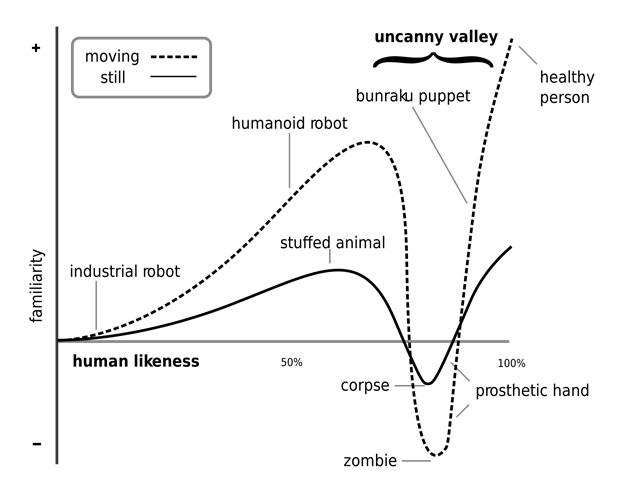
There is a concept in aesthetics called the Uncanny Valley. The idea is that generally we like things to be closer and closer to human likeness to maximize emotion and empathy. That is, until the thing reaches a point that is not quite human, but too close to human, for comfort. So, things that look somewhat human, but clearly are not (think C3PO from Star Wars or a teddy bear) look fine to us. But getting close without quite being right is highly offputting or creepy.

uncanny valleyYour dislike of clowns, explained.

For some, this is part of a dislike for ventriloquist dummies or clowns or porcelain baby dolls. It’s also why even in these days of high-tech CGI, you will see animated movies that make cartoon characters to be, well, cartoony and not human looking. Efforts to make hyperrealistic animations have fallen into the Uncanny Valley (e.g., Polar Express, Beowulf).

polar express

This girl has come for your soul.

I posit that there is a similar dynamic in personalization.

On one side of the spectrum, you have the cable company. Long after most people have heard of the concept of caller ID, the first thing they ask you to do in their automated system is to put in your phone number.

What is the first thing the person on the other end of the line asks for after your brief 47-minute wait listening to the instrumental version of “My Heart Will Go On”? Your phone number. That isn’t just not knowing your customer; that is Memento-level forgetting.

On the other side of the graph, you have the Target Knows You Are Pregnant story. To make a long and interesting story short, there was a man who called Target irate that his minor daughter was getting coupons for items that would imply that she is pregnant. Shortly thereafter, he called back to apologize, letting them know that there were things going on in his house that he didn’t know about. Target “knew” his daughter was pregnant before he did.

This story is a bit creepy: that Target’s algorithms would “know” something like this. After other coupons were a little too overpersonalized, Target has started putting in random dummy coupons into its coupons, so they look a little more random. (Even though they know what you really want).

“Even then, retailers learned early that shoppers prefer their shopping suggestions not be too truthful. One of the great unwritten chapters of retail intelligence programming featured a “personal shopper” program that all-too-accurately modeled the shoppers’ desires and outputted purchase ideas based on what shoppers really wanted as opposed to what they wanted known that they wanted. This resulted in one overcompensatingly masculine test user receiving suggestions for … a tribute art book for classic homoerotic artist Tom of Finland, while a female test user in the throes of a nasty divorce received suggestions for a small handgun, a portable bandsaw, and several gallons of an industrial solvent used to reduce organic matter to an easily drainable slurry. After history’s first recorded instance of a focus group riot, the personal shopper program was extensively rewritten.”
― John Scalzi, The Android’s Dream

So here is the Ellinger Personalization Satisfaction Curve (I figure if I keep trying to name things after myself, one will stick):

ellinger curve3
I spent upwards of 42 seconds on this graph

As personalization increases, you like it, unlike a point where you stop liking it.  The three big implication for nonprofits are:

  1. This curve is moving right. It used to be an innovation to have a person’s name included in the salutation. Now, unless you are going for an ultra-low-cost package, it’s table stakes. Donors used to be OK with the Super Mario Bros. excuse for not knowing entire gift history (“Thank you for calling, donor. But your data is in another database.”); now it is inexplicable. We now live in a world that knows our name and who we are (or can look it up quickly enough to simulate this).
  2. But people generally don’t like you to know things that aren’t logical leaps from their existing relationship. For example, if you are using acquisition lists from advocacy organizations, it’s almost certain fine to send them an advocacy piece from your organization to them. However, you don’t want to say “Because you support other advocacy organizations, you may want to help support our cause.” This is a part of the sausage making people don’t need or want to see.
  3. This sweet spot is different for everyone. Some people still get weirded out when people know who is calling from caller ID. Others wear their digital hearts on their sleeves, inviting everyone to know everything. The best you can do is aim for the middle for the general population at first, but then test up and down to see what each your donors prefer.

I’ll talk about a few positive customization techniques tomorrow.

Ellinger’s Peak of Ideal Customization