Influence in direct marketing: authority at work

I debated whether to do this one.  I have a bit of an anti-authority, and a definite anti-authoritarian, streak.  When you read about authority as a form of influence, you can delve into some very dark parts of what it is to be human.  There are famous Milgram experiments, where people generally gave shocks to a test subject to the point that the person would be in severe pain or dead just because they were told to.  And the Stanford prison experiments show “absolute power corrupts absolutely” isn’t just an aphorism to be stitched onto the world’s most off-putting throw pillow.

But authority is a form of influence.  And it’s one that nonprofits can and should wield.  After all, quite frequently, nonprofits are experts within their own realms and those with great expertise serve on their boards and as volunteers.

Testimonials in various forms can help validate your nonprofit in the minds of your supporters.  Some of that, as mentioned earlier in the week, can and should be from individuals who support your individuals as close to your target audience as possible.  But an authority pitch, with external validators, can be helpful as well.

So can burnishing your credentials.  One test to run online is whether an online security badge can increase your donation form activations (sometimes it does, sometimes it doesn’t).  A seal from the BBB can likewise be tested (just don’t use your Charity Navigator perfect score – that isn’t a badge of honor).

Talking about influential donors can also help.  Dean Karlan and John List did a study that found two things.  The first, no surprise, was that a matching gift increases response rates.  The second was that identifying the matching donor as the Bill and Melinda Gates Foundation (versus an anonymous matching donor) increased response rates by over 20%.  This effect also lasted past the matching period, which is unusual for often ephemeral nonprofit solicitation.

This would tend to indicate that the Gates authority is rubbing off on the nonprofit they are supporting and that their authority is a signifier for other donors.  Celebrities can also be a nice validator for certain audiences.

Finally, a successful authority technique that I’ve seen is to send copies of positive editorials or stories about a nonprofit’s impact to donors.  It’s one thing for a nonprofit to tell you how great they are and how great you are for making their work possible.  It’s another thing for an unbiased external source validating your choice in cause.

So that’s authority.  I hope you’ll join us for the scarcity discussion tomorrow.  It’s the last in the influence series, so you’ll want to be sure to read it.

(Yes, of course I planned the scarcity post as the last one.  Why do you ask?)

Influence in direct marketing: authority at work

Influence in direct marketing: liking at work

you-like-meHat tip to The Interview Guys for the image

Liking sounds like it is exclusively the property of face-to-face asks, where you work to be liked so as to directly solicit a gift.  There’s a reason that we direct marketers stay behind a desk while our glad-handling extrovert brethren ask for major gifts. (In my case, it’s introversion, a love of numbers, and a face most suitable for print.)

Did that self-deprecating humor make you like me more?  Good!  Then we can continue with the post.  (Also probably for the best that you think it is self-deprecating; there’s a reason this blog has no picture of me.)

There are three major areas in which the psychology of liking can give us a significant advantage, even when we aren’t physically with a person.

The first is in persona.  Not the hip marketing term where you put a name, face, and demographic/psychographic profile of your constituents, also that’s a bit of the idea.  Rather, it’s who the virtual faces to your brands are in your various communications.

In The Audacity to Win, David Plouffe talked about their digital strategy for fundraising and who quality signers were for various content:

To keep things fresh, we varied the length and tone of the messages–some were long and informative, others quite short and informal. Perhaps most important, we learned that people responded very well to e-mails from Michelle Obama and that we needed to use Barack somewhat sparingly–when he signed an e-mail it always produced by far the biggest response, but we did not want this to become a stale event. So many of the e-mails came from me, though when we needed a big response to an ask–for money, volunteer time, or to watch an event–we made sure the e-mails came from the Obamas.

To me, this speaks to a compartmentalization of voice: Barack Obama was the primary persona in the campaign, used for speeches, policy positions, debates, etc. etc.  Because he was everywhere and in every media, a communication needed to feel special.  However, Michelle Obama did not present in the same way.  A communication from her was able to touch different emotions, make different points, and, frankly, be liked in a way that you can’t like a person that you agree with even 90% of the time, because that 10% will always be in the way.

So who are the different voices in your organization and how do you use them?  I would recommend an inventory of people and uses.  For some, a victim/survivor is one certain type of voice.  A head of policy or government affairs can be the attack dog that your advocacy supporters and donors want to hear from.  A development staff member or volunteer can be used for institutional appeals – renewals of membership or reminders to fulfill pledges – so that your passionate voices aren’t drawn into this bureaucracy.  A celebrity can bring in his/her followers to the fold, even if they are loosely affiliated at first.

And so on.  Some even might want to transcend the human – would an animal charity want to have an official spokesdog?  I recommend using a person as a mouthpiece for a specific type of communication to a specific type of person who wants to receive that communication and will like the person who is the messenger. 

Don’t have institutional messages that aren’t from someone.  So many e-newsletters fall into this  trap.  They are from the National Conglomeration for the Amelioration of Sesquipedalianism, when they could be from Rachael.  I don’t know Rachael, but because she’s a human, people will generally like her more than the monolithic NCAS.

The second is in being liked by liking.  As with consistency, praise for past actions will get you everywhere.  People generally like people who like them.  Similarly, flattering works and since I mentioned that yesterday, here’s another study that shows this, lest I not be giving you sufficient value.

The third major impact of liking is that people are more likely to like people like them.  I’ve seen a 30%+ increase in response rate to a communication when people were told that the story they were hearing happened in their own state – and that includes states like California or Texas, where the case may not have even been within a full day’s drive.

Similarly, people reaction better to communications from, and about, people of similar age, background, religious persuasion, racial or ethnic breakdown, educational background, and so on and so on.  This is not to say that you should go out and create “the Hispanic mail package.”  In fact, please don’t.  But customization can help you talk about how the problem you are trying to solve affects the people like the person you are talking to.

These rich details given a good picture of a person and the more someone can picture a person, the more they like and empathize with that person.

So these help your communications make your voices, and you, more liked and bring in donations.  After Christmas, we’ll talk a bit about authority in influence.

Influence in direct marketing: liking at work

Influence in direct marketing: commitment and consistency

Just like people tend to do what other people do, people also tend to do what they themselves have done in the past.

Emerson said famously that “A foolish consistency is the hobgoblin of little minds, adored by little statesmen and philosophers and divines.”  Of course, that’s probably what he always said.

Our mind is wired to think we were right more often than we actually were.  Moreover, we have cognitive dissonance as a tool to help us justify these feelings.  So if we are right all the time, then why wouldn’t we keep doing what we are doing?

This is especially true for older supporters.  A study called “Evidence of a Positive Relationship between Age and Preference for Consistency” (with Cialdini as a co-author – he shows up a lot of different places) found that as we get older, we tend to want to have consistent thoughts, people in our lives, and patterns.  Since a large portion of most nonprofit direct marketing audiences skew older, this is particularly salient for us.

There are four key ways that consistency can work well for you in your direct marketing efforts:

  1. Getting your foot in the door. A small act toward your cause can cause a person to believe that they are the type of person who supports your cause.  This can be an email to their legislator putting up a sign of support, or downloading your materials.  Any small step can be referenced in asks for further, difference, and more valuable asks.  One of the executives I’ve had the honor of working with and for says “if you want to get money, ask for advice; if you want to get advice, ask for money.”There is a concern among some that so-called slactivism – taking on issues online by the least time-consuming means possible hurts “real” efforts.  I would argue that not only have well-run online campaigns changed hearts, minds, and/or votes, but also that these campaigns lend themselves to commitment-based follow-ups with language like “you’ve stood with us before; will you stand with us again” that uses commitment tactics.
  2. Flattery.  This should be easy, in that your donors and supporters are the people who make your valuable mission possible.  Telling them that, however, is not done often enough.  There was a recent quality study that looked at how recalling good deeds affected giving.  They found that when the study subjects primed themselves by recalling their past good deeds and perceive themselves as strongly moral people, they gave twice as many charitable donations as participants who recalled bad deeds.
  3. Playing back consistency. This can be as simple as variable copy letting the person know you know how long they have been giving.  After all, if you are told that “for 14 years, you have stood alongside poor suffering discarded stuffed animals,” who can resist a 15th year?
  4. Honoring consistency. Sending a communication on the anniversary of someone’s initiation with an organization not only gives them a nice feeling, it also reinforces that they are the type of person who gives to organizations like you.  Similarly, published donor rolls are both a great recognition tool and an advertisement on behalf of that’s person’s donation to you.

You should not rest exclusively on consistency’s laurels – expecting someone to give to you just because they have always given is a fool’s errand.  However, you probably noticed that many of the above techniques mix the reminder of the consistency with a reminder of the impact that someone is having or how good it feels to give.  That’s a good way to mix consistency with liking, which is what we’ll talk about tomorrow.

Influence in direct marketing: commitment and consistency

Influence in direct marketing: social proof at work

Observational comedy sometimes gets a bad rap as people complaining about airline food and never ending string of “what is the deal with X?”.  For my money, however, someone like a George Carlin or Jerry Seinfeld get to greater truths about the absurd reasons and non-reasons why we do what we do.

So for social proof, I’ll turn it over to Jerry Seinfeld to start:

99billion2006-05-20


Why is McDonald’s still counting? How insecure is this company? Forty million eighty jillion killion tillion….is anyone really impressed anymore? Oh eighty-nine billion sold! All right I’ll have one. I’m satisfied.

Who cares? I would love to meet the chairman of the board of McDonalds and say, look, “We all get it, ok, you’ve sold a lot of hamburgers, whatever the hell the number is, just put up a sign, ‘McDonalds, we’re doing very well. ‘”

What is their ultimate goal to have cows just surrendering voluntarily or something? Showing up at the door. “We’d like to turn ourselves in, we see the sign, we realize we have very little chance out there. We’d like to be a Happy Meal if that’s at all possible.”

This sign is here as a signifier of social proof.  The implication here is not trying to get cows to surrender – it’s to get people to surrender.  Social proof is when people assume that everyone else knows what they are doing and, as a result, they should do likewise.

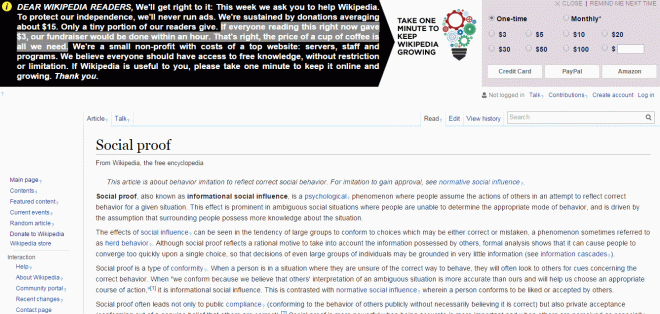
If you want a workable definition of irony, check out the Wikipedia page for “social proof.”  Here’s a screen shot:

social proof

See that banner at the top?

wikipedia header

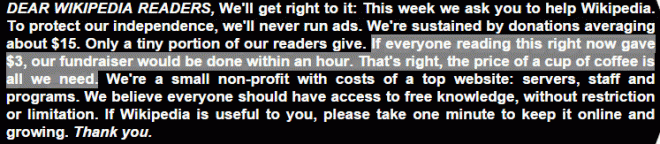
There’s a key counterproductive sentence in here (although there are other problems with this): “Only a tiny portion of our readers give.”

What Wikipedia is signaling, on top of this article about how people tend to do what other people do, is most people don’t donate to us – you shouldn’t either.

There is a famous study cited by Cialdini and many many other (in fact, it’s part of Yes!, another great book on influence) with the Arizona Petrified Forest.  They found that a sign that has negative social proof significantly increases the likelihood that someone will do something bad. In this case the sign said:

“Many past visitors have removed the petrified wood from the park, destroying the natural state of the Petrified Forest.”

In essence, this sign says out loud what your mom warned you about – everyone else is jumping off a bridge and you should too.

Yet Wikipedia is far from alone in using this tactic.  How many gap appeals have you seen that say, in essence, “not ask many people are donating as they had been; please give generously”?  These types of appeals are fraught with social proof peril.  Personally, I’ve only seen them be effective either when the gap is due to something outside of the nonprofit’s control (e.g., “you and people like you have been more generous this year than ever, but the loss of this government grant imperils…”) or when the gap is due to increased need (e.g., “Hurricane Oberhauser means that more people are homeless; can you help immediately?”).  To admit others aren’t supporting your nonprofit is counterproductive.

That said, social proof can be used for good.  People are more likely to support a nonprofit when the list of people supporting it before them is longer (see, for example, this study).  With major donor campaigns, it is common to have a quiet period where funds are raised to get to around 40% of the overall goal.  Donors during this period are told, correctly, that they will be helping with this effect.

But it works for small donors as well.  A challenge fund, in addition to creating scarcity/urgency, which we will talk more about, also communicates that other people are supporting this cause – you should too.  The thermometer on the side of walk pages works much better when there are people already supporting the cause.

Similarly, you may want to test “Join 324,224 members” instead of your “Become a member” button.  “Join” is in particularly a powerful word in this respect because it implies that you are becoming a part of something larger than yourself.

Pre-seeding campaigns works.  One nonprofit of my acquaintance starts recording donations for their year-end campaign in mid-November, but only puts the thermometer up in December, so that the social proof is in place when it is most likely to be helpful.

Another form of social proof is testimonials from your current donors.  A good donor story can be very effective in a newsletter.  One part of this that we’ll talk about more in the authority post is that it’s especially effective when it is a like person giving the testimonial – similar age, race, name, state, etc.  The message “people support this” is good; the message “people like me support this” is better.

Pictures also work well alongside testimonials.  A great study on what Stephen Colbert called “truthiness” (whether something “feels” true, not necessarily whether it is true) found that having pictures alongside of a truth claim makes it feel more true.  Thus, if you can get the picture of the person making the testimonial, the testimonial will tend to ring more true.

Have you seen strong examples of social proof in action?  Please leave them in the comments – everyone else is.

Influence in direct marketing: social proof at work